How winter battery failures start long before the first freeze
Key Highlights
- Summer heat and high electrical demand can weaken batteries months before winter starting problems appear.
- Battery load testing, cable inspections, and charging system checks can help prevent cold-weather no-starts.
- Monitoring battery health and maintaining charge year-round can help fleets reduce unexpected failures.
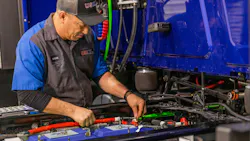
On a bitterly cold morning, there’s only one sound a semi-truck driver wants to hear: the throaty cough of a starting engine easing into a steady rumble. That’s the gentle song of a good day brewing. But far too often what follows the key turn is a rapid series of clicks, or maybe just one mechanical snap. The engine might even wheeze as thick, phlegmy oil struggles to circulate. These are the sounds of an issue with the starting system, and the last thing a driver needs before a harrowing day of driving.
Cold-start failures are one of trucking’s oldest, most frustrating challenges and a leading cause of roadside calls during the winter months. But the problem rarely forms when the temperature drops. More often, the root cause traces back to months earlier and the summer heat. That’s when the mercury was high and so were electrical demands. This may have led to undercharged battery packs, while the summer freight surge could have left little time in the shop to check corroded connections and aging electrical system components.
“Cold weather can expose battery problems very quickly, but the conditions that create those problems often developed during warmer months,” explained Wade Seaburg, chief commercial officer at Dragonfly Energy. “Heat, repeated cycling, and sustained electrical demand can contribute to battery wear over time, particularly with lead-acid batteries.”
He added that electrical demand increases in the summer, with air conditioning and other cooling loads running more frequently.
“Batteries and charging systems may be working harder well before winter arrives,” he noted.
At the same time, truck makers and fleets continue to add technologies that increase demand on the battery and the potential for faults, shorts, and parasitic losses, the bane of many a truck battery. And the demand is getting higher as trucks evolve into mobile workplaces with a growing range of electronics, telematics, and safety technologies.
Additional electrical loads like refrigerators, microwaves, power inverters, electronics charging, auxiliary HVAC systems, lighting, and other comfort features–although valuable for driver satisfaction and retention–consume energy whenever the engine is off. And these expanded hotel loads and electrical demands impact batteries year-round.
But there’s hope. Industry experts agree that fleets can significantly reduce no-start events with preventive actions. These include testing batteries and charging systems long before winter arrives, monitoring battery health more proactively, and adopting new technologies that provide visibility into electrical system performance.
In short, to ensure the starter reliably turns over in January, your maintenance department needs to treat winter battery preparation as an all-year task.
The cold truth
Just like us, lead-acid batteries move slower on chilly mornings. This is because lower temperatures slow the internal electrochemical reaction and limit the battery’s ability to deliver power. It’s critical to know and plan for which type of battery specific trucks use if they will be operating in freezing temperatures.
“Cold weather can reduce the amount of energy a battery delivers, but the impact can vary significantly by battery chemistry and application,” Seaburg said. “In testing comparing similarly sized AGM and lithium iron phosphate battery banks, both were affected as temperatures dropped, but the AGM bank experienced a much greater reduction in available energy, particularly as electrical demand increased.”
According to various sources, such as General Motors (GM) technical bulletins, at 32 degrees F, lead-acid battery capacity falls to about 80% and is cut in half at 0 degrees. An inactive battery, meanwhile, can freeze closer to 32 degrees F because of acid stratification. The heavier sulfuric acid that lowers the freezing point settles at the bottom of the battery, leaving more water concentration at the top. And while a fully charged battery won’t freeze until -94 degrees F, at a 25% depth-of-discharge, the battery could freeze at 9 degrees F.
All lead-acid batteries have diminished starting power as the mercury drops, which is why a given battery’s cranking amp rating could be 32 degrees F while the cold cranking amps rating may be 0 degrees F, explained Jim O’Hara, EVP of merchandising at Clore Automotive. To compensate for this, batteries are specified with far more starting capability than is required on a normal 40- to 80-degree F day. The same is true for the multi-battery packs found in Classes 4 to 8 trucks.
The cold also makes the engine’s oil more viscous, requiring more cranking power from the battery. All these temperature- related factors place an additional strain on commercial vehicle batteries precisely when vehicles need more power to start, offered Kate Johnson, Clarios director of marketing for the U.S./Canadian aftermarket. Also, she said, start frequency, idle time, auxiliary equipment use and engine-off electrical loads all affect battery demand, placing additional stress on starting battery packs and reducing reserve capacity.
Beat by heat
Cold weather itself is only part of the problem, O’Hara noted. Prolonged exposure to extreme summer heat can dramatically shorten battery life by accelerating deterioration of internal battery components. In regions with hot summers, damage accumulated during warm weather often becomes evident during the season’s first cold snap.
“Essentially, prolonged extreme heat accelerates aging for lead-acid batteries,” O’Hara said. “Then, as temperatures fall, batteries naturally produce less starting power so when cold weather arrives, a marginal battery is exposed, resulting in a no-start event.”
Jim Bevan, senior director of global transportation product management at EnerSys, pointed out that fleets will likely experience a spike in no-starts and battery failures during periods of transition from summer to winter, adding that hot and cold temperatures create different challenges for lead-acid batteries.
“Generally, heat causes more damage to batteries than cold,” Bevan related. “However, while slightly colder temperatures help reduce battery degradation, since engine cranking loads increase substantially in cold temperatures, more stress is placed on the battery.”
The other key aspect is how a battery’s reserve power is used in different conditions, Bevan noted. While a battery’s capacity is generally thought of as a static Ampere-hour (Ah) number, capacity varies with temperature, reducing in colder temperatures and slightly increasing in higher temperatures, he explained further.
Additionally, Bevan pointed out that temperature can be substantially affected by a vehicle’s design and location of the batteries. Many newer vehicles, for example, have increasingly higher under-hood and exhaust temperatures that affect other components on the vehicle, including batteries.
Test before the temperature drops
If there was a single recommendation that united all sources, it was the importance of getting ahead of potential battery issues. According to Anthony Tondola, field quality engineer at International, fleets should perform battery load testing, inspect terminals and cables for corrosion, and verify charging system performance before cold weather arrives.
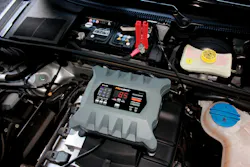
Rather than focusing solely on batteries, Bevan recommended a full evaluation of components and a voltage drop test. “If this is not done,” he said, “simply replacing the battery may mask another issue that will reoccur if not fixed.”
Seaburg likewise urged fleets to take a system-wide approach and to watch for warning signs, including slower cranking, low-voltage warnings, batteries that are not maintaining charge, or individual batteries within a bank behaving differently from the others.
O’Hara also recommended a predictive approach by tracking battery resistance values over time to identify end-of-life batteries before failures occur. He also believes that maintaining a high state of charge is among the most important predictive actions fleets can take.
“That means providing a beneficial charging cycle every time the vehicle is brought in for a scheduled maintenance, no matter what time of year that takes place,” O’Hara said. “The charging period should be adequate to bring the battery pack back to more than a 95% State of Charge.”
The batteries are not the only components to look at, though, and their performance should not be looked at in isolation, Johnson said.
“Broader electrical system conditions influence battery health, and increasingly, technologies that provide greater visibility into battery condition can help fleets move from scheduled or reactive maintenance toward more condition-based decision-making,” she said. “Identifying issues earlier through data-driven battery management is emerging as an important complement to traditional maintenance practices.”
While more often evident when cold weather sets in, battery failures rarely occur without warning. Instead, there are early indicators long before temperatures dip below freezing. With proactive maintenance and better visibility into battery health year-round, fleets can address problems before temperatures drop and reduce the risk of costly no-start events.
About the Author
 Seth Skydel
Seth Skydel
Seth Skydel, a veteran industry editor, has more than 41 years of experience in fleet management, trucking, and transportation and logistics publications. Today, in editorial and marketing roles, he writes about fleet, service, and transportation management, vehicle and information technology, and industry trends and issues.