Modern Brake System Design and Diagnosis
How Modern ABS Brake Systems Work
Modern brake systems do far more than simply stop a vehicle. Today's braking systems combine wheel speed sensors, control modules, hydraulic units and vehicle dynamics systems to improve safety and vehicle control.
Today's braking systems support much more than anti-lock braking. Functions such as traction control, stability control and automatic emergency braking all rely on information managed through the ABS system.
As braking technology has evolved, so has the repair process. In many cases, replacing a component is only part of the job, with additional service procedures required following repair. One example is the ABS Brake Bleed Procedure available on 2021+ Ford® F‑250 vehicles, which serves as the case study for this article.
How Wheel Speed Sensors Support ABS Operation
Brake system operation begins with accurate wheel speed information. Most modern vehicles use active wheel speed sensors, typically integrated into the wheel bearing assembly, to monitor wheel rotation and provide highly accurate speed information even at very low speeds.
Earlier systems commonly used passive inductive sensors, which generated an AC signal as a reluctor ring rotated past the sensor. While these designs are still encountered, active sensors have become increasingly common due to their improved low-speed accuracy and ability to support ABS, traction control and stability control systems.
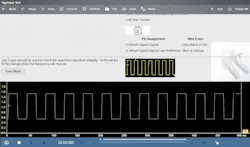
Unlike inductive sensors, active wheel speed sensors maintain a consistent signal amplitude and use changes in frequency to indicate wheel speed.