Can an Electric APU Keep a Semi-Truck Cool for a Full 10-Hour Rest Break? WeVolt Explains the Power Behind Overnight Comfort
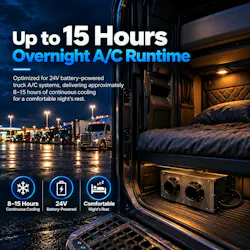
For long-haul truck drivers, a 10-hour rest break should mean a chance to sleep comfortably—not a choice between running the engine and enduring an uncomfortable cab. As electric auxiliary power units (eAPUs) become increasingly accessible, one practical question matters more than almost any specification: Can a battery-powered system keep a semi-truck comfortable throughout an entire rest period?
WeVolt, a developer of integrated electric APU systems for North American semi-trucks, believes the answer lies in matching battery capacity, efficient climate control, onboard electrical loads, and charging capability into one coordinated system.
Its WeVolt Apex eAPU combines an 8.04kWh LiFePO4 battery with a 10,000 BTU variable-speed truck air conditioner, designed to deliver 10–15 hours of engine-off cooling under optimized operating conditions.
Why Battery Capacity Alone Doesn't Tell the Whole Story
When evaluating an electric APU, drivers often focus on battery size. While stored energy is essential, the efficiency of the air conditioner determines how effectively that energy translates into comfortable rest.
A battery's capacity should be measured in kilowatt-hours (kWh), rather than comparing amp-hour ratings across different voltages. Similarly, an air conditioner's BTU rating describes cooling output, not its continuous electrical consumption.
Variable-speed technology plays an important role. Instead of operating at maximum output continuously, the compressor adjusts its operation to match changing cooling demand, helping conserve energy once the desired temperature is reached.
This combination of sufficient battery storage and efficient climate control is central to delivering dependable overnight comfort.
Designed Around a Full Night of Rest
WeVolt Apex uses a 25.6V, 314Ah LiFePO4 house battery, providing 8.04kWh of nominal energy. Paired with its 10,000 BTU variable-speed A/C, the matched system is designed for approximately 10–15 hours of engine-off cooling under suitable operating conditions.
Actual runtime depends on ambient temperature, thermostat settings, cab insulation, battery charge, and additional electrical loads. The published range represents manufacturer estimates for optimized operation rather than a universal runtime guarantee.
Beyond air conditioning, Apex configurations can include a 3,000W pure sine wave inverter for compatible 120V appliances such as microwaves, coffee makers, televisions, and other onboard equipment.
These loads share the available battery energy, making proper power management important when planning overnight use.
What Happens After the Rest Break?
Overnight cooling is only one part of the electric APU equation. The system must also replenish its stored energy before the next extended stop.
WeVolt Apex incorporates a bidirectional DC-DC charger that connects the truck's existing 12V electrical system to its independent 24V house battery.
While driving, the charger can deliver up to 50A to the house battery. Under favorable conditions, WeVolt estimates approximately 5–6 hours to recharge from 20% to full capacity.
The system can also provide controlled reverse charging to support the truck's starter battery while parked.
A Better Way to Evaluate Electric APUs
For owner-operators and fleets comparing electric APUs, overnight performance should be evaluated through four factors: usable battery energy, real-world cooling efficiency, additional electrical demand, and available driving time for recharging.
WeVolt's approach is to integrate these capabilities into a matched system rather than treating the battery, air conditioner, and charging equipment as unrelated components.
The objective is straightforward: help more truck drivers enjoy a full night of comfort while reducing unnecessary engine idling.
About WeVolt
WeVolt develops integrated electric APU systems for North American semi-trucks, combining lithium battery storage, climate control, intelligent charging, and configurable onboard power solutions to make engine-off comfort more accessible.