What's new with International's EPA27-compliant S13 powertrain
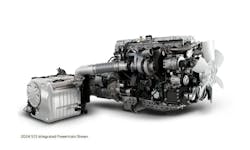
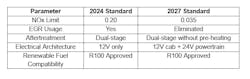
In less than a year, heavy-duty trucking will have a new emissions regulation with which to contend: the EPA 2027 low-NOx rule, which was confirmed in Nov. 2025 to be going ahead as planned for next year. Engines and aftertreatment systems will have to work more efficiently and last longer to meet the new standards, with NOx limits dropping from 200 mg brake horsepower per hour (bhp-hr) to 35 mg/bhp-hr.
International Motors recently confirmed that the new S13 Integrated Powertrain does meet the EPA27 requirements, while also featuring “game-changing fuel economy,” according to David Hillman, International’s VP of integrated powertrain, who spoke to the media in early January.
“Because we knew future regs were coming, we don't have as far to go to meet the 2027 regulations,” he explained.
The S13 has 700 million customer miles since going into production in 2023, and the MY2027 integrated powertrain hardware, comprising the engine, T14 transmission, and dual-stage aftertreatment system, is 90% similar to the previous iterations. This was an intentional move to ensure dealers and service providers did not have to do much additional training on the S13, Hillman said. Similar componentry also eases the transition for what parts are needed on the shelves and tools in the bay, he added.
Hillman called the new S13 “extremely non-disruptive,” with diagnostics and service being mostly the same or even easier, though there will be a couple of new things to learn for drivers and technicians.
“We are changing so little in terms of how this will function for the fleet and the driver that you'd have to have a bit of a trained understanding to even know that something had changed,” Hillman offered.
What’s the same?
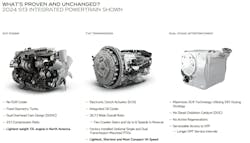
Like the original version, the NOx-compliant S13 is an SCR-only engine, with the exhaust gas recirculation (EGR) cooler and diesel oxidation catalyst eliminated. The dual-stage aftertreatment system features smart DEF dosing and overall reduces soot to the point that forced regenerations are also unnecessary.
The engine specifically has a 23:1 compression ratio, dual overhead cam design, and fixed-geometry turbo. Getting rid of the EGR allows 100% of the exhaust to flow to the turbo, a main driver of that efficiency and power boost. International also claims the S13 to be the lightest 13-liter engine in North America.
International reported in 2024 that the S13 platform, in conjunction with a more aerodynamic cab, allows International’s over-the-road Class 8 truck, the LT Series, to beat competitor fuel economies by 5%. Though Mack and Freightliner had yet to unveil their newer, more efficient models, the stat still speaks to the S13’s optimized efficiency.
The OEM says the T14 is also the lightest and most compact of 14-speed transmissions. It has a planetary gearset, electronic clutch actuator, integrated PTO options, and an advanced oil lubrication system. The powertrain owes a lot of its efficiency and drivability to the T14’s smooth power, and “those extra two gears really give that driver seat-of-the-pants feeling of the acceleration at low gears,” Hillman explained.
What’s new?
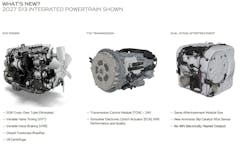
If the math is right, the engineering team only changed 10% of the powertrain to get it ready for 2027. The previous changes to the SCR already did the heavy lifting by completely handling the NOx loop. The new version goes one better by taking out the EGR crossover tube that existed for idle or no-load applications.
A closed crankcase breather was also added, as the NOx rule prevents venting to the atmosphere.
Fleets should also appreciate that the Diesel Particulate Filter interval has been increased from 625,000 miles to 750,000 miles. This means most first owners will not even worry about replacing the DPF. Customers also “demanded” longer oil drain intervals, so International added a new oil centrifuge and filter as well.
Variable valve timing has been around for several decades, but it's new to the S13. VVT helps manage engine temperatures during low-load operation, and was made possible by adding a hydraulically actuated clutch. The VVT also improves compression release braking, increasing braking power by over 20%—from 470 hp to around 570 hp.
Keeping with its Euro brethren, the S13 uses a 24-v powertrain architecture, which International said improves sensor speed and cold-cranking performance. The cab retains the standard 12-v system.
One thing missing is the 48-v electric grid heater, which Cummins will have on its ’27 engine. “We don't need those because of our forward-looking strategy when we developed the S13 in the first place,” Hillman said.
Customer feedback
Dan Kayser stressed that throughout International’s 124-year history, starting as International Harvester, the decades as Navistar, and now International Motors, the company has always taken a customer-centric approach.
The big question with the S13 was if the end-users who needed these tractors and work trucks were reliable and would provide value, whether they haul freight, drop salt, or move gravel. Customers from large to small tested the first production series S13 over the last two years, and according what International provided the media, the feedback could not have been better.
"This is one of the most positive word-of-mouth products that we've had in my 27 years with the company,” Hillman offered.
On the driver side, Kasyer pointed to the intuitive shifting, and customer feedback, which omitted names, attested to this:
“I had one driver tell me – it’s almost like it can read my mind. It knows when to shift, it’s exactly when I would shift with a manual transmission,” one user said.
Another commented: “The S13 Integrated saves about 3 hours round trip from Iowa to California with a T14 vs.a traditional manual transmission. I’m running 5-7 mph faster with the same load.”
[Editor’s Note: Fleet Maintenance can back this up, as International invited us to their proving ground in late 2024 to drive the LT with an S13 around a track and HV and HX Series around forested dirt paths. Shifting was so seamless that this trucking dilettante not only didn’t embarrass himself, but felt confident behind the wheel.]
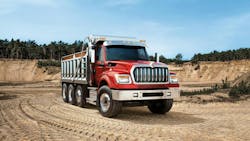
The S13’s fuel efficiency also captured a lot of user attention.
“We have a number of customers that are seeing a fuel economy not just exceeding expectations, but well above industry average,” Kayser said.
Hillman was surprised to see much of the fuel economy praise came from work truck fleets that plow snow and lay concrete.
Kasyer reasoned that better fuel mileage means these vocational trucks “have to stop fewer times in a day or a week or a month to fuel the product, which means that [they’re] more efficient in [their] overall operation, particularly critical in the vocational business.”
Overall, Hillman surmised, “They're getting the uptime, and they're getting the power delivered that does the job, and then they have game changing fuel economy on top of that.”
But all that drivability and efficiency on the road means nothing if the powertrain keeps your truck in the shop. The S13 was designed to achieve a high level of reliability, and the 700 million miles of experience prove this mission was a success, Kayser said.
About the Author
 John Hitch
John Hitch
Editor-in-chief, Fleet Maintenance
John Hitch is the award-winning editor-in-chief of Fleet Maintenance, where his mission is to provide maintenance leaders and technicians with the the latest information on tools, strategies, and best practices to keep their fleets' commercial vehicles moving.
He is based out of Cleveland, Ohio, and has worked in the B2B journalism space for more than a decade. Hitch was previously senior editor for FleetOwner and before that was technology editor for IndustryWeek, and managing editor of New Equipment Digest.
Hitch graduated from Kent State University and was editor of the student magazine The Burr in 2009.
The former sonar technician served honorably aboard the fast-attack submarine USS Oklahoma City (SSN-723), where he participated in counter-drug ops, an under-ice expedition, and other missions he's not allowed to talk about for several more decades.