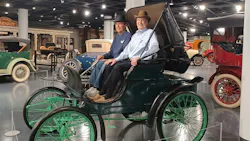
Americans didn’t invent the first diesel engine or truck, or build the first expressway (all credited to Germans), but make no mistake, trucking has been a distinctly American-made industry since 1898. From engineering to performance to maintenance, Americans of all types (both native-born and immigrant) have found ways to make trucks bigger and better, and most importantly, safer, all the while innovating ways to maintain and repair them with less effort.
And while the railroads of the 19th century connected America’s coasts and spurred industrialization, American trucks sparked the modern world, connecting once disparate and desolate communities together, democratizing the availability of goods through inventions like transport refrigeration units that help goods last longer and innovations like suspensions and air brakes, which help the driver safely deliver loads. All the while, automotive and trucking professionals have waged a war against downtime, helping fleets get more out of their assets and keep the overall cost of freight manageable.
None of this happened overnight, but it was a constant march of improvements, some manifested by classic American gumption and others mandated by government regulations. But they are all stitched into the same fabric that blankets our way of life.
And to honor that spirit of innovation, we’ve compiled a list of several inventions and breakthroughs that helped build and maintain the modern trucking sector.
1899 - Winton develops the first semi-truck
Alexander Winton is a man of many firsts, not the least of which is developing the first semi-truck.
In July 1897, the Scottish-born inventor and premium bicycle maker needed to drum up publicity for the horseless carriage prototype he had made the previous year. He had formed the Winton Motor Carriage Co. in March and set out to validate the design and reliability of his gas-powered 1-cyl., 10-hp contraptions by driving them all the way to New York City, an 800-mile journey. That nine-day publicity stunt didn’t make an impression, so he placed what is believed to be the first ever auto ad (in Scientific American).
That is believed to have worked.
“Winton got a buyer from Port Carbon, Pennsylvania, named Robert Allison, to come over, look at a car, do a test drive, and make a purchase—and that was the first time that a car was sold based upon an advertisement from an inventory,” explained Bill Carlson, a former civil engineer and volunteer docent at the Crawford Auto-Aviation Museum in Cleveland.
But the savvy Winton knew driving the new horseless carriage to buyers—in a time when roads were designed for actual horses and littered with shoe nails and piles of manure—would quickly depreciate their purchase. The solution was to invent the Automobile Hauler in 1899, a modified Winton touring car with a shorter wheelbase hitched to a two-wheeled wagon long enough to fit one vehicle. Winton went on to use it for his own fleet and sell to other automakers.
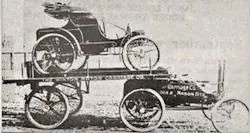
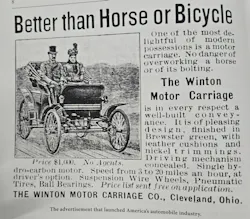
In 1899, Winton repeated the drive to New York, this time with a Plain Dealer reporter (who popularized the French term “automobile” in the states.)
“They filed updates all along the way,” Carlson said, and the public took notice. Sales took off, and he was selling the auto hauler commercially, and developed a delivery truck. In 1903, a Winton touring model was the first automobile to travel across the country.
Car sales dried up in the 1920s as Winton lost market share to Ford Motor Co., the conclusion of a 20-year rivalry between Winton and Henry Ford. In 1899, Ford was a virtual unknown and Winton a star. Winton’s chief of engineering recommended Ford for a job. Winton was reportedly unimpressed with Ford, and that misjudgment changed the course of history. Ford returned to Detroit, determined to improve auto manufacturing reliability and cost, but had trouble attracting investors.
Did you know...
Winton is credited with using the first semi-trailer, but Pittsburgh-based Autocar is believed to have sold America’s first commercial truck in 1898. The OEM is still in business.
In 1901, Ford met Winton again, this time on a Grosse Pointe racetrack. Ford wanted to impress investors by taking on Winton, a formidable racer. By the end, he got them, and revenge for the previous slight. The Winton Bullet’s 70-hp engine misfired on the back half of the 10-lap race, and Ford’s “Sweepstakes” won the day.
Ford and his engineering team had insulated the spark coil in porcelain to raise the temperature and increase engine efficiency. That would be the first of many innovations for Ford. remembered as a chief architect of America’s 20th century dominance. Winton, the man who started it all and accomplished so much, has become a faded footnote.
1901 - Goodyear develops a detachable tire
Three years after starting up the company in Akron, the Rubber Capital of the World, the Seiberling Bros. literally reinvented the wheel. Early automobiles had curved tires to stay on the rim, and removing them took a crowbar and a lot of pry force. Goodyear’s engineers developed a straight-sided tire, which anyone who does tire or brake jobs today still benefits from.
1908 - Henry Ford popularizes preventive maintenance
Ford’s impact on industrialization and transportation arguably looms larger than any other American in history. A big reason why was his total and absolute devotion to uptime, be it the moving assembly lines that brought the Model T to the owner’s garage.
To ensure maximum uptime, he knew you couldn’t wait until something breaks; you had to stay ahead of wear and tear with preventive maintenance. The concept wasn’t new, but never implemented at such scale and vigor as at Ford Motor Co. Moving parts were routinely lubed and inspected, and wear components were designed to be easily swapped out. This happened over time, but the 1908 Model T owner’s manual provided all the PM knowledge a new owner needed to reliably trot out their horseless carriage.
About the Author
 John Hitch
John Hitch
Editor-in-chief, Fleet Maintenance
John Hitch is the award-winning editor-in-chief of Fleet Maintenance, where his mission is to provide maintenance leaders and technicians with the the latest information on tools, strategies, and best practices to keep their fleets' commercial vehicles moving.
He is based out of Cleveland, Ohio, and has worked in the B2B journalism space for more than a decade. Hitch was previously senior editor for FleetOwner and before that was technology editor for IndustryWeek, and managing editor of New Equipment Digest.
Hitch graduated from Kent State University and was editor of the student magazine The Burr in 2009.
The former sonar technician served honorably aboard the fast-attack submarine USS Oklahoma City (SSN-723), where he participated in counter-drug ops, an under-ice expedition, and other missions he's not allowed to talk about for several more decades.