How to extend EV battery life with better diagnostics
The next phase of electric vehicle growth will depend on more than how many new EVs are sold. It will also depend on how well the industry supports the batteries already on the road.
As EVs age, batteries will move through a more complicated service journey. Some will need repairs. Some will need to be remanufactured. Some will be routed to recycling. But before any of those decisions can be made, service teams need to answer a more fundamental question: what is actually happening inside the battery?
That question is not always easy to answer.
An EV battery pack is a complex system made up of multiple modules, cells, electrical connections, sensors, control systems and cooling components. When a pack shows reduced performance, the issue may not involve the entire battery. It may be tied to one module, one section of the pack or one specific condition that only appears under certain loads.
For the industry, that creates an important opportunity. If battery health can be understood at a more detailed level, repairs can become more targeted. Usable components can stay in service longer. Replacement decisions can be made with more confidence. And the value of the battery can be protected across more of its lifecycle.
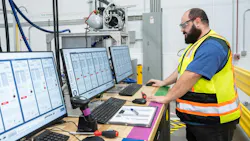
That is the thinking behind the General Use Module Tester, or GUMTer, developed by EV Battery Solutions by Cox Automotive.
General Use Module Tester
The GUMTer grew out of a practical need. EV Battery Solutions supports battery diagnostics, repair, remanufacturing and recycling across a wide range of battery platforms. The team found that existing tools did not always provide the flexibility needed to evaluate different module types, voltage ranges, service requirements and pack architectures.
The mindset behind the tool: if the right tool does not exist, build it.
That approach is becoming increasingly relevant as EV battery service matures. The industry is not dealing with one standard battery design. OEMs use different chemistries, layouts, module configurations, connectors and control strategies. A diagnostic process that works well for one program may not translate cleanly to another. Service teams need tools that can adapt without sacrificing accuracy, safety or repeatability.
The GUMTer was designed to help fill that gap by supporting module-level evaluation. Instead of relying only on pack-level indicators, the system helps engineers and technicians study the performance of individual modules and make more informed decisions about the next step.
One of its core functions is capacity testing. This measures how much energy a module can store and deliver under controlled conditions. That information allows teams to compare modules, identify underperforming units and determine whether a module is a good candidate for reuse, repair or replacement.
Another function is pulse testing. In real-world driving, a battery may be asked to deliver power quickly during acceleration, merging or other high-demand conditions. A module that looks acceptable during a basic test may behave differently under load. Pulse testing helps evaluate dynamic response and internal resistance, giving technicians a better view of whether a module can perform when demand increases.
The GUMTer also supports controlled depowering. When a module cannot be reused, or when it needs to move to another process, stored energy must be reduced to a safer level. Controlled discharge helps support safer handling, storage, transport and downstream processing. In battery service, this is not a minor detail. It is an essential part of managing risk.
The system can also support module balancing, helping equalize voltage and state of charge across modules. That becomes important after repair or replacement because a pack needs its modules operating within the right range to perform consistently.
Together, those capabilities point to a larger shift in how the industry should think about EV battery service.
Battery decision-making
Battery diagnostics should not be viewed as a simple pass-or-fail exercise. A more useful model is decision support. The goal is to gather enough reliable information to determine the best path for the battery: return to service, targeted repair, remanufacturing, safe storage, reuse of components or recycling.
That kind of decision-making matters for several reasons.
For OEMs, it can help support warranty programs and reduce unnecessary replacement costs. For dealers, it can help improve repair confidence and customer communication. For fleets, it can support uptime and more predictable maintenance planning. For the broader EV ecosystem, it can help keep valuable battery materials in use longer before recycling becomes necessary.
It also matters for sustainability. Battery packs contain significant embedded value in the form of materials, manufacturing energy and engineering. When functional modules are removed from service too early, that value is lost. Better diagnostics can help identify what still has useful life and what does not.
The development of the GUMTer also highlights the importance of connecting engineering directly to service operations. EV Battery Solutions maintains an in-house electronics engineering lab that designs and builds diagnostic and testing systems for battery operations. The team brings together electrical engineering, electronics manufacturing, circuit board assembly, wire harnessing, calibration and inspection capabilities.
That hands-on capability allows engineers to build around actual service needs. If a test takes too long, the team can look for ways to improve throughput. If a module is difficult to access, they can develop adapters or procedures that reduce unnecessary teardown. If data from one test is not enough, they can refine the process to capture more useful information.
This is where EV battery service is heading. As volumes grow, the industry will need tools and workflows that are accurate enough for engineering decisions, practical enough for service environments and consistent enough to scale.
The key lesson from the GUMTer is not that every organization needs the same piece of equipment. It is that EV battery diagnostics must become more granular, adaptable and tied to real-world repair decisions.
The more the industry understands what is happening inside the battery, the better it can protect the battery’s value. That means fewer unnecessary replacements, more targeted repairs, safer handling and a clearer path for batteries as they move through repair, reuse, remanufacturing and recycling.
EV adoption will continue to bring new demands to service networks. Meeting those demands will require more than trained technicians and high-voltage procedures. It will require better tools, better data and a willingness to engineer solutions around the problems batteries actually present.
That is what “built to solve” means in practice: creating the diagnostic foundation needed to extend EV battery life and keep more vehicles on the road.