Fleets must keep up as trailer brakes continue to evolve
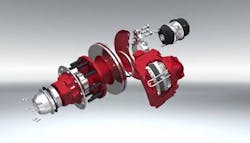
Stepping on the brakes does more than stop a vehicle's momentum; the act manages energy, according to Jeff Morris, director of the braking systems business unit at Hendrickson. He noted braking is fundamentally about "taking kinetic energy and turning it into heat," while on electric vehicles using regenerative braking, that motion converts to stored electrical energy. But the main thing for traditional brakes is that friction heat inevitably wears down the pads and rotors.
Because of that, he continued, "part of managing braking systems and making them operate correctly is managing that heat and the performance that has to live in that environment.”
At a media event in November, Morris went over how to better manage these vital systems, how brakes have evolved from drum brakes to modern air disc systems, and where brake performance is headed.
The top reason is safety. Properly working brakes protect drivers and everyone else around them. Regulatory compliance, serviceability, and total cost of ownership should also factor into brake system decisions.
"Maintenance costs of some of these things can get kind of high, and that's coming off the bottom line of the fleet," Morris added.
And over the years, the industry has worked to improve all those aspects to improve performance and total cost of ownership, with decades of research and development invested in managing heat and wear. Fleets need a firm grasp on this evolution to ensure longer and better performance out of their braking systems.
Drum brakes: pros and cons of a known commodity
Hendrickson alone has installed over 12 million trailer brakes, Morris said. The company manufactures everything from brake shoes and slack adjusters to drums and camshafts. They also partner with Wabco on the air disc brakes, but drum brakes are where they have the most experience.
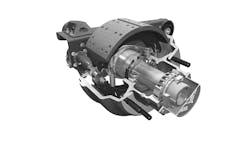
Drum brakes have been the industry standard on trailers since the 1930s, and for good reason. They are relatively low-cost and easy to maintain, and wide availability simplifies replacement and finding components. According to Morris, about 80% of the trailers sold today still have drum brakes on them.
“There's a wide variety of [drum brake] products that can suit most applications, from 22.5” wheels down to 17.5” wheels, different load ratings, different capacities, all of that exists,” Morris detailed. “They've really been developed over the years to suit many of these product applications.”
And because of that, most shops' technicians have a familiarity and the necessary tools to service them.
"It's another question whether they choose to do so, but usually there's not a technical gap in terms of how to maintain this problem," Morris said.
However, the industry’s extreme familiarity with drum brakes makes it easier to spot poorly maintained ones, increasing the likelihood that a roadside inspector will identify issues and levy a violation.
“Things like out-of-stroke brakes or non-functional brakes are easy for [Commercial Vehicle Service Alliance] inspectors to spot, and that drives out-of-service violations that come with fines, roadside service calls, all of these things tend to drive up the cost of operating with drum brakes,” Morris continued, referencing CVSA’s 2025 Brake Safety Week.
This year’s roadside check resulted in 2,296 vehicles OOS due to brake-related issues, a 15.1% OOS rate—up 2.3% from last year despite fewer inspections.
Morris reported that "41% of the vehicles that were placed out of service were due to some type of brake fault," such as excessive brake stroke, non-functioning brakes, and broken drums or rotors.
What fleets should do
- Strengthen PM programs before adopting new brake technologies
- Evaluation TCO, not just purchase price
- Prioritize servacibilty when choosing components
- Remember: Drums will remain dominant, but disc brakes perform better and require more attentive maintenance
Air disc brakes: can handle the heat but maintenance mistakes are costly
While air disc brakes (ADBs) have also been around for a while, Hendrickson started providing systems a decade ago through an integration with Wabco (now owned by ZF) that produced the MAXX22T trailer disc brake.
ADBs appeal to fleets for their performance benefits, especially in particular environments or applications. As Morris explains, thinking in terms of the physics of kinetic energy being converted into heat highlights a key benefit.
“If you think about a mountain descent as a good example, where you've got a lot of energy you’ve got to drive into that brake,” he said, “if you're doing that with drum brakes, and the drum is expanding away from the shoes, that leads to fade.”
That's why fleets running through the Rockies, Appalachians, or Sierra Nevadas might be part of the 20% who spec ADBs on their trailers.
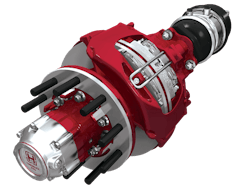
Brake durability and performance depend on the system as a whole, which is the principle behind the MAXX22T brakes. Balanced with the right torque output to match the tractor brakes, this design eliminates over-torquing to prevent ABS events and reduce wear.
Other innovations like the company’s outboard-mounted rotor, made with a proprietary spindle and premium bearings, further illustrate how a fully connected brake, wheel-end, and suspension system can simplify service and maintenance while improving safety and extending component life.
“It's the maximized uptime and performance,” Morris said, highlighting the key benefits of the product. “It's this whole wheel end and braking system that's designed to work together to perform well in the service life, but also make it easy to maintain, reducing the maintenance cost and the total cost of ownership of the trailer.”
They still require maintenance and inspection, but because the mechanism for adjustment and actuation is contained within the brake caliper, potential issues may be less obvious to roadside inspectors.
"There's not much that they can actually write you up for when they do these inspections," Morris said
Even so, disc brakes are not a shortcut for easier maintenance. Fleets with weak preventive maintenance programs can still face costly problems if serviced incorrectly or not at all, regardless of whether they are using drum or disc brakes.
“When [fleets] install a disc brake with the same inadequate maintenance practices, they start to have really expensive repairs,” Morris posed. “They didn't catch their brake pads before they wore out, and now they've got rotors that are damaged and calipers that need replacement. And instead of replacing a $60 slack adjuster or a $40 cam tube with new bushings, now they have a $600 caliper that they have to replace.”
The copper question
But even as air disc brakes improve performance and brake capabilities, the industry continues to face new challenges in brake system development. One recent shift is the Copper-Free Brake Initiative, an agreement signed by EPA in 2015 requiring a reduction of copper in brake pads to less than 5% by weight in 2021 and 0.5% by 2025.
According to Morris, there are around 25 to 30 materials that make up a brake pad, and with copper being phased out (just like the U.S. Treasury did with the pennies this November), this means that manufacturers must find a substitute to fulfill its role. This reformulation has been complex and costly, and just one example of how modern brake design is more than just the standalone components.
The question now becomes what impact the copper substitutes have on braking quality and performance. For example, the new pad formulation may stop the vehicle in the same distance as the copper pad, but wear may not be consistent.
"Does it have the same life?" Morris posed. "Does it create additional wear on the rotor or the drum, in the case of drum brakes, and what does it do to the durability of those components? Are we scratching and scarring the surface, causing rotors to wear out more quickly?"
Another consideration is that if pad manufacturers don't thoroughly test every aspect of new formulas to ensure balance, beyond just performance, before bringing them to aftermarket, then these shortcomings may be left up to fleets to discover.
Move toward smarter brakes
Looking ahead, braking systems will continue to evolve alongside the rest of fleet technologies, becoming smarter and more data-driven, Morris projected. He mentioned some of the sensors on the market today that let fleets know when it’s time to take a look at their brake pads.
“The first type is a pad rail sensor, where there's just a little clip that goes onto the brake pad, and when the pad gets worn away, it wears through a wire, creates an open circuit, and the light goes on the dash saying one of your brakes needs a pad replacement,” he explained.
The sensor is easy to install and implement. He also detailed the continuous wear sensor, which provides more data throughout the wear of the brake pad. But while this information is helpful, it still requires integration into a larger system to be actionable.
“Either of these sensors requires some type of infrastructure in terms of the electronic receiver that's going to transmit it somewhere for somebody to do something with it,” Morris pointed out, which will require further progression of telematics systems and tractor-trailer links.
If made actionable, however, this data has the potential to save fleets money and protect uptime.
“This technology is something that can help fleets catch [an issue] before there's collateral damage to these other components that turn into a very expensive repair,” Morris concluded.
About the Author
 Lucas Roberto
Lucas Roberto
Lucas Roberto is a Senior Staff Writer and producer of multimedia content for Fleet Maintenance magazine. He holds a bachelor's in media production and a master's in communication from High Point University in North Carolina.