Industry firsts: ConMet's wheel-end assembly
Related To:
March 6, 2026
6 min read
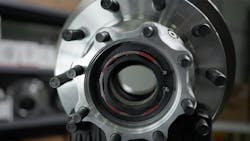
Throughout the 20th century, wheel-end installation on heavy-duty trucks followed a familiar pattern. OEMs largely sourced their hubs, bearings, seals, and other wheel-end components from different suppliers. Assembly and bearing adjustment then took place on the production line, relying on manual procedures and the skills of the assemblers.
The process worked but introduced the potential for inconsistencies. Even small differences in how a spindle nut was set could lead to variations in end play. This in turn affected heat generation and service life. For OEMs producing trucks at scale, that variability made it challenging to confidently support longer warranties. The industry largely accepted this as an unavoidable cost.
That mindset changed in the mid-1990s. Rising durability expectations from fleets and longer warranty targets for wheel ends put new pressure on OEMs, with more emphasis on achieving consistent bearing adjustment across high-volume assembly lines.
Wheel-end supplier ConMet began rethinking the traditional approach and had the technical know-how to do something about it. Since its 1964 founding in Portland, Oregon, the company had built its reputation on engineering-driven solutions, starting with lightweighting for Freightliner. By the ’90s, ConMet had evolved to focus on delivering complete systems versus individual components.
The new ambitious goal was to simplify wheel-end installation for OEMs while improving reliability in the field.
“ConMet was already producing the hub with the kind of precision the industry depended on,” recalled Mike Harman, a former ConMet sales VP. “And we had the engineering capability to design the bearing system around it. That’s what allowed us to start thinking of the wheel end as a complete, integrated assembly—not just a collection of parts.”
Eventually, the team collectively realized that a fully pre-assembled, pre-adjusted hub could eliminate those manual bearing adjustments on the line while also improving quality and supporting longer warranty intervals.
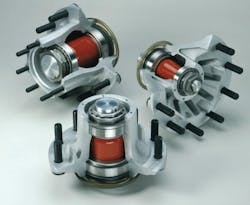
The true breakthrough came when ConMet engineers demonstrated that a bearing spacer, used in combination with bearings made to tight tolerances, could reliably control end play without manual adjustment. By assembling the hub, bearings, spacer, and seal into a single engineered unit, ConMet could hold critical dimensions and deliver consistent results.
“When we saw how repeatable the bearing setting was, we knew it wasn’t just a good idea on paper,” Harman said. “It had the potential to change how wheel ends were installed.”
This idea was commercialized in 1995 as the PreSet line, the first pre-assembled, pre-adjusted wheel-end solution for North America. The significant departure from tradition required ConMet to work closely with OEMs to walk through the design, testing, tolerances, and installation process.
Initial reactions from the OEM side were cautious, as many engineers and line workers wanted to understand how proper end play could be maintained without manual adjustment. But as ConMet walked them through the design and installation process and testing data and production trials demonstrated consistent results, confidence in the
approach grew quickly. OEMs began to recognize that PreSet technology reduced rework, simplified assembly, and improved confidence in meeting durability targets. Over the next seven years, PreSet wheel ends became standard equipment on nearly every Class 8 truck in North America, Harman noted.
Beyond adoption, PreSet technology helped redefine the wheel end as a fully engineered system rather than a collection of individual parts. That system-level approach delivered more consistent performance and supported the longer warranties the industry increasingly demanded.
“Wheel-end performance is very sensitive to installation and bearing setting, and there’s not much margin for error,” Roger Maye, technical service director at ConMet, said. “It is very difficult to set the end play right manually on every single hub, even on an assembly line. By assembling the units and setting the correct end play at the factory, ConMet was able to remove that variability. That improved consistency supported the industry’s move toward longer warranty expectations.”
ConMet also has more quality control by designing and producing hub castings, bearings, seals, spacers, and since 2011, spindle nuts as well. By engineering these parts to work together at such tight tolerances, ConMet is able to offer a single, unified warranty for the complete assembly.
Since PreSet’s inception, ConMet has continued to refine the PreSet line performance and improve component life, focusing on maintaining clamp load and managing the wide variety of spindle nuts used across different platforms.
Those efforts culminated in the introduction of PreSet Plus hubs in 2011. The integrated spindle nut was a key advancement, simplifying installation and improving consistency on the assembly line. In service, the PreSet Plus spindle nut locks in place to help retain clamp load and help prevent cone race rotation over the life of the wheel end. The spindle nut was also designed to help keep the hub on the axle if a wheel end experiences a severe failure, reducing the risk of a wheel-off event. During service, it can also function as a hub puller, making it easier to remove the hub from the axle.
More broadly, PreSet Plus technology was a refinement of an already proven design, strengthening long-term stability and addressing issues such as cone-race rotation later in the life of the hub.
In 2016, PreSet Plus entered into the aftermarket, giving fleets and technicians access to the same system-level approach used at the factory. By replacing end-of-life hubs with a complete PreSet Plus assembly rather than rebuilding them, maintenance operations could now reduce downtime and eliminate manual bearing adjustment.
Today, PreSet technology remains foundational to ConMet’s wheel-end portfolio. More than 40 million PreSet and PreSet Plus hubs have been installed on commercial vehicles, collectively traveling over 31 trillion miles. As the technology enters its fourth decade, development continues, driven by new applications, materials, and evolving fleet needs—all grounded in the same system-based approach that made PreSet technology an industry first.
About the Author
Brian Rieger
Brian Rieger is the vice president of North America Truck OEM and Aftermarket Sales at ConMet. He began his career at ConMet as a Design Engineer in 1999. During his tenure, he has also held the roles of Plastics Account Manager, Wheel End Product Manager, Director of Sales – Engineering and Marketing in China, Director of Sales – OEM, and Vice President of Aftermarket Sales. Before joining ConMet, Mr. Rieger received a BS in Mechanical Engineering from Oregon State University, where he began his career as a MECOP intern.
Sign up for our eNewsletters
Get the latest news and updates