Why wheel alignment is critical to ADAS performance
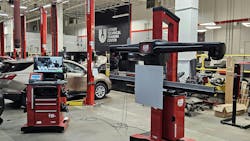
Wheel alignment has always been an essential service for maintaining vehicle handling, tire life, and ride quality. But on modern vehicles equipped with ADAS, alignment is now even more important.
Modern vehicles rely on a network of sensors including cameras, radar, and other sensors to detect obstacles, read lane markings, and monitor surrounding traffic. That interpretation relies on one fundamental assumption: that the vehicle’s geometry is correct.
If that assumption is even slightly off, ADAS systems can misinterpret the environment around the vehicle.
Small misalignments create large errors
ADAS systems depend on precision. A forward-facing radar sensor may be properly mounted and successfully calibrated, but if the vehicle’s thrust angle is off and the truck is not tracking straight, the sensor may still be pointing in the wrong direction relative to the road.
Even a one-degree error can significantly affect system accuracy. At 100 yards, a one-degree deviation can shift the sensor’s detection point by more than five feet. At highway speeds, that difference can affect how the vehicle detects obstacles, vehicles, or lane boundaries.
Because of this, proper alignment geometry is a critical first step before any ADAS calibration procedure.
Understanding vehicle reference points
ADAS sensors are calibrated relative to the vehicle’s frame of reference: its centerline, thrust angle, and level horizon.
When technicians perform a camera or radar calibration, the process does more than just teach the system to recognize targets; it also defines where “straight ahead” is and establishes the vehicle’s reference point for interpreting lane markings, vehicles, pedestrians, and other objects.
If the underlying geometry is incorrect, every system decision is based on faulty assumptions.
Forward-facing cameras, radar modules, blind spot sensors, and surround-view camera systems all depend on accurate alignment geometry and ride height. ADAS calibration synchronizes sensor inputs with the vehicle’s physical orientation.
This orientation begins with proper wheel alignment.
Alignment before calibration
ADAS accuracy does not start with scan tools and target boards—it starts with the alignment rack.
Many OEM calibration procedures recommend verifying alignment before calibration, but some leave this step optional depending on the repair performed. However, if alignment is not checked, technicians have no way of knowing whether the vehicle entered the bay with proper geometry.
Alignment establishes the vehicle’s geometry, while components like the steering angle sensor confirm driver input. Both must match before calibration begins. If any link in that chain is compromised, the calibration process may appear successful, but the system may not reflect the vehicle’s true direction.
In those cases, the vehicle may not set a fault code, yet ADAS systems may still perform incorrectly.
Factors affecting alignment
Wheel alignment measurements are closely tied to suspension geometry and ride height. For vehicles equipped with ADAS, ride height changes can alter sensor aiming angles. A change of just a few millimeters can shift the pitch angle of cameras and radar modules enough to affect their detection range.
For example, a vehicle that is heavily loaded in the rear may travel with a nose-up stance. This tilts the radar module upward, reducing its ability to detect nearby objects. Similarly, camera pitch changes can affect how the system interprets lane markings.
Because of this, many OEM calibration procedures require technicians to verify ride height before starting calibration.
Technicians should also consider how routine mechanical repairs can affect alignment. For example, removing a rear subframe to access a fuel tank or replacing rear suspension components can alter rear toe settings and change the vehicle’s thrust angle.
Any service that changes suspension geometry should include a wheel alignment to ensure the ADAS system continues to operate on an accurate foundation.
Steering angle sensor alignment
If thrust angle determines where the vehicle is actually traveling, the steering angle sensor (SAS) determines what the vehicle believes the driver intends to do. For ADAS systems to function correctly, those two references must match.
The steering angle sensor feeds data to systems such as lane keep assist, electronic stability control, adaptive cruise control, and collision avoidance features. If the SAS is not recalibrated after an alignment, the vehicle’s understanding of “straight ahead” may not match the vehicle’s true direction of travel.
This mismatch can lead to subtle but important issues, including:
- Lane departure warnings triggering incorrectly
- Lane keep assist applying unnecessary steering corrections
- Adaptive cruise control misinterpreting vehicles in adjacent lanes
After every alignment, technicians should perform a steering angle sensor reset according to OEM procedures.
Workflow for ADAS-equipped vehicles
While manufacturer procedures vary, most ADAS service workflows follow similar steps:
1. Pre-scan documentation
Perform a full diagnostic scan before beginning repairs. Document DTCs, freeze-frame data, and system status.
2. Suspension inspection
Verify ride height, inspect suspension and steering components, and confirm tire size and inflation.
3. Perform a four-wheel alignment
Document the alignment results and confirm geometry is within specification.
4. Reset the steering angle sensor
Recalibrate the SAS so the system’s steering reference matches the vehicle’s geometry.
5. Perform ADAS calibration
Carry out static or dynamic calibration procedures according to OEM guidelines.
6. Post-scan and road test
Verify system operation and confirm that calibration was successful.
Alignment and calibration must work together
As vehicles become more dependent on ADAS technology, wheel alignment is evolving from a routine maintenance task into a prerequisite for safety system performance. Every sensor and camera assumes the vehicle’s geometry is correct. If it is not, the systems interpreting the environment around the vehicle will be working from inaccurate data. By verifying alignment, confirming ride height, and following proper calibration procedures, technicians can ensure that ADAS systems function as intended.
When alignment and calibration are treated as one connected process, the result is a vehicle that performs safely and accurately on the road.
About the Author
 Erik Screeden
Erik Screeden
Erik Screeden is the Technical and Multimedia Content Director for the Vehicle Service & Repair Group. Erik is an ASE Master Automobile Technician with L1, and L4 credentials, who has been in the industry for over 25 years in various capacities. During that time, Screeden was a technician. He started out at a Ford dealership and continued to several independent repair facilities as well as spent time in the specialty aftermarket at a GM-specific performance shop. After his time as a technician came to an end, Screeden transitioned into a role providing scan diagnostic and J2534 tool support. He was then able to parlay his experience as a technician and a support specialist and use that in several technical sales roles.