Kicking the tires: How to choose the best fit for your fleet
Key Highlights
- Evaluate tires by total cost of ownership—not purchase price—using fuel, mileage, retreadability, and uptime data.
- Test tires in controlled, real-world fleet trials to measure fuel economy, wear, and cost per mile before switching brands.
- Strong tire maintenance programs maximize tire life and ROI, regardless of brand or purchase price.

When you have the right tire partner, your tires are like a beloved spouse. Treat them well and respect them, and they’ll do the same for you. When things are bad, they’re more like in-laws who have overstayed their welcome. You’re stuck with them until the service agreement ends.
Fortunately, it’s a lot easier to vet a tire than in-laws. For starters, your human partner might not appreciate you kicking their parents, while kicking the tires is encouraged. And with tire costs consuming so much of a fleet’s spend, you should always look to optimize and swap when necessary, (another thing some wish they could do with in-laws).
Fleets can change tire suppliers, though it’s often easier said than done, according to Brian Antonellis, SVP of fleet operations at Fleet Advantage. They often fall into two camps.
“Low-cost operators will move between brands with very little loyalty,” he explained. “Operationally-focused companies will use data to understand tire performance and balance vs acquisition. While they will move between brands, they are far more loyal and understanding of how their decision will impact the P&L and operational performance of the fleet.”
And beyond the contract itself, jumping between vendors can create logistical challenges.
“Switching providers can be challenging,” Antonellis continued. “Managing the inventory of casings, prebuilt recapped product, and matching tire heights based on new and recapped drive patterns make switching a project you need to prepare for.”
Evaluation priorities vary fleet by fleet based on their intended application and what they ultimately expect from the tire. Whether it’s lower rolling resistance for fuel efficiency in a long-haul application or durability in urban and regional applications, the evaluation should inform your purchasing decision.
While the purchase price of a tire will have some influence on the buying decision, lifecycle cost is the true arbiter of the “best” tire. The only way to establish the true total cost of ownership is to evaluate a tire from cradle to grave, considering miles to removal and the number of times a tire can be successfully retreaded.
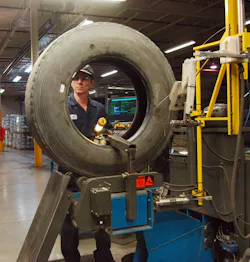
“Fleets that choose tires based on price alone often end up paying more in the long run,” said Shaun Uys, head of replacement tire sales, Continental Tire, Americas. “I encourage fleets to look at the full cost of ownership: mileage, fuel efficiency, casing durability, retreadability, maintenance needs, and uptime. Price matters, but it should be the starting point, not the whole decision.”
[Editor’s note: In our Fleet Maintenance 2025 audience survey, 27% said TCO was the most important factor in selecting tires, versus 8% for initial cost.]
Any relationship requires both parties to put in work. You can’t blame the tire for poor TCO if you don’t perform the proper preventive maintenance.
That means the key to a long-lasting tire that performs at a high level is an effective tire maintenance program. If you think a tire will last simply because you paid a lot for it, you may end up feeding premium rubber to the wolves. Be honest about your maintenance program. Even the best tires money can buy won’t tolerate sheer neglect for very long.
There’s no single best tire for every fleet. The right choice depends on how and where the vehicle runs. And anyone who knows tires will tell you that certain tire brands seem to run better on certain brands of trucks. But fleets have a lot riding on their tire choice, so a thoughtful evaluation is a more sound approach than word of mouth. We talked with several experts to find out how to make the process easier.
Start with fuel efficiency
Controlled trials can scientifically prove which tire works for you. Mesilla Valley Transportation Solutions (MVTS) routinely helps fleets figure out the right tire choice via A-B testing on a track to determine the impact of the many variables at play.
The most important variable to test for is fuel efficiency, according to Daryl Bear, COO of MVTS. He also said it’s almost universally ignored, estimating that “99% of fleets overlook fuel economy testing on tires, which is a costly oversight.”
He added that this initial part of the testing “takes a few hours when done right.”
And the results are well worth the time.
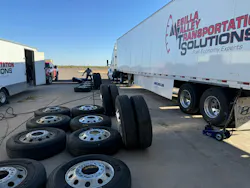
“In testing, we have seen a difference in fuel economy of 1 to 8 gallons per 1,000 miles traveled even with EPA SmartWay-approved low rolling resistance tires,” he said. “You can easily do the math, but as an example, a tire set traveling 250,000 miles saves 250 to 2,000 gallons of fuel, which adds up to $1,000 to $8,000 per tire set in fuel spend. A tire that costs less at purchase or has a longer tread life may result in an overall loss due to fuel spend. It’s important to factor fuel spend into the CPM of tires, which most fleets don’t do.”
He also noted MVTS works with fleets “on the leading edge of adaptation,” which need to continuously evaluate how new tractor-trailer technology and specifications influence a tire’s impact on fuel efficiency and, therefore, cost per mile.
After a tire’s impact on those metrics is determined, he said a fleet can perform long-term testing on a smaller set of assets to evaluate how tread depth and other factors affect CPM.
“This reduces disruption in operations as well due to less tracking and management,” Bear noted.
Other factors to consider
Assuming your fleet has narrowed down the best tires for fuel efficiency, the next challenge is determining how each will hold up to specific duty cycles and routes over hundreds of thousands of real-world miles.
Partnering with your local tire dealer is a good place to start. They can provide tailored recommendations based on the fleet’s specific needs. A little independent research never hurts either. Tire makers are constantly introducing new models. Stay on top of the market, and keeping an eye on your competitors’ tire choices may also provide some insight.
Testing four to six trucks per tire model should provide a solid understanding of overall tire performance and capability, suggested Tom Clauer, Yokohama’s senior manager of commercial product planning.
“The greatest challenge lies in minimizing differences between the test groups to ensure the results are not influenced by outside variables,” he told Fleet Maintenance. “This sample size also helps offset any losses over the evaluation period caused by road hazards or other unforeseen issues.”
Controlling as many variables as possible ensures a level playing field for all tire models and tread patterns under evaluation.
According to Greg Kidd, application engineering manager at Bridgestone Americas, test routes should offer similar speeds, daily mileage, and comparable numbers of daily starts and stops. At the very least, all test vehicles should be of a similar make, model, horsepower, and torque rating and be in good mechanical condition before beginning the evaluation.
“If possible, all test vehicles should be domiciled in the same yard so the test tires are available for scheduled inspections,” Kidd added.
“In the steer axle position, Bridgestone recommends running a minimum of six vehicles for every pattern being tested,” Kidd advised. “In the drive and trailer positions, we recommend running a minimum of four vehicles or trailers for every pattern being tested.”
Plan on keeping the steer tires in the test phase for at least a year. Drive and trailer tires may take two years or more to complete.
“Run a real evaluation,” Uys recommended. “Testing a few tires over a few months won’t tell you much. A meaningful test should include enough miles to show real wear trends.”
Obviously, if you’re concerned with miles per 32nd or the tire’s suitability for recapping, you’ll want to run it right down to the pull point. In some cases, that could be two or three years, depending on the tire and the application.
Royal Jones, president and CEO of Mesilla Valley Transportation, is currently evaluating a new premium drive tire from a Tier 1 supplier on several of his 6x2 tractors. He said drive tires typically run no more than 150,000 miles before they are rotated back to the tag axle.
“We’ve already got over 230,000 miles on some of the 6x2 drive tires, and they have a long way to go,” he said. “We have some of those same tires on our 6x4s, too, and I’m thinking we’re going to see 450,000 miles before we pull them.”
In other words, a thorough tire evaluation may go on longer than you expect. Be prepared.
Avoid skewing the results
There's more than one way to ruin a tire evaluation. These are long-term projects that can take a year or longer. Tread wear likely won't even appear on the tire within the first few months.
You don't want to baby those tires, but nor do you want to beat them up. You want to evaluate them on trucks and with drivers that best reflect the state of the fleet. You also don't want to over-maintain them. Treat them as any other tire in the fleet and stick as close as possible you your regular inflation and inspection routines.
"If you’re only checking air pressure on the tires being evaluated, it will skew the results," suggests Kevin Rohlwing, chief technical officer Tire Industry Association. "Inflation pressure maintenance is a year-round component for every tire program, and it has a direct effect on cost-per-mile -- positive or negative. Don't treat the test tires any differently."
Pick a handful of trucks at early- to mid-life that are mechanically sound. Align them and replace the shock absorbers before the evaluation begins. This eliminates two of the major sources of irregular tire wear.
"The greatest challenge is minimizing differences between the test groups to ensure the results are not influenced by outside variables," says Tom Clauer, Yokohama Tire senior manager of commercial product planning.
If you're evaluating the tires for fuel efficiency, extra care should be taken to avoid missing a fill-up. Even a few hundred gallons over a year can make a difference in the results.
When tracking fuel consumption, use actual gallons pumped at each fill up rather than fuel burn recorded by engine software. Fuel consumption data can be off by as much as 5%. Also, there can be significant variations across various OEMs.
We never said this would be easy.
About the Author
 Jim Park
Jim Park
Jim Park is an award-winning journalist who has covered the trucking industry since 1998. Prior to that, he racked up 2 million miles as a driver and owner-operator pulling tank trailers over-the-road. He continues to maintain his CLD.
Jim's previous driving experience brings a real-world perspective to his work. Jim's strong suits are equipment and technical matters, emerging technology, vehicle spec'ing, safety, and driver issues. He has hosted an overnight radio show for truckers, produced many technical and training videos, and has published three research papers on driver fatigue and the driver shortage. He has earned 9 Jesse H. Neal awards, including “Best Range of Work by a Single Author” in 2020.