Trailer technology to improve vehicle efficiency
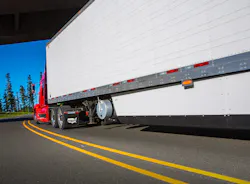
Originally included as part of the U.S. Environmental Protection Agency (EPA) and National Highway Traffic Safety Administration (NHTSA) Phase 2 greenhouse gas (GHG) emissions standards regulations, trailers were considered an additional step toward fuel efficiency improvements. While federal regulations regarding trailers have been put on hold for the indefinite future, trailer manufacturers are still taking steps to improve the efficiency of their products.
“Should the regulations become effective in the future, trailers will have to be compliant with the EPA GHG [Phase] 2 rules, which mandate incremental stringency increases by phase years 2021, 2024, and 2027,” says Chris Lee, vice president of engineering for trailer manufacturer, Great Dane.
Even without mandates dictated by the Phase 2 ruling, trailer manufacturers have been exploring and offering efficiency improvement technologies such as lighter weight materials for trailer construction, aerodynamic side and rear fairings, low rolling resistance (LRR) tire specifications, and tire monitoring systems including tire pressure monitoring systems (TPMS) or automatic tire inflation systems (ATIS).
“There is definitely value to running LRR tires on the trailer,” advises Phil Mosier, manager of commercial tire development at Cooper Tire. “The trailer positions can account for up to 42 percent of the total vehicle’s rolling resistance coming from the tires.”
“Many fleets are already running with side skirts and low rolling resistance tires and experiencing the benefits in improved fuel efficiency,” says Larry Adkins, senior manager for trailer manufacturer Wabash National. “This is a trend that the industry has been moving toward as fleets determined, on their own, what technologies made the most sense for their operations. As the regulation’s requirements step up over the years, we will see the cost of a new trailer increase as more advanced technologies will need to be installed.”
The key for fleets is the operations they run. Many of the technologies designed to provide optimal efficiency and fuel consumption reductions work best when the vehicle is traveling at more consistent highway speeds. While that works well for over-the-road fleets, it’s not the best use case for urban and regional fleets running in heavier traffic at slower speeds. This is a main reason, says Jeff Sims, president of the Truck Trailer Manufacturers Association (TTMA), that the organization petitioned to not apply the Phase 2 standards to trailers.
“These devices work at highway speeds – 60 miles an hour-plus,” Sims says. “So if you were forced to buy aerodynamic side skirts, boat tails, and low rolling resistance tires, and you are a local fleet running in heavy traffic, all you did was add weight, cost, and maintenance and you got zero benefits.”
This is not to say fleets would not benefit from the advanced technologies. But Sims argues it should be a voluntary program based on application and fleet choice, as is the case with the current SmartWay certification.
“Even some places they have dedicated long-haul equipment and they have dedicated local equipment,” Sims adds. “If they order 1,000 trailers, under SmartWay they can choose some number to be equipped and some number not to be equipped with aerodynamic devices. The greenhouse gas rule, if it were to be an effect, would force them to put that on every piece of equipment they purchase.”
With or without mandatory specing, the trucking industry will continue to see improvements on existing technology as well as introductions of new products. Some of these technologies may include electrification, better improvements to using a combination of aerodynamic devices, zero-emission trailer refrigeration units, “airless” tires, and more.
“What you won’t see is teardrop-shaped van trailers,” Adkins says. “They don’t fit our freight profiles, and they don’t match our dock heights. What you will see is further advances in materials like laminated metal composites and high impact plastics that allow manufacturers to continue to reduce weight. The industry is ripe for a trailer technology explosion. The technology has arrived but is not quite at the price point where a value proposition can be developed that will drive mass adoption.”
About the Author

Erica Schueller
Media Relations Manager | Navistar
Erica Schueller is the Media Relations Manager for Navistar.
Before joining Navistar, Schueller served as Editorial Director of the Endeavor Commercial Vehicle Group. The commercial vehicle group includes the following brands: American Trucker, Bulk Transporter, Fleet Maintenance, FleetOwner, Refrigerated Transporter, and Trailer/Body Builders brands.
An award-winning journalist, Schueller has reported and written about the vehicle maintenance and repair industry her entire career. She has received accolades for her reporting and editing in the commercial and automotive vehicle fields by the Truck Writers of North America (TWNA), the International Automotive Media Competition (IAMC), the Folio: Eddie & Ozzie Awards and the American Society of Business Publication Editors (ASBPE) Azbee Awards.
Schueller has received recognition among her publishing industry peers as a recipient of the 2014 Folio Top Women in Media Rising Stars award, acknowledging her accomplishments of digital content management and assistance with improving the print and digital products in the Vehicle Repair Group. She was also named one Women in Trucking’s 2018 Top Women in Transportation to Watch.
She is an active member of a number of industry groups, including the American Trucking Associations' (ATA) Technology & Maintenance Council (TMC), the Auto Care Association's Young Auto Care Networking Group, GenNext, and Women in Trucking.
In December 2018, Schueller graduated at the top of her class from the Waukesha County Technical College's 10-week professional truck driving program, earning her Class A commercial driver's license (CDL).
She has worked in the vehicle repair and maintenance industry since 2008.