Diesel spikes as U.S.-Iran ceasefire offers little short-term relief

Diesel and gas prices climbed again this week following a more modest increase last week. The national average on-highway diesel price rose 24 cents to $5.643 per gallon, according to the Energy Information Administration (EIA) on April 7, while gas prices rose 13 cents to $4.120.
Though an April 7 ceasefire agreement between the U.S. and Iran could help stabilize global oil supply chains, government officials cautioned this week it could be "months" before fleets and consumers see any meaningful relief at the pumps.
What are current diesel prices across the U.S.?
Here are this week’s diesel price highlights from each region of the U.S.:
- West Coast: The biggest increase in diesel prices this week occurred along the West Coast, where diesel surged 33 cents to $6.924. Without including California, West Coast diesel increased 31 cents to $6.366.
- Gulf Coast: Along the Gulf Coast, diesel prices jumped 31 cents to $5.415.
- East Coast: Along the East Coast, diesel prices increased 21 cents to $5.740.
- Midwest: In the Midwest, diesel prices increased 20 cents to $5.05.
- Rocky Mountain: In the Rockies, diesel prices increased 14 cents to $5.412.
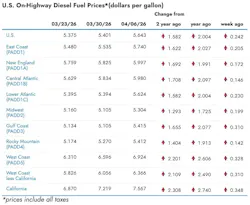
According to AAA Motor Club (AAA), the current national diesel price average is $5.646. This is less than 1 cent higher than EIA’s estimate and $2.22 higher than this time last year.
What are current gas prices across the U.S.?
The current national average on-highway gasoline price is $4.210 according to EIA, which is 13 cents higher than last week’s average. The only region without an increase in price was the Rockies.
Here are this week’s gasoline price highlights from each U.S. region:
- Gulf Coast: The biggest increase in gas prices this week occurred along the Gulf Coast, jumping 20 cents to $3.787.
- West Coast: Gas prices along the West Coast increased 6 cents to $5.396. Without including California, West Coast gas increased 8 cents to $4.951.
- East Coast: Along the East Coast, gas prices increased 19 cents to $4.00.
- Midwest: In the Midwest, gas prices increased 6 cents to $3.771.
- Rocky Mountain: In the Rocky Mountain region, gas prices actually fell 2 cents to $3.893
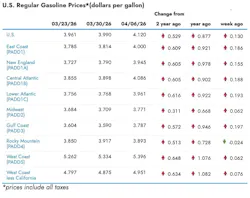
According to AAA, the current national gasoline price average is $4.140. This is 7 cents lower than EIA's estimate and 88 cents higher than this time last year.
Ceasefire unlikely to bring immediate relief
Fuel prices have continued to rise due to disruptions in oil flow around the Strait of Hormuz. While the recent ceasefire agreement with Iran promises to reopen the strait—prompting Brent crude futures dropped nearly 20%—fuel prices are unlikely to return to normal right away.
EIA estimates that fuel prices will continue to rise as producers work to reopen the strait.
"Just as we had never before seen the strait close, we’ve never seen it reopen," the agency said. "What exactly that looks like remains to be seen. Full restoration of flows will take months. Our modeling indicates that fuel prices will continue to rise until these variables resolve."
About the Author
Jeremy Wolfe
Editor
Editor Jeremy Wolfe joined the FleetOwner team in February 2024. He graduated from the University of Wisconsin-Stevens Point with majors in English and Philosophy. He previously served as Editor for Endeavor Business Media's Water Group publications.