Spear abruptly leaves ATA after a decade of leadership
Key Highlights
- Chris Spear’s departure leaves ATA seeking new leadership as trucking faces major regulatory and economic challenges.
- ATA will continue pursuing tort reform, Federal Excise Tax repeal, and other industry priorities under interim leadership.
- The next ATA leader will inherit 2027 emissions deadlines, freight market pressures, and unresolved insurance concerns.
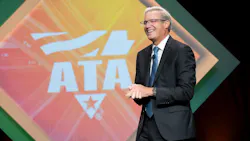
After a decade of steering the American Trucking Associations (ATA), Chris Spear is out at the industry’s largest trade federation. The departure, announced during the early afternoon of Friday, August 21, and effective immediately, comes as a surprise. Spear had signed a contract extension in 2024 that would have expired in 2029.
ATA Chairman Greg Hodgen, also the CEO of Groendyke Transport, confirmed Spear’s departure in a member-wide email on August 21, thanking him for his service to the industry, citing that during his tenure, "ATA strengthened its voice in Washington, secured important policy victories, and advanced the priorities of trucking nationwide.”
Spear's tenure, which started on July 9, 2016, came at a highly tumultuous time for trucking. Five months prior to his becoming the ninth ATA president, trucking began its mandatory electronic logging device rollout. And from there, onboard technology exploded from simple telematics to highly advanced AI today. The landscape has changed just as much.
Along with a world-changing pandemic, trucking has faced a proliferation of nuclear verdicts and subsequent rising insurance costs, while during the Biden administration, emissions regulations were put in place at the state and federal levels that would effectively force fleets to move to electric vehicles in the early 2030s, despite the technology not yet proving itself cost-effective and reliable enough to handle freight duties at scale. This threatened to completely upend an industry that works best with stability and slow changes.
Spear would routinely hit back at threats to the industry, often in fiery speeches at industry events. Notably, at the 2025 ATA Management Conference & Expo, Spear called California regulators “bark-licking bureaucrats” who were effectively trying to force the industry to move freight with “donkey carts.” The ATA worked with President Trump's EPA to dismantle the Clean Air Act waivers that granted CARB its unfettered power.
And this past July, Spear was on the dais when EPA Administrator Lee Zeldin announced major rollbacks to the upcoming low-NOx regulations for MY2027 heavy-duty vehicles. Essentially, this reprieve gives OEMs more time (2030) to meet useful life and warranty requirements. Without having to fulfill those aspects of the regulation, the cost of MY2027 Class 8 diesel trucks should be less than it would have been. While announcing the NOx changes, the EPA also shifted its stance on what happens during emissions system failures, essentially ending the engine derate era and improving truck productivity by $6,000 per vehicle.
Many issues still remain for the industry, from how to eliminate chameleon carriers to making insurance premiums more manageable. And though it is unclear who will succeed Spear, it's safe to say they will have their work cut out for them.
Navigating the freight recession
Spear’s final stretch at ATA was marked by a prolonged freight recession that had dragged on for three years since the industry saw a boost in activity and recognition during the COVID-19 pandemic. He acknowledged that the downturn shifted an early-decade focus on a driver shortage to a greater focus on cultivating highly qualified professional drivers who meet stringent safety and language standards.
- Tort reform: Lawsuit abuse and nuclear verdicts remained a top issue throughout Spear’s leadership. He spearheaded a dual strategy of supporting state-level damage caps and pushing the federal Lawsuit Abuse Reduction Act.
- Federal Excise Tax: To offset rising costs of commercial equipment and Trump tariffs, Spear actively pushed to repeal the 12% Federal Excise tax on heavy trucks and trailers.
What’s next for ATA?
Hodgen’s statement highlighted Spear’s success in assembling a formidable advocacy team, ensuring ATA has the “horsepower” to continue driving its legislative agenda in Washington.
“One of Chris’ most important accomplishments was assembling an exceptionally talented and experienced team to represent this industry,” Hodgen wrote. “ATA has the advocacy horsepower to keep advancing our priorities without missing a beat. From our policy experts and technical professionals to our government affairs and communications teams, we have a world-class operation working together to deliver results for our members. That depth, expertise, and shared sense of purpose will continue to drive our association forward, regardless of who is at the wheel.”
With the 2027 emissions deadlines fast approaching and economic pressures not easing as quickly as much of the industry expected, the next ATA leader will face a highly demanding environment. Hodgen said that ATA’s board has already begun the process of finding its next president and CEO.
“The trucking industry faces enormous challenges and opportunities, and ATA will continue leading the fight for policies that strengthen our supply chain, improve highway safety, grow our workforce, and keep America’s economy moving,” Hodgen said. “We are not slowing down. We are moving full speed ahead, and our unity as an association and industry will continue to drive our success.”
About the Author
 John Hitch
John Hitch
Editor-in-chief, Fleet Maintenance
John Hitch is the award-winning editor-in-chief of Fleet Maintenance, where his mission is to provide maintenance leaders and technicians with the the latest information on tools, strategies, and best practices to keep their fleets' commercial vehicles moving.
He is based out of Cleveland, Ohio, and has worked in the B2B journalism space for more than a decade. Hitch was previously senior editor for FleetOwner and before that was technology editor for IndustryWeek, and managing editor of New Equipment Digest.
Hitch graduated from Kent State University and was editor of the student magazine The Burr in 2009.
The former sonar technician served honorably aboard the fast-attack submarine USS Oklahoma City (SSN-723), where he participated in counter-drug ops, an under-ice expedition, and other missions he's not allowed to talk about for several more decades.