Lightning bottled: Ford pivots from electric pickup to hybrid version
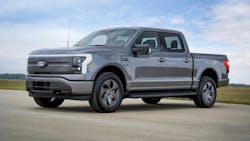
Profit losses and changing customer demand have forced Ford’s hand. The Detroit-based OEM is shifting away from pure battery-electric light trucks and vans, opting instead to focus on extended-range electric vehicles (EREVs) and traditional gas versions. This means the Ford Lightning and e-Transit in their current form will be no more.
Ford announced the news on Dec. 15, citing losses of $19.5 billion due to the EV side of the business. However, a low-cost, flexible Universal EV Platform is still being developed, with a midsize pickup truck slated to start production in 2027 at the Louisville Assembly Plant.
“This is a customer-driven shift to create a stronger, more resilient, and more profitable Ford,” said Ford president and CEO Jim Farley. “The operating reality has changed, and we are redeploying capital into higher-return growth opportunities: Ford Pro, our market-leading trucks and vans, hybrids, and high-margin opportunities like our new battery energy storage business.”
Looking ahead at Ford’s future
“The F-150 Lightning is a groundbreaking product that demonstrated an electric pickup can still be a great F-Series,” said Doug Field, Ford’s chief EV, digital, and design officer. “Our next-generation Lightning EREV is every bit as revolutionary. It keeps everything customers love—100% electric power delivery, sub-5-second acceleration—and adds an estimated 700+ mile range and tows like a locomotive. It will be an incredibly versatile tool delivered in a capital-efficient way.”
That’s more than double the Lightning’s max range of 320 miles. The biggest problem with the all-electric F-150 was that towing slashes range, rendering it unfeasible in several commercial applications, and less versatile for personal use.
Fleet Maintenance’s reporting found the Lightning performed well in municipal duties, where towing was less needed, and range was less of an issue. Without gas engines, maintenance was also reduced, easing the burden on short-staffed city repair shops as well.
Other moves include shifting the Tennessee Electric Vehicle Center, which will be renamed the Tennessee Truck Plant, to assembling all-new Built Ford Tough truck models starting in 2029. Ford said these “affordable gas-powered trucks will broaden Ford’s truck family and extend its market leadership, replacing the previously planned next-generation electric truck.”
The Ohio Assembly Plant will also become a central hub for Ford Pro in 2029, assembling the new gas- and hybrid-powered commercial van starting, along with Super Duty chassis cabs.
By focusing more on hybrids and using the new architecture designed for higher volumes and lower costs to consumers, Ford Model e is expected to reach profitability in 2029. By 2030, Ford projects half of its global volume will comprise hybrids, EREVs, and fully electric vehicles. It was 17% in this year.
Ford is also launching a new Battery Energy Storage System (BESS) business to capitalize on large-scale demand for energy storage from data centers and infrastructure. Ford will convert the currently underutilized U.S. battery manufacturing capacity in Kentucky to produce the BESS and start shipping in 2027.
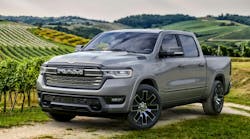 2026 Ram 1500 REV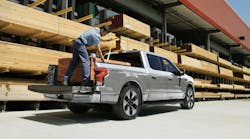
About the Author
 John Hitch
John Hitch
Editor-in-chief, Fleet Maintenance
John Hitch is the award-winning editor-in-chief of Fleet Maintenance, where his mission is to provide maintenance leaders and technicians with the the latest information on tools, strategies, and best practices to keep their fleets' commercial vehicles moving.
He is based out of Cleveland, Ohio, and has worked in the B2B journalism space for more than a decade. Hitch was previously senior editor for FleetOwner and before that was technology editor for IndustryWeek, and managing editor of New Equipment Digest.
Hitch graduated from Kent State University and was editor of the student magazine The Burr in 2009.
The former sonar technician served honorably aboard the fast-attack submarine USS Oklahoma City (SSN-723), where he participated in counter-drug ops, an under-ice expedition, and other missions he's not allowed to talk about for several more decades.