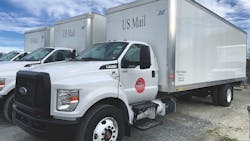
Founded in 1971, McAbee Trucking has a staff of 68 employees, all dedicated to the company’s long-term work as a contractor for the United States Postal Service, transporting packages to and from USPS locations throughout North and South Carolina. To accomplish this work, the company boasts a fleet of 63 vehicles with a diverse mix of fuel types, including propane autogas, compressed natural gas (CNG), and diesel trucks.
McAbee Trucking’s owner, Lisa McAbee, made the decision in 2014 to begin exploring alternative fuels for her company, driven by not only a desire to benefit her company’s bottom line, but also a commitment to shrink the company’s carbon footprint as well.
Finding inspiration in their partnership with the USPS and their shared vision of creating a more sustainable future, McAbee initially acquired six Ford F-750 propane autogas trucks, which the company credits with demonstrating the ability to reduce fuel spending without sacrificing performance — as the new propane vehicles carried equivalent horsepower, torque, and towing capacity as their gasoline- and diesel-fueled counterparts.
Economic Impact
McAbee Trucking was able to discern immediate financial benefits of switching to propane autogas. Once in operation, the propane autogas trucks demonstrated a 40% reduction in total ownership costs when compared to CNG vehicles, and a 60–70% reduction in total ownership costs when compared with diesel. In addition, McAbee can take advantage of a 36-cents-per-gallon excise tax for the use of propane. With the overall savings experienced due to propane’s ability to reduce spending, the company was able to upgrade its facilities, vehicles, and parking lots.
Ease of Maintenance
The leadership team at McAbee Trucking was similarly impressed with the lack of additional maintenance required of its new propane autogas vehicles. Propane removes the complexity and cost of after-treatment measures, eliminating the need for additional fluids or filters, exhaust after-treatment, particulate trap systems, turbochargers, intercoolers, or regeneration. Further adding to the satisfaction of McAbee’s service technicians was the ability to perform routine maintenance without requiring special service equipment — and without coming away smelling like diesel. “When they service our propane vehicles, there is no odor,” McAbee said. “Every oil change with diesel you smell like diesel.”
McAbee Trucking’s team received training on fueling and how to use the shut-off valve. Since their launch, McAbee’s propane vehicles have been trouble-free to maintain. In the instances where the staff has needed help, ROUSH CleanTech has been responsive. “We are very satisfied with ROUSH CleanTech,” McAbee said. “We can always get in touch with them and they take away the stress.”
Reduced Emissions and Increased Satisfaction
Because propane autogas is naturally lower in nitrogen oxides, McAbee Trucking is also cutting harmful emissions by adding propane autogas vehicles to its fleet, benefiting employees’ health and improving the local community’s air quality. The vehicles produce fewer greenhouse gases and smog-producing hydrocarbons, and no particulate matter.
In addition to the environmental benefits, the quieter performance of propane autogas-fueled vehicles has turned many of the company’s drivers into fans. As McAbee explains, “One of my senior drivers said he’d never drive a propane truck; he stayed with diesel. But then one day, he had to take one of our propane trucks out. Now he won’t go back to diesel and smiles every day doing his job.”
McAbee Trucking Propane Hightlights
- 60% COST-SAVINGS in total ownership costs compared to diesel vehicles
- 40% COST-SAVINGS in total ownership costs compared to CNG vehicles
- 8,000 MILES traveled per month, per vehicle
- 16,000 GALLONS OF PROPANE used per year, per vehicle
To learn more about how propane can benefit the delivery vehicles in your fleet, visit Propane.com/delivery-trucks.