Small fleets lag in dashcam adoption, but could cost them in long run
Key Highlights
- Dashcams have been shown to help reduce driver accidents and improve coaching
- However, a new stucy from Tech.co found that larger fleets are mostly the ones recieving these benfits, as they have the capital to deploy dashcams
- Smaller fleets have plenty of options to choose from to leverage dashcams, including those from Nauto, Lytx, Motive, and Pedigree Technologies
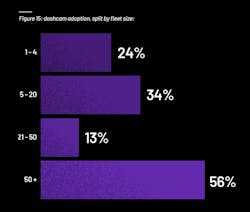
According to a survey from media outlet Tech.co, about twice as many medium- and large-sized fleets (>50 vehicles) adopt dash cams compared to small fleets (<50 vehicles). Overall the report found 48% of logistics businesses have adopted dash cams.
Jack Turner, Tech.co editor for the study, said the reason for this lag in dashcam deployment based on fleet size is likely due to costs, especially when smaller fleets have less cash to spend, and thus need to be sure of their ROI on any purchase.
“For example, we know that among these firms, maintenance software and route optimization software adoption is high, which makes sense as they have clear, tangible benefits linked to continued operation and revenue,” Turner noted. “While dashcams can also be beneficial, it's likely that they're just not as high up the priority list as the ties to revenue aren't as clear cut."
Benefits of dash cams
But while smaller fleets may need to keep a closer eye on their ROI, they may have more to gain from dash cams than they think. For both large and small fleets, each form of dash cam provides a number of benefits. For example:
- Forward-facing dash cams can assist fleets with litigation by providing visual evidence of conditions around a vehicle at the time of an accident. And they can help exonerate drivers by revealing bad actors on the road, helping avoid nuclear verdicts (judgments above $10 million)
- Inward-facing dash cams (paired with AI systems) can help monitor drivers for fatigue and distraction, making them safer while they drive.
- AI-powered dash cams that are connected to a vehicle's telematics systems can also improve driver coaching by revealing unsafe behaviors such as harsh braking and tailgating.
For more concrete examples in each segment:
- Alain Samaha, president and CEO of Teletrac, said that using the company's AI-powered IQ Camera helped one fleet exonerate their drivers in three "back-to-back" incidents.
- Lily Transportation's division vice president Ken Charmevil noted how Samsara's cameras and AI program have helped alert distracted drivers, cutting accident numbers down 30-40% year over year.
- Motive VP of Product Management Abhishek Gupta said customers have reduced their accident rates "above 70% and really saved millions of dollars" through AI coaching.
And, for some programs, using dash cams can help lower insurance premiums. For example, Geico and Motive recently partnered on a program where Geico policyholders using Motive's Driver Safety Program and Motive Fleet Management Solution (such as Motive's AI Dash Cam), can lower their insurance premiums by up to 10%.

Options for smaller fleets
But of course, while dash cams can stand to help fleets cut their accident costs, that doesn't mean the solutions themselves don't still carry their own costs. But it's up to fleets to evaluate the costs of protecting themselves versus what they could incur from an accident or settlement.
To help, here's some example pricing from providers.
Pedigree Technologies offers a plug-and-play 360-degree view with its daschcam, CameraView. While the company doesn't list its dash cam prices, its ELD hardware costs range from $299-$750 up front, according to ELDFocus.com. Meanwhile, the company's software subscriptions start at $25 per month, but fleets should call the company for a specific quote for their business. So, for a fleet with 20 vehicles, assuming an up-front cost of $399 (the rough cost of Pedigree's Cab-Mate Open ELD), it would cost $7,980 to install 20 pieces of hardware.
Meanwhile, SureCam's dash cam program and fleet maintenance services runs at $39.99 per vehicle per month. For a fleet with 20 vehicles, that comes out to $800 per month. For these prices, fleets get self-service video download, accident alerts, GPS location tracking, advanced speeding alerts, an AI insights dashboard, AI in-cab alerts, and more.
It should be noted fleets of any size need to also factor in maintenance. Velociti offers a program called VeloCare Unlimited, which monitors for problems with dash cams and helps repair them when issues crop up, whether through a remote repair or scheduling a technician to travel to a fleet. In this case, VeloCare Unlimited starts at $4/month per asset, so a fleet with 20 vehicles would pay $80 per month to take care of their devices.
These costs do add up, especially with the freight recession making margins even slimmer, but when leveraging the insights from dashcams to catch bad driving behavior and coach up drivers, as well as exonerate your fleet when an accident is not their fault, the question becomes, how much does it cost to not invest in this technology?
About the Author
 Alex Keenan
Alex Keenan
Alex Keenan is an Associate Editor for Fleet Maintenance magazine. She has written on a variety of topics for the past several years and recently joined the transportation industry, reviewing content covering technician challenges and breaking industry news. She holds a bachelor's degree in English from Colorado State University in Fort Collins, Colorado.