Spec’ing and maintaining jack stands: A safer foundation for shops
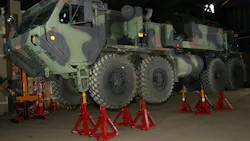
Technician injuries tied to improper vehicle lifting remain a persistent—and often preventable—issue in fleet shops. When working under improperly supported vehicles, skipped steps, misused equipment, or inconsistent procedures can lead to serious or fatal consequences.
But beyond following proper lifting procedures, fleets can further reduce risk by taking a proactive approach. This means spec’ing the right jack stands, maintaining them properly, and reinforcing consistent usage through training and shop culture.
Spec’ing the right stands for your fleet
Selecting the right jack stands begins with capacity. “You want jack stands that are rated for at least the GVWR of the vehicle being supported,” said Sean Price, director of product development and quality control at BendPak. “Also consider its features. Does it offer sufficient height adjustment to reach the lifting points of the vehicles in your fleet? Is it easy enough to move around the shop and use that technicians won’t hesitate to grab it when they need it?”
Todd Michalski, SVP of sales and marketing at Gray Manufacturing, emphasized matching stand capacity to the jack, not just the combined rating. “Each support stand should meet or exceed the capacity of the jack,” he explained. He also recommended choosing heavy-duty steel stands that are PASE compliant with positive pin designs.
Choosing the correct type of stand also depends on the service being performed, with different designs suited to different jobs and equipment.
“Axle stands generally have a Y-shaped head in order to cradle the axle, whereas frame stands are generally flat to mate to a flat surface, such as the frame of the vehicle,” added William Brahler, director of operations for Gaither Tool Company. “Frame stands should be used for any service that will cause an axle to shift, such as alignments, shocks, springs, or even axle replacement. Axle stands can be used when there are no components involved with axle movement, such as tire replacement or service, brake or hub service.”
Inspection and maintenance tips
Tips from OSHA
Keeping jacks and jack stands in good condition is part of safe operation. Clean off dirt, oil, and grease to prevent corrosion and slipping hazards. Check for leaks or damage after lowering a load, as problems are often easier to spot immediately after use.
Remove from service any equipment that shows signs of damage or wear. Never attempt unauthorized repairs or modifications. For jacks and jack stands, always follow the manufacturer’s instructions for proper operation, inspection, and maintenance.
Proper inspection and maintenance are critical to keeping lifts and stands safe long term, as just like with any component, equipment, or tool, they can become damaged if cared for improperly.
“For any equipment, such as vehicle lifts, jacks, or jack stands, always follow the equipment manufacturer’s directions for inspection, maintenance, and end of service life,” offered Dale Soos, senior project engineer with the Automotive Lift Institute (ALI). He advised that shops hire an ALI Certified Lift Inspector to perform an ALI Check360 Certified Lift Inspection. These inspectors are trained to follow all the requirements of the national safety standard.
Vehicle support stands should be checked for cracks, bends, damaged or missing pins, rust, weld separations, and stability of the base, Michalski noted. Any structural damage, corrosion, missing labels, or use of non-OEM pins is reason enough to remove a stand from service.
Training techs for safer lifting
Even the best equipment only works if technicians use it correctly and consistently, and it’s crucial to implement “constant enforcement of policies to use jacks and jack stands appropriately for both new hires as well as established technicians, so that people remember this is important and it’s driven home,” Brahler said. He added that proper training and enforcing mandatory jack stand usage are the first steps to prevent most jack stand-related incidents in fleet shops.
Justin Fisette, senior product marketing manager at Bosch Mobility Aftermarket, agreed, offering that “consistency and repeatability are key to safely using lifting and holding equipment. Technicians should always follow proper lifting and support protocol, regardless of how long the vehicle will be lifted.”
Maintaining that consistency ultimately comes down to technician training and shop culture.
“I think the biggest thing would be to train technicians to use the stands regularly and in accordance with the stand manufacturer’s instructions,” Soos concluded.
About the Author
 Lucas Roberto
Lucas Roberto
Lucas Roberto is a Senior Staff Writer and producer of multimedia content for Fleet Maintenance magazine. He holds a bachelor's in media production and a master's in communication from High Point University in North Carolina.