Call for backup: How rear-view cameras became essential for fleets

For nearly a decade, NHTSA has mandated backup cameras on vehicles weighing less than 10,000 lbs., though they had become standard on most cars several years earlier. With technology readily available in the consumer space, it was only a matter of time for the commercial sector to join in.
That is steadily happening, with more OEMs and aftermarket providers advancing the technology and making it easier to deploy. On the pickup side, Ford has Pro Trailer Hitch Assist, which combines ADAS and a backup cam to automatically line up the ball hitch with a trailer coupler on the first attempt.
For tractors, myriad options exist that give drivers a rear view or full visibility when cameras are attached to the front and sides and connected to a hub.
Professional drivers have become so used to backup cams in their personal vehicles that they now also expect it in their trucks, explained Aaron Scates, VP of vocational & medium duty market development at Daimler Truck North America. The OEM made backup cams a standard feature on Freightliner and Western Star vocational trucks last year. Scates said the backup cams can come with a 15-ft. pigtail cable to provide upfitters with more options—a welcome addition due to the near-limitless variation in vocational bodies.

“You’re so used to it in your daily life that when you jump into a heavy truck, it makes so much sense,” Scates noted.
It probably makes more sense, considering the shape and size of medium-and heavy-duty work trucks and blind spots, and lack of a rear-view mirror on larger trucks, offered Kambiz Haghighi, Samsara’s director of hardware safety. The additional views, AI alerts, and in-cab coaching allow fleets to “supercharge” their safety solution, he added.
But why stop there?
“What we’re seeing is [fleets] want to have two backup cameras—essentially one on the trailer and one on the tractor itself,” Haghighi said. The one on the tractor is for bobtailing and hitching, while the trailer cam provides a behind-the-scenes look when coupled.
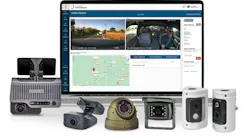
Samsara’s AI Multicam solution includes the dual-dash cam, side cams typically mounted to the mirrors to keep away from dirt and debris, and the infrared HW-MC-31 rear cam. They all connect to the Multicam Hub in the dash. Users can opt to use a wireless connection for the trailer cam.
Other options available
Phillips Industries’ REAR-VU Backup Camera, now standard on Wabash dry vans, uses a Wi-Fi signal with a 70-ft. range. Drivers connect by scanning a QR code on the trailer nose, and fleets can track individual cams via an app.
Pedigree Technologies opted for a wired connection through the 9-pin connector for the trailer-mounted cams on its OneView 360-degree system.
Rocco Marrarri, VP of sales at Pedigree, said Bluetooth and WiFi “are really not stable enough yet, so you’re going to lose some connections…we opted to go away from there, because we want full power and full stability.”
To find the most reliable solution for their application, fleets should test different options before deploying at scale.

OEMs pull a 360
The OEMs have had backup cameras for years, and a few have made big leaps in the vocational space this year.
In February, DTNA launched its Exterior Camera System for its vocational and medium-duty trucks. This factory-install solution adds three additional cameras—two on the side and one on the grille to give the driver a clear vision around the truck, with the ability to turn on a specific camera when specific equipment activates.
It provides only a live feed to the cab display and does not record video, but even that is highly advantageous. Using DTNA’s Custom Hardware and Electronics Configurator (CHEC) upfitting tool, fleets can create interlocks that allow the cameras to turn on when work truck equipment activates. This means the driver of a side-conveyor truck can see if they are lined up and concrete is pouring properly. The OEM’s QuickFit electrical architecture for work trucks also makes the installation less stressful.
As a factory install, the camera system is included in the OEM warranty, and there is no need to remove parts later in the upfit process, where typically a body upfitter takes apart dash panels and rips up flooring. “All of those things are creating opportunities for cutting wires or getting plastic parts broken,” explained Kevin Otzenburger, DTNA’s medium-duty and vocational product marketing manager.
Customers can also choose a pre-wire option to easily install another preferred vendor’s camera.
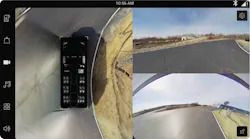
Shortly after DTNA’s announcement, Mack Trucks unveiled CommandView, another 360-degree camera system. Planned for Class 8 Granite models in late 2027, this system also displays certain camera angles when a turn signal or equipment is switched on. The system also overlays camera feeds for a composite view. Beyond that, CommandView records video at the edge which can be sent to the cloud, provides alerts, and comes with an onboard weighing system to provide accurate real-time load data.
As these cameras were built for the roughest jobsites, IP-rated for dust and moisture, and wired at the plant, they don’t require much maintenance. Drivers do need to check them during pre-trips, though, and clean off any dirt.
“You need to make sure all the wires are there and check the cameras to make sure they all work,” advised Marty Foulks, product manager for Mack’s GuardDog Connect.
That little extra time is worth it, as they allow drivers to become nigh omniscient, as evidenced by DTNA’s Ride & Drive Competition at World of Concrete in January, where drivers can win prizes for avoiding obstacles.
“We were a little bit worried it was going to make it too easy,” Otzenburger recalled. “What it really did was just increase the level of precision that these drivers had…and the ability to operate in even tighter spaces.”
About the Author

John Hitch
Editor-in-chief, Fleet Maintenance
John Hitch is the award-winning editor-in-chief of Fleet Maintenance, where his mission is to provide maintenance leaders and technicians with the the latest information on tools, strategies, and best practices to keep their fleets' commercial vehicles moving.
He is based out of Cleveland, Ohio, and has worked in the B2B journalism space for more than a decade. Hitch was previously senior editor for FleetOwner and before that was technology editor for IndustryWeek and and managing editor of New Equipment Digest.
Hitch graduated from Kent State University and was editor of the student magazine The Burr in 2009.
The former sonar technician served honorably aboard the fast-attack submarine USS Oklahoma City (SSN-723), where he participated in counter-drug ops, an under-ice expedition, and other missions he's not allowed to talk about for several more decades.