Kenworth’s severe-duty roots shape its approach to durability, electrification
Key Highlights
- Kenworth’s severe-duty testing philosophy emphasizes durability and long-term component performance.
- Parts commonality and modular designs can simplify maintenance and repairs across newer truck platforms.
- The T880E shows how fleets can adopt electric powertrains while retaining familiar chassis and service components.
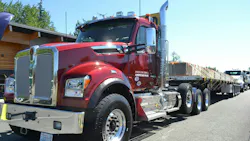
Kenworth’s approach to truck durability starts with its vocational applications and extends across its broader product lineup, according to Editorial Director Kevin Jones in a recent article for FleetOwner. During a vocational technology showcase, company leaders explained how severe-duty testing, parts commonality, and serviceability influence everything from off-road trucks to battery-electric Class 8s.
Severe-duty engineering drives durability and serviceability
Kenworth’s vocational trucks are tested against demanding durability requirements, with the company targeting up to 1 million miles of testing. The philosophy is that components designed to withstand extreme vocational environments can provide a foundation for highway applications as well.
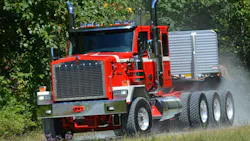
That approach is evident in the new C580, which replaces the C500 after five decades of production. The truck combines Kenworth’s 2.1-meter cab (6.9 ft.) with the existing C500 chassis architecture, allowing fleets to retain components such as planetary axles, specialized suspensions, front drive axles and twin-steer configurations.
The C580 uses Kenworth’s largest cooling module, measuring 1,780 sq. in., to support a Cummins X15 EPA 2027 engine rated at up to 600 hp during stationary or low-speed operation in high temperatures.
Kenworth also highlighted the T880S Performance Hood for heavy-haul and bridge-formula applications. Its 1,440-sq.-in. cooling module and enhanced charge air cooler are designed to manage thermal demands under high gross vehicle weights. The five-piece modular hood is intended to simplify repairs after jobsite damage—a replacement fender can be changed in about 90 minutes without replacing the entire hood or performing extensive fiberglass repairs.
Electrification and safety bring new technology to familiar platforms
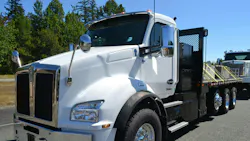
Kenworth is taking a similarly practical approach to electrification with the T880E battery-electric vehicle. Rather than creating an entirely new platform, the company adapted its vocational T880 by replacing the diesel powertrain with a centrally mounted 350-kW electric motor.
The T880E retains the T880 cab, hood, frame, axles, suspensions, and brakes. For maintenance departments, that means existing tooling, body upfitters, and spare-parts inventories can continue to support much of the vehicle.
The truck uses modular battery configurations ranging from three to five battery strings, with each adding about 50 miles of range. The five-string configuration provides up to 250 miles of range from 625 kWh and can charge at up to 350 kW. Kenworth also offers factory electric power takeoff options (ePTO) and high-voltage junction box access for vocational bodies.
Beyond powertrains, Kenworth is adding technology designed to reduce operational and safety-related risks. Its electronic parking brake is slated to become standard on heavy- and medium-duty trucks beginning with 2027 builds. Connected to the vehicle CAN bus, the system can automatically apply the parking brakes when certain rollaway conditions are detected and release trailer brakes after a speed threshold is reached.
The Digital Mirror System is also expanding into vocational models. Its passenger-side cameras provide both a rearward view and a downward view extending toward the front axle, helping reduce blind spots when maneuvering around jobsites.
Together, the technologies demonstrate how Kenworth is applying its severe-duty engineering philosophy beyond traditional mechanical durability. For maintenance professionals, the common thread is designing trucks that can withstand demanding use while making repairs, component replacement, and technology adoption more manageable.
You can read the original article from Jones and FleetOwner, a Fleet Maintenance affiliate publication, here.