The search for J560’s replacement
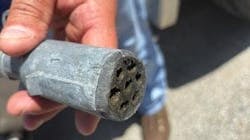
As with most things in trucking, trailers have evolved and become smarter. Unfortunately, the connection to the tractor has not advanced along with the amount of trailer technology, with most fleets using the 7-pin SAE J560 standard connector that was first developed in 1951. At the time, each pin had a specific role, such as for brake lights or turn signals.
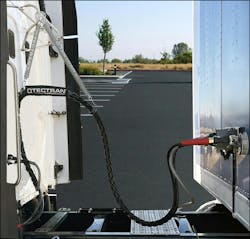
Nowadays, these 12V connectors transmit crucial power and diagnostic data between the cab and trailer, primarily for antilock braking systems (ABS) and lighting. While J560 has worked admirably for a long time, it appears a bit antiquated as trailers add more sensors but also need to power ABS, liftgates, and lights.
The original J560 developers could not have foreseen the futuristic bandwidth needs of 21st century trailers. After all, famed sci-fi author Phillip K. Dick wasn’t even published until 1952. But the industry realizes that it needs a smarter connector to match the tractor-trailers of today and tomorrow.
“The traditional role of a trailer connector was lighting and basic ABS signaling, but that no longer reflects how trailers are actually used,” explained Dan Forthoffer, VP of corporate research and development at Phillips Industries, a component manufacturer for trucks and trailers, adding that connectors are now tasked to move “information, not just power.”
So, something has to change.
SAE did introduce a revised standard SAE J2691 15-pin connector 13 years ago, but it failed to attract widespread adoption like its European cousin, the ISO 12098 15-pin 24V connector. In recent years, industry leaders have mulled over what a new standard should look like at various conferences, such as American Trucking Associations’ Technology & Maintenance Council meetings.
They have a few options on the table, but before we get into those, let’s look at what J560 does in more detail.
Current J560 capabilities
The J560 hit mass adoption in the late 1960s and has changed with the times as much as it can.
Chris Lee, VP of engineering at Great Dane, noted that the J560 connector has increased its durability and sealing over the years, with stronger strain relief, better locking tabs, and stronger cable jackets. As part of that durability, the connector’s corrosion resistance has also improved.
“Specifically, manufacturers have enhanced plating materials (nickel, tin blends), sealing and gaskets, and terminal designs to reduce fretting corrosion,” Lee explained.
Additionally, Griffin Wurm, systems engineering supervisor at Truck-Lite, also noted that connectors now often have corrosion-resistant plating on the terminal pins and that they often fit better in the plug.
Also, OEMs increased the J560’s electrical contact quality over the years so they can better deliver power from tractor to trailer.
“Even with the same pin count, newer J560 connectors offer lower contact resistance, more consistent voltage delivery, and reduced flicker and ABS fault triggers,” Lee added.
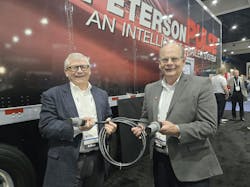
Another notable recent advancement is the Repairable J560 connector from Peterson Manufacturing, which makes lighting and harness systems. It features the standard electrical connection and corrosion resistance of the typical J560, but it also provides easier maintenance and has the capability to integrate with smart trailer systems, according to the company. The key feature is in its name: When a connector end hanging from a tractor in the yard gets run over or damaged, a technician can disconnect the end from the cable, so you only replace the damaged part.
“You only pay the cost of that end [connector]; you save everything else, in terms of the part price; and in terms of labor, you don’t have to unwind it and rewind everything,” emphasized Al Anderson, VP of sales and marketing at Peterson.
Additionally, current J560 connections have evolved to carry Power Line Carrier (PLC) communication via the PLC4Trucks integrated circuit. This allows the connector to ferry ABS and lighting malfunction signals from the trailer to the tractor and was officially standardized in SAE J2497 in October 2002.
“Since lighting and ABS systems share common power and grounding paths, intermittent electrical issues can often be the cause of both lighting failures and ABS faults,” Wurm explained. “PLC diagnostics allow technicians to identify if the failure originates from the Tractor-Trailer interface, internal trailer wiring, or other components on the trailer. This allows for a more efficient root-cause analysis and minimizes unnecessary parts to be replaced due to trial-and-error techniques.”
Today, several companies, such as LaunchTech USA (with its J560 PLC Trailer Connector) and Autel (with its Trailer PLC Connector), offer diagnostic connectors that interface with the J560 so technicians can troubleshoot trailer ABS and lighting issues using PLC signals.
Modern fleet needs
Despite these updates, the J560 still can’t keep up with the raw data demands of today’s trailers.
Smart trailers today “need to have a different set of information going back and forth between the tractor and trailer that the J560 cannot handle, because they’re just not in the right kind of devices to carry it,” Anderson stated.
For today’s fleets, a modernized connector needs to have a few main features. According to Great Dane’s Lee, that includes backwards compatibility with current J560 systems, higher bandwidth and connectivity capabilities for cameras and sensors, greater durability, lower maintenance, and the ability to be rolled out without disrupting current operations.
That backwards compatibility is important so that the new connectors don’t make the millions of tractors and trailers on the road today unusable—or, more likely, the connectors themselves.
“Across the board, the message is the same: [Fleets] want compatibility, flexibility, and choice,” Phillips’ Forthoffer said. “They do not want to be forced into a wholesale retrofit or stranded with legacy equipment.”
More specifically, fleets seem like they want to remain compatible with the J560 via a direct plug-in connector, according to TMC Executive Director Robert Braswell.
The second requirement for the next-gen connector is strong, reliable connectivity. This is especially important for smart trailers equipped with camera arrays and assistive-driving sensors, which require gigabytes of processing power.
“Neither the J560 connector nor existing ISO CAN connectors are designed to support Ethernet over the length of a truck-trailer combination,” Wolfgang Hahn, systems innovation leader, ZF Group, explained. “As a result, enabling next-generation trailer sensing and automation will require new connector standards that add Ethernet capability alongside existing power and CAN connections.”
And this higher bandwidth data communication isn’t just important for the next generation of trailer technology but for devices used in fleets right now.
“It’s really important for fleets to understand the need for the reliability of that transmission [and] the speed of that transmission of information,” said Bruce McKie, chairman of the Board of Directors for Tectran, a designer and manufacturer of maintenance and safety solutions for transportation equipment, and head of several SAE Standards development teams. “If I’m trying to back into a shipping dock, or if I’m trying to negotiate my way around a fairly busy parking lot for delivery purposes, I need split-second, immediate information if I’m a driver.”
Plus, Noregon Research has stated that faster, more reliable tractor-trailer communication is likely to advance beyond PLC notifications, impacting that facet of connector design as well.
“Tractor–trailer communication will advance significantly as the industry moves beyond legacy J2497 power line communication, historically limited to ABS fault alerts,” Noregon Research reported. Instead, trailer connectors using CAN communication will need to be able to provide deeper trailer data, spurring the adoption of more smart-trailer technologies and scanning tools with greater diagnostic reach.
Next, durability and serviceability are also important for fleets, especially since technicians already need to take apart and clean out the current J560 connector with some regularity, Braswell added.
Finally, the new connector needs to be able to provide enough power for all the devices that let a trailer detect the world around it, whether that’s pumps, cameras, or sensors.
“We have to think about the future of higher voltages,” McKie cautioned. “We have to have something that’s adaptable to 24 or 48 volts, that’s critical [for the next generation of connectors].”
When the industry can agree to a new standard and a new connector is rolled out that meets these capabilities, the roads will be safer, Truck-Lite’s Wurm asserted.
“Fleet safety across all aspects will be achieved with a next-generation connector that provides a physical layer for controlling safety systems on the trailer and enables instantaneous data flow between the power unit and trailer,” he said.
This is especially true for braking and safety systems, even on present-day trucks.
“A more modernized trailer connector could support improved system robustness for ABS today and emerging technologies like EBS (brake-by-wire) in the future,” Jason Paauwe, VP, head of Trailer Sales North America for the ZF Group, noted. “Enhanced power availability, improved communication pathways, and greater redundancy can contribute to faster diagnostics, improved system response, and higher overall reliability, all of which support vehicle safety and uptime.”
And looking even further ahead, a new connector should be able to support the next leap in trucking operations, where there may be no driver in the cab at all.
“Recognizing the industry’s appetite for change—such as the current J560 standard, which has been in use for 70 years—the next generation of connectors must also address the needs of Level 4 and Level 5 autonomous vehicle ecosystems,” Wurm added.
Debating the J560 successor
TMC and SAE have been working toward replacing the J560 for some time now. TMC presented a position paper, “Recommendations Regarding Technical Needs for Next Generation Tractor/Trailer Electrical and Data Connectivity” in 2024, after which the group received four potential connector system proposals.
Two years later, the main connector front runners will soon undergo testing from SAE to make sure they meet safety requirements, TMC’s Braswell said.
This testing includes both computer-based, or lab, testing as well as field testing. According to Braswell, the industry will be starting lab-based testing by the end of 2026, which may yield results within the next year or two as SAE evaluates which tests are needed and what performance metrics they’re looking for.
“Within the SAE group, we’re [looking at] performance requirements,” Tectran’s McKie said. These performance requirements for the next connector include sealing, environmental elements, and vibration. “We’ve gone through all of the ISO standards, the SAE standards, some of the USCAR standards, and other ones that are out there, and created a test plan and performance requirements,” McKie continued.
Then comes the field testing, which fleets are likely to be much more involved in.
“Generally speaking, fleets are rather curmudgeonly,” Braswell joked. “If they don’t see ‘real-world testing,’ they usually will scoff at the results.”
After that, the industry at large will need to decide which connector design they prefer. Once that decision is made, then the chosen connector specs will be put into a full design that any manufacturer can use while building their products.
“We want to make sure that it’s not just a single player that can do this; anybody can manufacture according to the next-generation connector standard,” McKie affirmed.
Then, TMC and SAE will turn its attention to the J560 to see where it can be further improved so that all future connectors have a strong basis to work with. And, of course, there will be even more durability testing.
However, Braswell noted that even as testing is ongoing for these connectors, there’s not much consensus yet in the industry on which design will be the standard going forward.
“It’s not all that entirely sure what the fleets want,” he said. “We’ve had these discussions, we’ve put together these educational sessions, and I think a lot of fleet maintenance personnel are still like ‘Is this really relevant to me right now? Is there a standard that’s going to emerge?’”
Despite this, Braswell is confident that there will be an outstanding connector that will become standard throughout the industry, as determined by the most important stakeholders: fleets.
But there’s no timeline on how long this process will take.
“Typically, we found at TMC [that it takes] 35 to 40 years for technology to become ubiquitous,” Braswell stated. “But take a look at automated manual transmissions. They actually started back in the late ’80s or early ‘90s, but they didn’t really become ubiquitous until just a few years ago.”
Ultimately, it depends on when and how fleets decide which connector will “do the best job for the least amount of maintenance and cost and stay in the field the longest in terms of durability and reliability,” Braswell concluded.
About the Author
 Alex Keenan
Alex Keenan
Alex Keenan is an Associate Editor for Fleet Maintenance magazine. She has written on a variety of topics for the past several years and recently joined the transportation industry, reviewing content covering technician challenges and breaking industry news. She holds a bachelor's degree in English from Colorado State University in Fort Collins, Colorado.