Upgrading the 7-way for the smart trailer era
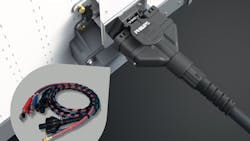
Like most things in trucking, trailer connectors are at a crossroads. The industry still relies heavily on the 7-pin SAE J560 standard developed in 1951—a connector originally designed to power lights and basic brake signals.
Today, that same 12-V architecture is expected to transmit ABS data, support liftgates, and increasingly serve as the backbone for smart trailer technology. As trailers add cameras, advanced braking systems, telematics, and sensors, the humble seven-way connector is being asked to do far more than its designers ever imagined.
Now, the industry is actively exploring what comes next.
TMC Executive Director Robert Braswell noted that right now, there are a few main connector options and some from Europe that could replace the J560 connector. These include Phillip’s Industries EvolutionIQ and Tectran’s 17-Way Tractor/Trailer Connection System.
Phillips EvolutionIQ
The EvolutionIQ connector combines seven-way power with Ethernet, CAN, and four auxiliary circuits in one connector, according to Dan Forthoffer, VP of corporate research & development at Phillips Industries. It is cross-compatible with legacy 7-way connectors and allows for future tractor-trailer communication expandability. Plus, it can handle a minimum of 2G of video streaming through two field-serviceable, ISO Standard Ethernet channels and 6k plug cycles with IP67/IP69K protection, and includes two CAN FD networks and four AUX power/ground connections.
“With EvolutionIQ, we built an architecture that preserves the trusted J560 power foundation but adds dedicated safety-critical communication paths, CAN for driver and trailer status data, Ethernet for low-latency video and smart trailer systems [like Phillips Connect], and additional auxiliary power circuits,” Forthoffer said.
He said this means that EvolutionIQ will be able to support cameras, real-time video, and more accurate sensors, making vehicle maneuvers like backing into a dock safer and more controlled. That kind of technical support will also make unloading operations safer, as stronger connectivity can let a driver know immediately if freight shifts inside the trailer or a door opens unexpectedly.
Finally, Forthoffer also emphasized that EvolutionIQ’s connectivity will increase the braking and stability capabilities for trailers.
“Advanced brake systems already exist on tractors and trailers, but without a robust communication path, they cannot function as a truly coordinated system,” he noted.
Tectran's 17-Way Connector
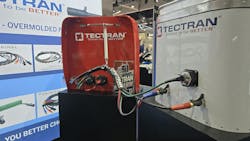
Tectran’s connector includes seven standard J560 pins, two 30A AUX pins, two CAN buses, and two High-Speed Ethernet buses, all capped off with corrosion-proof connectors, according to the company. It is also backwards compatible and fits within the J560 seven-way connector, and it features multi-stage engagement for security and compatibility, Bruce McKie, chairman of the Board of Directors for Tectran, noted.
The multi-stage approach features several steps, he explained, starting with the longer, fatter ground pin mating with the plug.
“The whole idea is to try to guide it in place, and then it mates with the six remaining pins,” McKie stated. “Then, because we put the data connections deeper into the connectors, it will connect there.”
Then for the last step, the connector fully locks together. This, plus the specially designed “Park Socket” used for bobtailing, requires that the trailer plug and gladhands are locked in for the parking brakes to release. This helps avoid drive-offs and connector damage, McKie explained.
“That engagement and the locking capability help to make it a better connection for the data itself,” he stated. “When you are connecting a new [trailer] to a new [tractor], you really need to have that compression for sealing and vibration resistance.”
Tectran emphasized how its connectors were designed as part of a system at the back of the tractor, including air brake lines and other components, because the tractor-trailer never exists in isolation.
“They all influence each other,” McKie said. “It’s important for us to think of [the connector] as a complete system, that’s an important part of how we are designing this.”
About the Author
 Alex Keenan
Alex Keenan
Alex Keenan is an Associate Editor for Fleet Maintenance magazine. She has written on a variety of topics for the past several years and recently joined the transportation industry, reviewing content covering technician challenges and breaking industry news. She holds a bachelor's degree in English from Colorado State University in Fort Collins, Colorado.