Bollinger Motors ceases operations
Key Highlights
- EV startup Bollinger Motors has closed, with its last day of business on Nov. 21
- The company quickly fell into debt and owed money to its suppliers and founder, and even struggled to pay its employees from October into early November
- Bollinger Motors' fall highlights a difficult environment for commercial electric vehicles as EV tax credits have ended and infrastruture development is underdeveloped
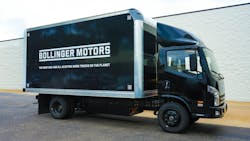
After pushing forward for 10 years, Bollinger Motors has reached its end, according to sources close to the company.
After its first year as an OEM, the week of Nov. 19, the Detroit Free Press reported that Bollinger Motors had not paid its employees for two pay periods. Then the following Monday, I received an email from my Bollinger Motors communications rep that he no longer represented the company, as the CEO of Bollinger Motors’ parent company, Bollinger Innovations, had officially pulled the plug on what Bollinger Motors called 'badass' trucks.
A scrappy beginning
In 2015, Robert Bollinger started the company he'd go on to found in his garage by building an electric SUV from the ground up. In 2022, the company shifted its operations to serve only the commercial market with the Class 4 Bollinger B4. Then, in September 2024, the company officially made it to OEM status with a truck in production. But despite this unlikely win, even early on, the company was no stranger to problems.
Only three months in as an OEM, Bollinger halted production (contracted by Roush) and furloughed its production employees. The company owed its founder, who had stepped away from the company but had still loaned Bollinger Motors $10 million. Bollinger sued to recoup that loan in March 2025, alleging that the company was broke and looking to establish a receivership to repay his initial investment. Bollinger Motors did so with help from Mullen Automotive, exiting its receivership in June. But that was not the last lawsuit Bollinger Motors would face. According to Crain's Detroit Business, at least six suppliers sued Bollinger Motors in 2025 to settle more than $5 million in overdue bills.
I chatted with Bollinger Motors’ Chief Revenue Officer Jim Connelly this summer after the dust of lawsuits settled. He told me the company’s focus was on selling the B4 vehicles in Bollinger’s inventory and on moving the production line from Roush’s facility in Michigan to the Bollinger Innovations facility in Mississippi. Overall, his tone seemed hopeful, and Bollinger Innovations announced the sale of at least six B4 vehicles in August and September.
But as of emails from the end of October, Walter Collins, chief operating officer of Bollinger Motors, wrote: "Unfortunately, we could not process this week’s payroll on schedule due to a delay in receiving the expected funds. As of today, we do not yet have a confirmed update on funding to meet payroll ending October 31, 2025. As soon as funds are received, we will process payroll in full."
By Nov. 6, there still wasn't enough funding to pay employees, and Keely Lovern, a spokesperson for the state labor department, told the Detroit Free Press that there were almost 60 open claims against Bollinger Innovations for unpaid wages or benefits.
Finally, Bollinger's Human Resources Director, Helen Watson, confirmed to the Detroit Free Press via email that the company's last day of business was Friday, Nov. 21.
What’s next for the remaining inventory and production line is yet to be known. I reached out to Connelly and one other Bollinger Motors employee but have yet to receive a reply.
Are EV makers facing a breaking point in 2025?
But Bollinger Motors wasn't the only EV production company to face steep challenges in 2025. Chevrolet’s electric cargo van BrightDrop recently received the kibosh, Ford has halted manufacturing for its Lightning pickup, and Ram nixed its plans to provide an electrified Ram pickup.
Plus, the federal government’s $7,500 EV tax credit expired at the end of September, and the EPA is looking to review the 2009 endangerment finding that allows the EPA to regulate greenhouse gas emissions entirely, which is part of the basis for pushing electric vehicles. Those factors, coupled with the fact that the U.S. has not adequately built a viable charging infrastructure, have led to a considerable drop in sales in electric vehicles.
While other OEMs have gas- and diesel-powered products to help recoup the cost of their electric experiments, all-electric OEMs that are new to the market hardly have a chance in 2025.
Whether I’ll write more obituaries for electric vehicles in 2025 is unknown, but if the remedy for EV adoption isn’t found soon, you can be sure you’ll see more EV obits in 2026.
About the Author

Jade Brasher
Senior Editor Jade Brasher has covered vocational trucking and fleets for the past five years. A graduate of The University of Alabama with a degree in journalism, Jade enjoys telling stories about the people behind the wheel and the intricate processes of the ever-evolving trucking industry.