How to prevent and identify bad welds
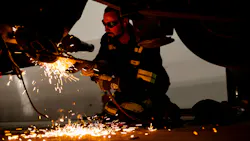
With every mile, vibration, harsh road conditions, chemicals, and weather exposure challenge the integrity of components welded to the truck and trailer. These parts are critical for both safety and uptime, which is why proper welding plays a central role in both design and repair.
“Welding is commonly used in vehicle and equipment repair whenever metal parts need to be joined, reinforced, or restored,” explained Kurt Gustafson, general manager at Cox Fleet. “That includes collision and body, frame and chassis, and component repairs, including where worn or rusted parts need rebuilding or custom fabrication.”
But when welds fail or are improperly performed, the results can range from premature component wear to catastrophic structural failure. That means everyone from the technician to the driver should know how to spot a bad weld and what to do about it.
Types of repairs
According to Cristian Fonseca, senior fabrication and body technician at Fleet Fast, a collision shop based in Akron, Ohio, welding may be required for a range of repairs, from panel sectioning to liftgates. “If not checked or done properly, the welds will crack,” he warned.
Commercial trailer repairs, in particular, often depend on welding for structural work. For example, service providers routinely perform frame welding, crossmember replacement, structural reinforcement, and rust repair to restore the structural integrity of trailers after damage or corrosion.
On gas-powered vehicles, welding is also common to repair and replace rusty exhaust pipes.
In many cases, welding is required not only to fix damage but also to restore the vehicle’s original load-bearing capability. And when welding is done correctly, the repaired component can often perform as reliably as the original structure.
Common areas
Although welds can occur anywhere metal components meet, certain areas on trucks and trailers experience higher stress levels and therefore have a greater risk of weld fatigue or failure. Fonseca, for example, pointed to trailer thresholds, the frame rail ends, and liftgate aluminum platforms. “Because these components experience repeated stress cycles, even small defects in welding can eventually lead to cracks or structural damage,” he added.
“These areas tend to carry a lot of weight, flex frequently, or experience constant vibration, and are often exposed to road salt and water, making them more prone to cracking or rusting,” Gustafson said. “Truck frames are subjected to twisting forces, heavy loads, and road shock, which makes weld quality particularly important.”
Among the most common weld failure points, these experts noted, are:
- Suspension mounting points
- Axle brackets
- Frame rails
- Crossmembers
- Welded joints along structural frame sections
Trailers are also especially vulnerable to weld fatigue because they flex significantly under load. Areas behind axles often experience additional stress as trailers flex during braking, acceleration, and cornering. That can lead to common trailer weld failure areas that include:
- Rear bumpers
- Trailer beds and loading ramps
- Support brackets
- Landing gear mounting structures
- Subframe structures near axles
Liftgates represent another critical area where weld failures can occur due to repeated loading cycles. Typical liftgate weld failure locations, Fonseca pointed out, include:
- Mounting points where the liftgate attaches to the truck frame
- Platform supports
- Hinges and pivot points
- Structural joints that twist during loading and unloading
 preventing shop fires, how to prevent welding fires
 A Lincoln Electric employee tries the VRTEX 360 Compact, a more portable version of its virtual reality welding simulator.
What can happen?
Poor welds can lead to expensive repairs, equipment reliability issues, and, in the worst cases, equipment failure on the road. “If welding isn’t done correctly or if it isn’t inspected, several issues can occur,” Gustafson said.
Common problems resulting from improper welding include:
- Cracks or weak spots in the metal
- Rust forming inside the weld joint
- Misalignment or detachment of components
- Loose structural connections by transferring stress to other parts of the vehicle
- Premature structural failure
Fonseca also noted that when welds are not properly completed, the welds themselves can crack, leading to failure and further structural damage. As a result, welding repairs should always follow proper procedures and be inspected to ensure structural integrity before the vehicle returns to service.
Identifying failing welds
Early detection is one of the most effective ways to prevent weld failures from becoming major repairs. Routine visual inspections can reveal warning signs that indicate a weld may be failing or weakening, allowing for repairs before structural damage spreads.
Both drivers and technicians should perform regular inspections before and after vehicle use, Gustafson related. “Regular visual checks are the easiest way to find problems early,” he said. “Technicians may also see uneven weld beads, gaps, or leftover debris that signal a weak or poorly made weld.”
Key warning signs include:
Cracks: Hairline cracks near welds are often the earliest indication of fatigue. Even small cracks can quickly expand as the vehicle continues operating under load.
Rust or Oxidation: Rust around a weld can indicate moisture infiltration or a weakening joint.
Misalignment: Components that appear crooked, uneven, or out of position may indicate a failed weld.
Movement: Moving parts that shouldn’t move may signal that a weld joint has failed.
Rattling, clunking, or popping sounds during operation can also indicate structural issues near welds.
Technicians may also detect poor welding during close inspections. Signs of improper welds can include uneven weld beads, gaps or incomplete penetration, excess slag or debris, and poor alignment.
Corrosion points
Corrosion is one of the most common indicators that a weld may be weakening or compromised. Moisture, road salt, and debris often accumulate around welded joints, making them particularly susceptible to rust.
“The heat from welding changes the metal, making it more vulnerable to rust,” Gustafson explained. Corrosion tends to show up around welds because small defects like tiny cracks allow rust to form inside the joint. If rust is concentrated around welds and not the rest of the frame, it often means the weld is weakening and should be inspected/repaired before it fails.”
Fonseca stressed that corrosion must be addressed quickly. “You have to get rid of it, or it will cause problems down the road due to the way it spreads rapidly,” he said. “Left untreated, corrosion can weaken both the weld and the surrounding metal, eventually leading to cracking or structural failure.”
Sidebar
Building the Next Generation of Skilled Welders
One of the biggest challenges facing the commercial vehicle industry is attracting, training, and retaining skilled welders. To help address this need, the NTEA Work Truck Industry Welder Certification Program was developed in partnership with Lincoln Electric and the National Coalition of Certification Centers (NC3).
The program delivers a customized training curriculum tailored specifically to work truck industry companies. Through the Lincoln Electric Education Partner Schools (LEEPS) program, businesses can develop and certify welders in-house, creating a consistent pipeline of qualified professionals.
Available certifications span a wide range of skills, including welding safety, principles of welding, SMAW, GMAW, FCAW, GTAW, thermal cutting processes, welding math, print reading, fabrication, pipe welding, and robotics. Some certifications focus on knowledge-based assessments, while others include hands-on performance evaluations.
To participate, companies must become NC3 Industry Members and complete a Train-the-Trainer initiative. Once completed, trainers gain ongoing access to NC3’s learning management system, certification exams, and updated training resources. The program helps fleets ensure repairs meet industry standards while strengthening the long-term skill base of the work truck industry.
For more information on the NTEA Work Truck Industry Welder Certification Program, visit www.ntea.com/events/work-truck-industry-welder-certification-program
About the Author
 Seth Skydel
Seth Skydel
Seth Skydel, a veteran industry editor, has more than 41 years of experience in fleet management, trucking, and transportation and logistics publications. Today, in editorial and marketing roles, he writes about fleet, service, and transportation management, vehicle and information technology, and industry trends and issues.