Go Cart: How to spec the most efficient diagnostic cart

It’s no secret that modern vehicle maintenance revolves around the diagnostic process. Nowadays, finding underlying issues often starts with a scan tool over master technicians’ own senses. They spend so much time diagnosing and investigating ECUs and OBDII ports over manipulating nuts and bolts that they’re more fault whisperer than wrench turner.
The amount of time to diagnose issues is unpredictable, though, possibly taking minutes or hours. Respondents in our 2025 survey who perform their own maintenance listed diagnostics and repair efficiency as the top maintenance management concern (33%). Noregon Research’s far more expansive 2026 study on heavy-duty diagnostics reported more than half of both fleets and shops said accurate and effective diagnosing and troubleshooting was their top issue.
Because of this, it makes sense to shave off diag time (while achieving an accurate resolution) wherever you can. Over weeks and months, small changes can improve uptime and shop throughput, and ease any possible debates with customers or insurers about billing. In short, it becomes a clear competitive advantage.
Experience and training do the heavy lifting in this respect, but there’s also a simple and immediate way for any tech to reduce diagnostic time: an organized diagnostic cart.
“Proper cart organization is one of the fastest and easiest ways to improve diagnostic efficiency,” Jason Hedman, product manager at Noregon, said. He noted that an orderly and properly stocked cart helps techs move more quickly through the troubleshooting process.
Conversely, he said a disorganized cart slows things down.
“When technicians constantly need to dig around for tools or test equipment, especially when those items should always be at hand, it brings a halt to the diagnostic process,” he offered.
This goes hand in hand with lean methodology, an approach focused on minimizing waste, where the goal is to make every movement and every action as efficient as possible.
Think about it: trips back and forth across the shop or searching for the right tool eat up valuable time. This is where the cart comes in. Outfitting and organizing it the right way can make a world of difference and steal some of that lost time back. Here are some ways to set up that cart—and your diag techs—for success.
Understand the cart’s role
When setting out to build a diagnostic cart that works for you, it’s important to consider its purpose, because not every cart needs to be equipped for every job. Will it need to provide support in performing in-depth diagnostics, or will an austere triage cart suffice? Deciding the role of the cart should come before choosing the right tools and even the cart itself. Maximizing efficiency while avoiding overbuilding is key.
“A triage cart works great with basic tools, such as a simple code reader and DEF refractometers and test strips to better understand the level of repair a heavy-duty vehicle needs,” Hedman explained. “However, advanced diagnostic carts require a stronger setup.”
A complete diagnostic suite could include tools that might be helpful for deeper diagnostics dealing with electrical, aftertreatment, or software issues, like a thermal imager or borescope.
Generally, set the cart up to attack the most common problems, makes, and models that come into your shop. According to our survey, your peers cited the most costly repair challenges relate to engine/aftertreatment (49%), electrical systems and wiring (24%), and diagnostics in general (15%).
A review by management of specific issues based on equipment and VMRS codes can further narrow what tools you will need, as can using historical repair data.
While the essentials may be standard, like scan tools and a multimeter, if your shop only deals with gas-powered vehicles, for example, DEF equipment won’t be necessary.
Spec’ing the cart itself
Once you know what the cart will be used for, it’s time to spec the cart itself.
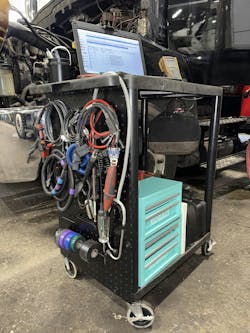
At its most advanced, a diagnostic cart can serve as a true mobile command center. A cart walkthrough from Jarhead Garage on YouTube shows just how far a diag workstation can be taken. The custom buildout houses scan tools, test equipment, and reference data in one centralized workspace. Add-ons include a modified side table for extra workspace, an attached boom arm to hold leads out of the way, and a mounted PC and battery backup. These highly built-out setups are designed to cut down on wasted motion by keeping everything a technician needs within arm’s reach.
The goal isn’t to load the cart with every tool in the shop, however. It’s to understand the role the cart needs to play, and build it accordingly.
The tool loadout you carry should also influence your choice of cart itself, with many options available on the market. Bigger isn’t always better, and things like mobility and access are key aspects of how well your diag cart will serve you. For example, Missy Albin, technician at Taylor and Lloyd International, learned through trial and error just how much the wrong setup, and even the wrong cart, can impact your workflow.
“I thought that having a larger selection of tools with me would make me more efficient, more organized,” she said. But the size and loadout were too much.
She noticed this and pivoted, scaling down her tool loadout, which also allowed her to downsize the cart itself. She now uses a lighter composite cart from Luxor that she says is easier to maneuver and navigate within the shop.
“I found that having this composite cart with no top and without the metal, it’s more narrow, very easy to manipulate and push around into tight areas,” she continued. “I can bring it closer to the vehicles without having to worry that I’m going to damage somebody’s vehicle, their paints, or dent anything.”
Cart choice can also make a difference when it comes to organization and discipline, ensuring you only have space for what you need. Albin discussed her tendency to fill the larger cart she used previously just because she had the space to do so, even if the tools weren’t absolutely necessary.
“This cart has helped me stay cleaner because it’s smaller. I am now forced to only use the tools that I am usually using on most jobs, and it’s disciplined me to keep the tools that I’m not using constantly in my actual box rather than pushing the extra around.”
Where the cart will be used is equally important. Take a look at the terrain in your shop. If the floors are cracked or the cart needs to be maneuverable in outdoor environments, this will tell you how robust it should be. Larger wheels or heavy-duty casters can make it more versatile, and given the investment in diagnostic tools it carries, the cart should be sturdy and built to last.
Essential tools for a diagnostic cart
- Scan tool or diagnostic software
- Laptop or tablet
- Power strip or surge protector
- Battery maintainer / diagnostic power supply
- Extension cords
- USB hubs and charging cables
- Shop Wi-Fi or cellular hotspot access
- Test light
- Fault code databases and repair procedures
- Note-taking tools
- Quality multimeter
- Wiring schematics
- Test leads
- Breakout leads and probing kits
- DEF refractometer/test strips
- Mechanical gauges
- Breakout box
- Socket set with common sizes
- Flashlight or headlamp
- PPE (gloves, glasses)
Building the tool loadout
Once a cart’s purpose is settled on and you know what size you need, the next step is outfitting it with the essentials. These are the tools that technicians use in almost every diagnostic situation.
Access to OEM diagnostic procedures, wiring diagrams, and other service information is a good start. As a former lead technician, Nathan Herschbach, diagnostic product manager, Snap-on, noted that many repairs aren’t mechanical but require software updates or calibrations, making information just as essential as the tools themselves.
“Following the factory diagnostics tree on how to fix a vehicle error code is the fastest way to the fix, and you need shop information to get them and wiring diagrams,” he said.
As Hedman said, another crucial addition is the proper scan tool, laptop (or tablet), and cables to interface with the vehicle. A centrally mounted or easily accessible location ensures the tool is ready whenever it’s needed.
Albin prefers a laptop for most of her diagnostic work because the ability to have multiple windows open helps her multitask, though she says the portability of a tablet can be convenient.
“The laptop is tough and when closed, you’re less likely to break your screen, versus a tablet that would be easier to break,” she continued. “I have done that before by closing a driver door onto it. I didn’t see it.”
Johnny Chagoya, operations director and technician with Rush Enterprises, highlighted the importance of schematics when it comes to electrical confidence.
“If you don’t know what you’re looking at or what the connector looks like, you’re going to be lost,” he said. “You’re just going to be guessing, ‘What wire is this?’”
“A lot of carts often miss simple tools like a good test lead kit, DEF refractometer, or mechanical gauges,” Hedman detailed, “and of course, somehow the 10mm socket is always missing! When those few essentials aren’t within the technician’s reach, the diagnostic process slows down.”
Sidebar infographic - Essential tools for a diagnostic cart:
- Scan tool or diagnostic software
- Laptop or tablet
- Power strip or surge protector
- Battery maintainer / diagnostic power supply
- Extension cords
- USB hubs and charging cables
- Shop Wi-Fi or cellular hotspot access
- Digital multimeter
- Test light
- Breakout leads and probing kits
- Wiring diagrams
- Fault code databases and repair procedures
- Note-taking tools
- PPE
About the Author
 Lucas Roberto
Lucas Roberto
Lucas Roberto is a Senior Staff Writer and producer of multimedia content for Fleet Maintenance magazine. He holds a bachelor's in media production and a master's in communication from High Point University in North Carolina.