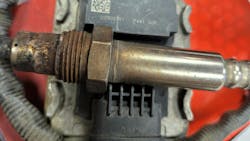
NOx sensors occupy a difficult position in modern diesel engine diagnostics, and few components sit at the intersection of regulation, technology, cost, and technician frustration quite like the NOx sensor. These sensors play a central role in emissions compliance, measuring nitrogen oxide levels in exhaust before and after selective catalytic reduction (SCR) and sending the data to the ECU. If that received data is out of tolerance, it may trigger warnings and fault codes and put the truck in derate mode. The root cause of these warnings could be any number of upstream problems, but oftentimes the technician decides to “shoot the messenger” and swaps the sensor out.
While legitimate sensor failures do occur, industry experts agree that unnecessary NOx sensor replacement remains a systemic problem, often done in haste and leaving the real problem unresolved. The main issues are “service misdiagnoses and swapnostics,” according to Raymond Parrish, current product support leader for the Cummins Components business segment.
And at a price tag of several hundred to over a thousand dollars per replacement, taking out the NOx sensor can be a costly misunderstanding. And with the industry prepares for EPA 2027 emissions-compliant engines, understanding how NOx sensors actually fail and how to service them correctly has never been more important.
So, let’s try to clear the air regarding these critical components.
Role of NOx sensors
Modern diesel emissions systems usually employ multiple NOx sensors, often positioned both upstream (inlet) and downstream (outlet) of the SCR system. Diesel vehicles typically use two to three NOx sensors, reflecting the need to measure both raw engine-out emissions and post-treatment effectiveness.
On the Detroit Gen-5 DD15, for example, the inlet sensor monitors NOx levels entering the aftertreatment system, providing baseline data for dosing strategies, while outlet sensors confirm SCR efficiency and regulatory compliance. This distinction matters when it comes to diagnostics because an outlet sensor reporting high NOx levels may be accurately signaling poor SCR performance, DEF dosing issues, or catalyst degradation, not a failed sensor.
Phasing out the swapnostic approach
At some point, all NOx sensors will need to be replaced. For example, a Cummins X15 sensor could last anywhere from 50,000 to 150,000 miles, with higher severity of service and poor aftertreatment system maintenance reducing its lifespan. But in the past, technicians might not consider a sensor’s lifespan when dealing with aftertreatment issues in favor of resolving alerts. This meant that the answer to NOx fault codes has typically been to first assume the sensor is bad and see if engine issues persist with a new one.
Things have improved on the OEM side, though, “NOx sensor replacements in recent years have dropped significantly with improvements in sensor designs, optimized placement, and refined control strategies,” Parrish offered.
Compared with other service events, NOx sensor issues are relatively rare, said Mike Young, powertrain and safety product marketing manager at Daimler Truck North America, saying, “While they can occur, they are among the least frequent service items.”
However, the picture appears to be quite different from the aftermarket perspective. Steve Hoke, president of Diesel Emissions Service, sees NOx sensors replaced in large volumes, often without addressing the underlying cause.
“As an aftertreatment parts supplier, we sell several thousand NOx sensors annually,” Hoke related. “It seems like it’s the go-to sensor to replace without looking for the actual cause.”
This disparity reflects a core issue in aftertreatment service. After all, many NOx sensors are replaced not because they have failed but because they are reporting a problem elsewhere in the aftertreatment system. Technicians and fleets just need to be prepared to find these issues instead of defaulting to the easiest solution.
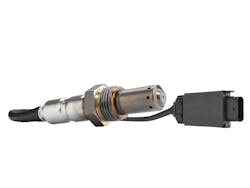
The root cause of unnecessary replacement
Because NOx sensors are designed to measure system performance in accordance with EPA guidelines, a fault code may indicate that the aftertreatment system is not operating efficiently, not that the sensor has failed.
“It is important to follow published troubleshooting trees to determine if a replacement is actually needed,” Cummins’ Parrish emphasized.
Bosch Engineering Manager Roop Majumder added that wiring issues are frequently misinterpreted. “A wiring failure may trigger fault codes, but in some of these instances, technicians may mistakenly replace the sensor instead of addressing the faulty wiring,” he said.
For Hoke, high-mileage engines introduce additional variables to sensor health. “Engine wear can allow combustion, oil, or fuel past the piston rings,” he explained. “Many factors can contribute to either the NOx sensor failing or needing replacement because it shows readings outside its given parameters.”
Young, meanwhile, pointed to delayed action as another contributor. “Ignoring fault notices from the system can allow problems to escalate beyond the initial issue, affecting other components in the aftertreatment system,” he said.
Real causes of NOx sensor failure
Despite their reputation, NOx sensors are relatively robust. When they do fail, the cause tends to fall into a few well-defined categories:
Environmental and contamination factors: Water is one of the most common enemies of electronics, and NOx sensors are no exception.
“Water is known to transport material that can block the internal chambers from proper operation and cause damage to the sensing element,” Parrish said.
Several other factors can cause a NOx sensor to fail as well, Hoke added. “The most common include soot and carbon buildup on the sensor head, moisture or heat damage, or contamination from DEF,” he said. “Weather and external corrosion cause issues with sensors because these units depend on an exact voltage to operate properly.”
Electrical and signal-related failures: According to Bosch’s Majumder, modern NOx sensors contain their own electronic control unit, which is capable of diagnosing internal issues. “Electrical failures occur when there is no signal, a short circuit, or an open circuit, often due to wiring damage,” he explained.
“Slow response faults can be triggered when sensor gas entry holes become clogged,” Majumder added. “Offset and gain failures occur when contamination or degradation alters the sensor’s baseline or sensitivity, leading to inaccurate readings.”
Additional note: The symptoms indicating a bad NOx sensor are consistent across all manufacturers. Whenever a malfunction criteria exceeds thresholds, the engine control module intervenes, and a Check Engine Light will be displayed to the driver and technician, Parrish said.
Best practices for Nox sensor service
As diesel aftertreatment systems become more integrated, NOx sensors will increasingly function as system health monitors rather than standalone components. Still, one point is consistent across all sources—NOx sensors are not routine maintenance items.
“The NOx sensor will only need replacement if the Engine Control Module flags a fault code that requires so,” Parrish said.
Every expert also stressed the importance of adherence to published troubleshooting procedures. In addition, technicians should use the correct service manual for the engine platform, review warnings carefully, and rely on fault trees that may have been updated since their last service event.
At Bosch, Majumder advised technicians to reference the sensor’s internal ECU and use OBD-II scanners to identify the specific fault type before replacing any component.
“Poor engine maintenance can shorten sensor life dramatically,” he said. “And irregular oil changes, incorrect oil specifications, and delayed component replacement can be major contributors to contamination.
“Conscious use of fuel additives is another way to prolong the life of a NOx sensor,” Majumder continued. “The use of manufacturer-recommended fuel additives ensures the sensor is not exposed to unwanted chemicals and prevents poisoning. This also helps by creating a cleaner combustion process, preventing soot and unburned fuel from interfering with or contaminating the sensor.”
In addition, it is important to consider fuel quality. Jessica Crabtree, director of technical services for Power Service, explained the influence of seasonal challenges can indirectly affect NOx sensors.
“During winter months, some fleets rely on anti-gel agents with little detergency, allowing injector deposits to build up,” Crabtree said. “Poor spray patterns lead to incomplete combustion, excess soot, overloaded DPFs, and increased stress on sensors. Preventive fuel system cleaning can reduce soot accumulation and protect aftertreatment components during cold-weather operation.”
Hoke emphasized the importance of ensuring that the installation is done properly.
“The best practices are to follow the manufacturer’s recommended torque values and to keep the lead harness free from kinks or sharp bends,” he explained. “Always use quality fuels, operate the engine at the correct temperature, and service your DPF and EGR systems as recommended."
Role of NOx sensors
Modern diesel emissions systems usually employ multiple NOx sensors, often positioned both upstream (inlet) and downstream (outlet) of the SCR system. Diesel vehicles typically use two to three NOx sensors, reflecting the need to measure both raw engine-out emissions and post-treatment effectiveness.
On the Detroit Gen-5 DD15, for example, the inlet sensor monitors NOx levels entering the aftertreatment system, providing baseline data for dosing strategies, while outlet sensors confirm SCR efficiency and regulatory compliance. This distinction matters when it comes to diagnostics because an outlet sensor reporting high NOx levels may be accurately signaling poor SCR performance, DEF dosing issues, or catalyst degradation, not a failed sensor.
New technologies bring new demands
As the EPA 2027 emissions standards approach, NOx sensors will operate within increasingly sophisticated aftertreatment architectures. Part of the new regulations relates to cutting NOx down 82% from current standards, while the other aspect deals with useful service life.
“To meet 2027 EPA standards, some engine manufacturers are using dual SCR substrates to increase efficiency,” Steven Hoke, president of Diesel Emissions Services, explained. “Others are adding heaters to the exhaust stream, along with more efficient turbochargers and EGR systems.”
Cummins, for example, will use a Twin Module aftertreatment system with parallel exhaust flow to reduce backpressure. The new aftertreatment system will incorporate 5kW electric heaters powered by a 48V alternator.
“The purpose of the heating system is to directly add thermal energy to the aftertreatment system, ensuring that the catalysts operate at optimal temperatures,” said Raymond Parrish, product leader, Cummins Components business segment.
Even with the changes, Cummins states that the modular design will make the engine more serviceable and configurable to various chassis.
International Motor’s EPA27-compliant S13 Integrated Powertrain does not have the heaters, but also uses a dual-stage SCR and smart DEF dosing. International is adding an Ammonia Slip Catalyst NOx sensor, which takes into account if the SCR is getting too much DEF and the unreacted ammonia ought be oxidized.
Volvo’s EPA27 NOx sensor has a new sensing-head design with primary benefits on the controls side.
“Previous-generation NOx sensors required a delayed activation on cold start to allow exhaust condensation to clear, which limited early control authority,” Duane Tegels, product marketing manager at Volvo Trucks North America, explained. “The new design is dewpoint-free and activates very rapidly after engine start, enabling earlier and tighter control of both the engine and exhaust aftertreatment systems.” He added the NOx sensor meets or exceeds the MY2027 useful-life requirement of 650,000 miles.
Specific details will be announced soon on Detroit’s Gen 6 heavy-duty powertrain and Paccar’s MX engine to meet upcoming standards.
About the Author
 Seth Skydel
Seth Skydel
Seth Skydel, a veteran industry editor, has more than 41 years of experience in fleet management, trucking, and transportation and logistics publications. Today, in editorial and marketing roles, he writes about fleet, service, and transportation management, vehicle and information technology, and industry trends and issues.