Common hydraulic system failures and how to detect them
Key Highlights
- Contamination from leaks and debris can cause premature component failure; routine oil sampling helps detect issues early.
- Hoses and fittings are the most common points of failure; proper routing and regular inspections can extend their lifespan.
- Heat buildup damages hydraulic components; larger reservoirs and cooling systems can mitigate excessive temperatures.
- Regular filter changes and cleaning are essential to prevent cavitation and maintain oil quality, reducing system wear.
- Listening for unusual noises and conducting visual inspections can help diagnose problems before they lead to system failure.

If you’re waiting for an energy provider’s aerial lift truck to fix a downed line this spring, or a construction crew to widen a road on your morning commute, it could be because a hydraulic hose was left on duty for too long or an oil drain interval was ignored, and the system failed. Remember that without a functional hydraulic system, work trucks are just trucks. Buckets don’t rise, and cement mixers don’t spin.
It’s another example of the maintenance butterfly effect, where small mistakes or neglect compound over time to impact thousands of people. As Kenneth Calhoun, fleet optimization manager for Altec, notes, these are often part of a larger crew, including digger derricks that set the poles to cable placer trucks, and if you remove one piece, everything is brought to a halt.
“If there’s not one on standby, which, as you know, there very seldom is, then now you’re down the crew,” Calhoun said.
With hydraulics vital to a vast majority of vocational equipment, the teams responsible for their maintenance must prioritize this system’s upkeep as much as the powertrain that moves the vehicle to the jobsite.
That doesn’t always seem to happen, according to Tucker Dally, general manager at Hydraulic Specialty, Inc., based on nearly three decades of experience.
“I’ve always said that hydraulic systems are like A/C systems; no one seems to service them until they fail,” Dally said.
Rick Ball, service manager for Summit Truck Bodies, relates the system to the cardiovascular system and heart: “When it’s healthy, you don’t
even notice it’s working. When it skips a beat, everything stops.”
That includes revenue. “If the oil isn’t moving, the money isn’t coming in,” he added.
However you want to think of the hydraulic system, it’s clear failure is not an option. To get ahead of issues that cause downtime, we caught up with leading hydraulic experts to identify where to focus preventative maintenance and inspection efforts, and how to better identify root causes.
Root causes at a glance
What the hydraulics do and how the engineers design each system vary widely, but according to Dally, the main culprits for failure include hoses, cylinders, valves, pumps, and PTOs.
The individual root causes range from ignoring oil and filter change intervals to squatting squirrels, which regimented preventative maintenance and inspections can alleviate. But keep in mind hydraulic set-ups are rarely identical due to design constraints and engineer preference.
“Each engineer has their own idea that can be laid out differently with the same outcome of operation,” Dally said. In addition, problems at one end of the system could originate upstream. Hydraulic Specialty strives to obtain the manufacturers’ hydraulic schematics, which “can lead you
in the right direction much faster and is usually available from the manufacturer,” Dally said.
He said that technicians should also diagnose each component independently. If not, you may fall into the swapnostics trap.
“A bad relief valve or a slipping clutch in a PTO can act like a bad pump,” Dally offered. “Eliminating that potential issue may save you from replacing a good pump.”
And just like a doctor can listen for heart irregularities, a tech can often hear what’s wrong with the system.
“If you’re hearing a clunk in the cylinder, that could be something like the piston and the head are hydraulically locked,” said Josh Stevens, director of engineering at Texas Hydraulics and Hydromotion. A popping noise could indicate a problem with cylinder design, he added.
Ball, meanwhile, said cavitation “sounds a lot like running a blender full of marbles.”
Also, try to see beyond the visible issue to the real root cause. Mike Klepac, product manager at Hydromotion, recalled an instance where a technician crew working on refuse vehicles tried to compensate for the loss of system efficiency by cranking the relief valves above the recommended 3,500 psi. He said that it got to a point where the engine was burning through fuel.
It turned out the crew failed to check the hydraulic oil, which would have saved a lot of time and effort. It turned out someone in purchasing got a good deal on the fluid, but it was the wrong viscosity, Klepac recalled.
(Stevens said you should never adjust relief valves to exceed OEM standards, and tamper-resistant caps can prevent this.)
Leading causes
Hoses
Knowing the most common causes can help speed up diagnostics and repair.
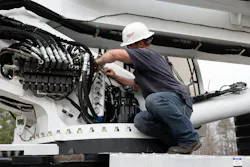
Kelsey Eisenhut, who leads Altec’s hydraulic reliability and repeatability team, offered that hoses and fittings “are by far the most common points of failure.” These are wearable parts that will need to be replaced, but “where and how they are routed and secured makes a big difference in their life,” she said.
Eisenhut said that clearance issues may be difficult to spot when the truck is at rest, but look for potential rub points and where hoses may be too close to heat sources.
Technicians need to be aware of how the different mounted accessories can increase risk.
“Hoses can rub in their channels and in trucks with telescopic booms, and are very costly to replace,” Dally said.
Hector Varela, fleet supervisor for San Antonio-based CPS Energy, noted that crane arms are more preferable homes than trees for some varmints, which can also damage and chew hoses.
“Birds and critters tend to get in these booms, just to stay warm,” Varela explained.
Oil leaks are a telltale sign of these feathered or furry intruders. To detect any and all hose issues and potential leaks, CPS Energy performs monthly and quarterly inspections in-house, and has a third-party perform the annuals.
Without that due diligence, a major leak could spring, Varela said, potentially stranding an operator in the air.
Contamination
The other problem with leaks is what can enter the system.
“Where the oil leaks out, contamination or air can enter, causing early component failure,” said Brad Gulick, commercial product manager for mobile power products for Eaton Mobility Group.
Poor fluid condition is commonly missed by fleets, Summit Equipment’s Ball said. “You can have a reservoir that’s full, but if that oil is contaminated or heat-damaged, it’s basically liquid sandpaper running through your system.”
Gulick said contamination and heat are directly responsible for premature pump failures, and a reason why the industry sells 2.5 times more pumps than PTOs.
“Dirty or overheated oil will cause havoc through a whole system you will be chasing for a long time,” Eisenhut noted.
Calhoun added that replacing a pump incurs a significant replacement cost, and the service event overall “is going to be pretty intense, because once that pump fails, now you’ve got metal throughout the system, and you’ve got to get that cleaned and purged.”
Aside from the general PMs, such as changing hoses when needed and cleaning the vent cap at the reservoir, fleets should make sure to keep up with filter changeouts. Gulick advises to always swap these during PMs and write the install date on the filter. Dally suggested annual filter changes at a minimum.
“One of the best things you can do to reduce downtime is to properly maintain the hydraulic oil filtering system,” Gulick said. “Clean oil is happy oil.”
Dally explained that air within the system causes cavitation, which “is devastating in a hydraulic system.” Aside from leaks, an incorrectly sized filter creates a high-vacuum situation where these bubbles form. Dally recommended shops have a flowmeter rated for 40- to 60 gpm and 3,000 to 5,000 psi to detect if something is restricting proper oil movement.
Water can also enter via leaks, degrading performance and reducing pressure, but Gulick noted that in the winter, some people think it’s a good idea to intentionally thin the hydraulic oil with diesel fuel. It is not, as it undermines lubrication and may eventually cause major systemic failure, he said.
Heat buildup
As mentioned, excessive heat also wreaks havoc and stresses the system’s capacity to cool the oil.
“If your system runs hot, it’s because the system most likely wasn’t designed properly, and heat will take a toll on all components, causing early component failure,” Gulick said. A larger reservoir or hydraulic cooler can mitigate this. “The general rule of thumb is to have a reservoir two times the output of the pump,” he explained, so if the pump operates at 15 gpm, the minimum reservoir size should be 30 gallons.
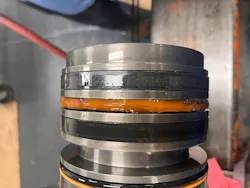
Oil can slip by worn piston seals and put the cylinder in bypass, limiting performance and putting the equipment in a dangerous state. This generates heat, and Dally advised having a thermal imager on hand to locate failed cylinders.
Dally offered that as a benefit of keeping the temperature under 140 degrees F, the system’s oil can last longer.
Stevens noted that Texas Hydraulics provides higher-rated packages for extreme environments, with ratings up to 212 degrees F for seals.
Importance of oil sampling
Altec’s Calhoun believes a lot of hydraulic issues can be solved with routine oil sampling.
“Just like engine oil, hydraulic oil sample analysis is maintenance 101,” he said. “If you’re not doing it, you’re missing a really good opportunity to understand how your fleet’s performing and to reduce the opportunity for catastrophic failures.
His team has to be even more aware of the bulk storage, as Altec builds bucket trucks and has to fill the systems. “It’s amazing to me how much foreign material can be introduced just in the refilling process,” he noted.
As Altec was refining its oil sampling several years ago, Calhoun realized many third-party testers could not meet the necessary dielectric standards for its insulated equipment. They did ultimately connect with APEX Oil Labs. APEX provides a detailed breakdown of every type of contaminant and particle count, with descriptions of the fluid tested. This can reveal any seal or breather issue, or other areas that need to be addressed, Calhoun said.
Eaton’s Gulick agreed that oil sampling can quickly assess what is wrong with the system.
“High brass content can indicate the wear plates in the pump are going bad, and the condition of the pump is not good,” he explained.
Just looking at the oil can reveal a lot. Darker oil means dirt and dust, while shiny specs are from metal wear. Milky oil that dissipated over time indicates cavitation, while if it does not, it is likely due to the presence of water. Too much heat will give the oil a burnt smell.
These are solid indicators, but should not replace lab work, which offers a very clear ROI.
“One catastrophic failure will probably pay for a year’s worth of oil sample analysis on your entire fleet,” Calhoun said.
Gulick said one of the best strategies is to simply listen to the truck’s operators.
“If they say the system is running slow or just isn’t the same, look into it right away,” he concluded. “This will save you downtime and money.”
About the Author
 John Hitch
John Hitch
Editor-in-chief, Fleet Maintenance
John Hitch is the award-winning editor-in-chief of Fleet Maintenance, where his mission is to provide maintenance leaders and technicians with the the latest information on tools, strategies, and best practices to keep their fleets' commercial vehicles moving.
He is based out of Cleveland, Ohio, and has worked in the B2B journalism space for more than a decade. Hitch was previously senior editor for FleetOwner and before that was technology editor for IndustryWeek, and managing editor of New Equipment Digest.
Hitch graduated from Kent State University and was editor of the student magazine The Burr in 2009.
The former sonar technician served honorably aboard the fast-attack submarine USS Oklahoma City (SSN-723), where he participated in counter-drug ops, an under-ice expedition, and other missions he's not allowed to talk about for several more decades.