Challenge accepted: Diag techs turn problems into new tools
Key Highlights
- Custom diagnostic tools can help technicians identify intermittent engine faults that standard testing may miss.
- Technician-built tools can reduce physical effort and save time on repetitive maintenance tasks.
- Real-world testing, technician feedback, and 3D printing help refine specialty tools for commercial vehicle repairs.
During a frustrating repair in the bay made harder by an uncooperative tool, my fellow diagnostic technicians and I may wryly joke that the engineers “got it right on paper.” It would have been nice if they also got it right in the real-world application, too. That’s where it counts, and we need tools that we can rely on to help us get through the troubleshooting and repair process.
But this is not always the case, and that leads us to sometimes take matters into our own hands, making tools that will help us on the job. Throughout my 20+ years as a diesel technician, I have come across an abundance of homemade tools that were heated, welded, cut, bent, soldered, and brazed to get the job done.
Because tool innovation is really just another form of troubleshooting—how to do something better, faster, safer—it’s an area several technicians I’ve met have excelled in. And because part of being a good diagnostician is repeating what works, here are a few examples that could inspire the next great diag tool.
Tools need to evolve with the trucks
Coming into the electronic era of the mid-’90s, International techs needed new tools to diagnose electronic engines such as the T444E and DT466E. Joe Dougherty, service manager/mentor at my employer Taylor and Lloyd, developed a diagnostic tool to run a hot cylinder contribution test while the engine was cold. The point of the test was to see if every cylinder was working properly, or if any were skipping. The test wouldn’t run if the coolant was under 160 degrees F. But sometimes the skipping would go away when the engine heated up, so it was difficult to identify the root cause. Dougherty had a novel solution.
“I thought I could trick the engine ECM into thinking it’s hot, and we could locate the bad injector,” he explained. After finding the value the ECM wanted to see, he recreated it by combining a potentiometer and an old coolant temp sensor.
“I could plug that in and then run the cylinder contribution test with the engine cold,” he said.
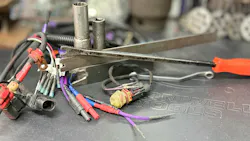
After seeing Dougherty’s invention, I created a breakout adaptor that added terminal leads to bridge the gap between the oversized component and the sensor ease installation and removal. And I still use that tool for cold engine skips, as well as any sensor that I may need to change the value of to run tests.
Since then, I have been inspired to make more breakouts, voltage drop/load, and test leads. Being able to keep my tools organized is a must, so I also color code the wires for a little extra efficiency.
Innovation born of necessity
Karl Lahodny, a diagnostic tech at Cumberland International in Florida, started creating new tools when he was 20. Back then in the ’90s, he was figuring out how to best repair front axles and perform alignments. During kingpin replacements, he would have to “beat them out” and thought there had to be a better way. There was—a kingpin press. He didn’t know that and created his own. It worked on only one style of kingpin but got the job done.
After that, he was inspired to make more tools. One was a coolant pressure tester. These typically require manual pumping to verify if the coolant system is holding pressure and help find leaks or a bad cap.
“I had a wave of engines that had coolant leaks, and having to pump all day was exhausting,” Lahodny explained. He decided to make one that ran off shop air instead, which he made by disassembling a manual pressure tester and adding a pressure regulator and two gate valves he bought from Home Depot.
He fine-tuned it using the same troubleshooting methods he does on far more advanced systems today. He slowly adjusted the pressure until the intermittent pops from the cap turned into a steady high-pitched hum to indicate the system was building pressure.
Lahodny recalled that other techs came over and asked, “What the hell is that sound?”
He said they “were impressed and wanted to disassemble their pressure testers and copy mine, so they didn’t have to manually pump anymore.”
Lahodny has kept on inventing, saying terminal test lead kits are the easiest—and a good use of time. If you bought a kit, you may spend up to $800 and may never use most of them. He reasoned it’s better to make the ones you will use on your own.
He did caution that if you do invent your own tools, be careful who you tell. He built a tool—basically a nut welded to a pair of vice grips to attach a slide hammer and help remove an engine block pin. He saw a commercial on TV asking inventors to contact them to help commercialize it. He said he emailed them and they responded that Lahodny would need patent lawyers to help him. He didn’t have time for that and abandoned the idea. Four years later, he saw an ad during a Hot Rod TV show selling a tool that looked exactly like his.
“I was devastated thinking my idea was stolen and could not prove it,” he shared. “There was nothing I could do.”
The development process
While that has deterred Lahodny from trying to patent the tools he creates, he still likes the challenge of trying to invent new ones. His thought process of deciding whether to do that or not includes if a similar tool is available in the shop and if it is easy and affordable to make.
International has a more formal process to develop the specialty tools that Lahodny, myself, and others use. That team for Lead-Tech/Tool Development is headed by David Bialas, a project manager at International Motors.
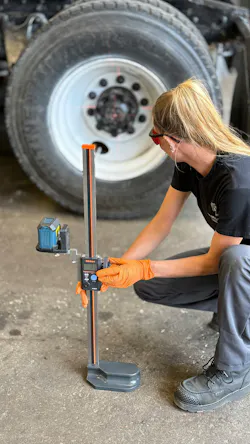
His favorite he designed was a ride height tool.
“It’s basically just a height gauge with a laser level attached to it, but the problem it solves is big in my book,” he explained. “Those who know International vehicles know that measuring ride height can be very tedious, with additional math and getting under the vehicle. With the tool, ride height can be measured quickly in under a minute on each side, all without the need to get on the floor.”
These tools have a rigorous process before being finalized.
“The first step is to design something that gets the job done correctly,” he said. Revisions can come from validation tests or technician or supplier input.
“Every tool goes through a blind survey-type validation in-house,” Bialas said. “We give our technician the tool and a manual-style written instruction, and we don’t explain anything about that tool to simulate a real-world first-time experience a technician would have.”
Bialas also added he now uses 3D printing to make the in-house development process faster and easier, using additive technology for basic tools such as dimple dies for pressing, or tubing holders as cutting jigs for certain angles.”
He added that 3D printing, 3D modeling, and scanning are all more approachable now for any tech looking to make their job easier while also taking on a new challenge.
“Everything is available to learn about online these days and can potentially advance your career one day,” he concluded.
About the Author
 Missy Albin
Missy Albin has been recognized by International Trucks as “one of the best technicians in the network” and is the OEM’s Female Technician Ambassador for the Tech EmPowerment recruitment program. She began working on diesel trucks in 2004 and joined International in 2009 at an IC dealership. While pregnant in 2017, Albin continued to work in the shop and even earned her Master Truck Certification during that time.