Bosch, Kodiak partner to scale autonomous trucking
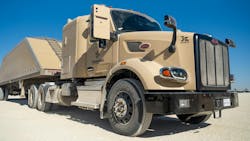
In 2018, Kodiak was one of many tech start-ups vying to break out with a practical self-driving truck. After many years of testing and tweaking—and other autonomous vehicle companies falling by the wayside—the company's fully driverless RoboTruck fleet is out in force, delivering more than 7,300 loads for Atlas Energy in the American Southwest. Kodiak, which went public in September 2025, also has partnerships with C.R. England, J.B. Hunt, and Werner.
This all proves the technology can work in real applications. The next major hurdle is whether these driverless trucks could be reliable and still allow fleets to make their margins. A new partnership with Bosch to scale the highly sophisticated hardware and software seeks to do just that.
Kodiak AI and Bosch are partnering on manufacturing and scaling Kodiak’s vehicle-agnostic autonomous platform, Kodiak Driver, a solution that can be factory-installed or upfit. As part of this agreement, Bosch will help produce integrated hardware, firmware, and software interfaces for a “production-grade, redundant autonomous platform,” according to Kodiak. These include sensors and steering components.
“Advancing the deployment of driverless trucks and physical AI not only requires robust autonomous technology, but also manufacturing experience and a robust supply chain in order to achieve true scale,” said Don Burnette, founder and CEO, Kodiak. “We believe collaborating with Bosch will allow us to scale autonomous driving hardware with the modularity, serviceability, and system-level integration needed for commercial success for both upfit and factory-line integration.”
Bosch will support the production of Kodiak’s AI-driven software and vehicle-agnostic hardware platform by supplying several hardware components. These include sensors and vehicle actuation components, like steering technologies.
"By supplying production-grade hardware, we are enabling the next generation of autonomous trucking alongside Kodiak,” said Paul Thomas, president of Bosch in North America and Bosch Mobility Americas. “Kodiak has already deployed trucks with no humans on board in commercial operation and this cooperation gives us a valuable opportunity to deepen our understanding of real-world autonomous vehicle requirements and to further enhance our offerings for the broader autonomous mobility ecosystem.”
Fleet Maintenance's take
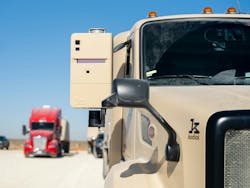
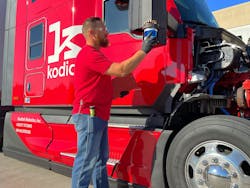
On the maintenance side, Kodiak relies on remote diagnostics and over-the-air updates to catch issues, and the sensor technology is packed in SensorPods, modular units that can be swapped out as opposed to having a technician troubleshoot any problems with the array. Humans can also inspect the tractor-trailer before departure and upon arrival at the programmed destination. Flesh-and-blood support personnel can also take remote control of a vehicle at any time, such as to pull the truck to the side of the road if there's a tire blowout.
The flat, arid Permian Basin is akin to learning how to drive in an abandoned mall parking lot. Questions still remain on how the technology will perform in unforgiving conditions, such as in the mountains or on icy highways. With the way AI has developed, it's hard to predict if and when that challenge will ever be solved. It could be next year or 50 years from now for all we know.
What AVs have working for them in the near-term is that they at least can comprehend road signs and are always watching the road, something that can't be said in certain states that hand out CDLs like they are participation trophies.
According to an audit by the Federal Motor Carrier Safety Administration, one in three non-domiciled commercial driver’s licenses issued in Minnesota was issued illegally.
“Minnesota failed to follow the law and illegally doled out trucking licenses to unsafe, unqualified non-citizens—endangering American families on the road," noted U.S. Transportation Secretary Sean P. Duffy last month.
If it comes down to driving next to one of these "unqualified" CDL holders or an AV, we might take our chances with the robot. At least we know it's not wearing flip flops.
What do you think?
About the Author
 John Hitch
John Hitch
Editor-in-chief, Fleet Maintenance
John Hitch is the award-winning editor-in-chief of Fleet Maintenance, where his mission is to provide maintenance leaders and technicians with the the latest information on tools, strategies, and best practices to keep their fleets' commercial vehicles moving.
He is based out of Cleveland, Ohio, and has worked in the B2B journalism space for more than a decade. Hitch was previously senior editor for FleetOwner and before that was technology editor for IndustryWeek, and managing editor of New Equipment Digest.
Hitch graduated from Kent State University and was editor of the student magazine The Burr in 2009.
The former sonar technician served honorably aboard the fast-attack submarine USS Oklahoma City (SSN-723), where he participated in counter-drug ops, an under-ice expedition, and other missions he's not allowed to talk about for several more decades.