Motive Maintenance bridges critical fleet data to limit unplanned downtime
Key Highlights
- Automates work order generation based on fault codes and inspection results, reducing manual data entry and errors.
- Provides a single-pane view of vehicle health, fault history, and maintenance spend, facilitating proactive decision-making.
- Uses AI to interpret fault codes into plain language, offering technicians detailed context for faster diagnostics.
- Tracks warranty status and maintenance history, enabling better planning and cost control.
- Supports predictive analytics by analyzing fault trends and parts replacement patterns to prevent future failures.
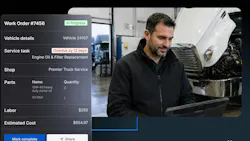
After a fleet’s maintenance system registers a fault code or driver-reported defect, how fast and efficiently a shop can resolve the issue depends on proper communication and coordination. But keeping track of various fault codes and driver maintenance complaints, while also scheduling preventative maintenance items, is easier said than done for the many understaffed shops and overworked fleet managers. Critical work can and does slip through the cracks, allowing what would be relatively minor downtime to spiral into lengthy and costly repairs.
To help these teams stay ahead of repairs and control costs, Motive launched Maintenance, a new AI-powered product within its integrated physical operations platform that links inspection and vehicle/asset health data with the repair workflow and spend to enable a far more proactive approach to maintenance.
At a high level, Motive Maintenance, the seventh product within the AI platform, serves as a bridge between the fleet and shop. It does this by providing a single-pane view of fault codes, inspection results, maintenance workflows, and spend data, ensuring that a single unit is receiving prompt repairs while also tracking warranty status and offering insights into larger maintenance concerns.
"With Motive Maintenance integrated directly into the broader Motive platform, organizations have a comprehensive and early picture of a vehicle’s health, which allows them to proactively address issues before they become costly failures,” said Hemant Banavar, chief product officer at Motive. “This means fewer breakdowns, less downtime, and real savings on every vehicle and asset they run.”
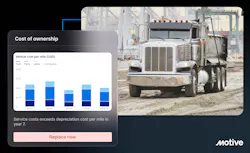
These unplanned events are helping drive up maintenance costs, which, according to Torque by Ryder, average around $450 to $760 per day, with $1,000 in extreme cases. Torque also estimated fleet vehicles get sidelined about nine days a year from unplanned downtime.
Motive Maintenance came together in only a few months and was partially spurred by a recent "State of Fleet Maintenance Report" the company conducted. The survey found 80% of fleet respondents noted significant gaps in their system integrations, and only 13% agreed that their systems were well-integrated.
“Fleets are actually struggling with disconnected systems,” explained Sriteja Kolluri, staff product manager at Motive. “A lot of them still use spreadsheets, and even those who use connected solutions put a lot of manual effort into entering, reconciling, and transferring data.”
According to the study, half of respondents said they spend 6 to 20 hours on these manual processes per week, with about 29% not tracking the metric.
Because Motive Maintenance automatically generates work orders based on accurate vehicle data, this saves on manual entry while ensuring accurate data for the shop to work on. Those records are stored and can be mined for myriad analytics purposes at any time.
This allows managers to predict and mitigate critical issues when the work order is generated, along with the priority level.
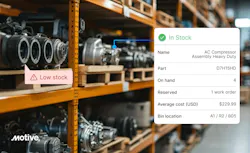
“A lot of deep dives can be done, because all of the data that we are now building with Motive Maintenance also sits in Motive Analytics,” Kolluri said. “That allows customers to diagnose some of these bigger questions, like what parts are being replaced the most? Then they actually see the fault codes from these vehicles and come up with a predictive analysis.”
How Motive Maintenance works
On a per-event basis, certain data from an inspection (via the Motive Driver app DVIR), fault code, or scheduled service will trigger the automatic creation of a work order and alert the maintenance team, explained Kolluri to Fleet Maintenance. The rules are customized by the fleet, he added.
“The severity of the issue also is completely configurable: Major or minor,” Kolluri said. “It is mostly pass or fail, but with a tire, there could be four different issues. Instead of just marking it as pass or fail and then adding a text description, you can enforce your driver to select a specific option as to what problem has occurred.”
Once a work order is resolved, the system marks the job complete on the DVIR.
Because the fault code data comes in as plain code, which is hard to interpret, the AI switches to a simple-language description, allowing the platform to add far more context.
“If you have a work order created with that fault code, what we do is basically give detailed insights into how many times the fault code occurred, what it actually means, and the criticality,” Kolluri said. “We interpret that again based on various rules, so you will actually know if this is something that you need to immediately address.”
The technicians also receive important contextual data to enable a more informed diagnosis, including DTC timestamps and even GPS and engine RPM at the time.
“When they're opening the work order, they would view all that information, including when the DTC was first observed and when it last occurred,” he said. “They don't even have to open a different diagnostic screen for that. You can do that entire investigation within Motive Maintenance.”
Kolluri added that the system also assigns relevant Vehicle Maintenance Reporting Standard codes: “It becomes very easy to make a category-based analysis of what type of action was performed and really slice and dice information and identify what are my most problematic categories, what actions were performed on those specific parts, and were they replaced more often?”
About the Author
 John Hitch
John Hitch
Editor-in-chief, Fleet Maintenance
John Hitch is the award-winning editor-in-chief of Fleet Maintenance, where his mission is to provide maintenance leaders and technicians with the the latest information on tools, strategies, and best practices to keep their fleets' commercial vehicles moving.
He is based out of Cleveland, Ohio, and has worked in the B2B journalism space for more than a decade. Hitch was previously senior editor for FleetOwner and before that was technology editor for IndustryWeek, and managing editor of New Equipment Digest.
Hitch graduated from Kent State University and was editor of the student magazine The Burr in 2009.
The former sonar technician served honorably aboard the fast-attack submarine USS Oklahoma City (SSN-723), where he participated in counter-drug ops, an under-ice expedition, and other missions he's not allowed to talk about for several more decades.