Rising costs, regulations top list of fleet concerns, Fleetio says

According to Fleetio's 2026 Fleet Benchmark Report, a majority of fleets (54.4%) identified rising costs as their top concern. This topped the list, followed by regulations and emissions mandates (46.1%). The transition to EVs and related infrastructure (35.1%), technician shortages (32.5%), and parts and vehicle availability (28.9%) rounded out the top five.
Respondents were able to select multiple concerns.
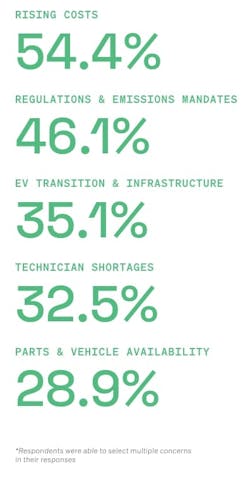
The order of these top concerns should not come as a surprise. In the last three years, fleets have had to deal with a historically long freight recession, combined with tariffs imposed by the current administration and inflation that ballooned during the previous one. They are bringing in less money, while parts and equipment are more expensive. Fleets also must navigate changing emissions requirements and the impact on EV adoption, as well as persistent labor shortages. Together, those forces make it harder to execute maintenance plans consistently and predictably.
"OEM quality issues, technician shortages, and inconsistent vendor performance add pressure, while rapid regulatory and technology changes are outpacing infrastructure, training, and clear total cost visibility,” explained one fleet manager who completed the survey.
Maintenance consistency
When it comes to completing jobs on time, most fleets describe themselves as capable, but not optimized.
About 44.3% of respondents say they “do a decent job” with room for improvement. Another 25.6% consider themselves good at performing maintenance on time. Only 9.7% say they are great at it.
This middle-heavy trend extends to the type of maintenance itself, with nearly half of fleets (48.0%) reporting that their work is split evenly between scheduled and unscheduled repairs, and just 6.7% describing their environment as fully scheduled.
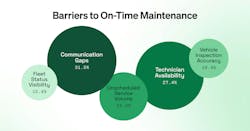
But when fleets miss targets, the issue isn’t a lack of knowledge—it’s in execution. The most cited barriers to on-time maintenance were communication gaps (31.5%), technician availability (27.4%), and unscheduled service volume (25.2%).
The tools themselves are changing too, with high adoption of fleet and telematics software, although most organizations still work in multi-system environments that blend digital tools with manual processes. Administrative burden remains significant: 25.9% of fleets spend 1-2 hours per week on manual data entry, 24.1% spend 2-4 hours, and 21.3% spend 4-8 hours. Another 13.8% report 16+ hours.
Artificial Intelligence
AI continues to generate curiosity, but many are still skeptical. More than half of fleets are using the technology to some extent, with 35.1% researching and 18.2% piloting solutions. However, only 5.6% report broad AI usage today.
The hesitations center on trust and data. Accuracy and reliability concerns were reported by 50.8% of respondents, while 43.3% pointed to general trust and confidence issues. Another 37.7% said human oversight is still required, and 35.2% expressed concerns about data quality.
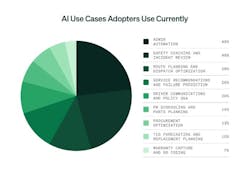
The takeaway is not resistance, but caution. Fleets are willing to experiment with AI, but adoption at scale will depend on proven reliability. The use cases that non-users were most interested in were service recommendations and admin automation, while the use cases most reported by adopters were admin automation and safety coaching.
About the Author
 Lucas Roberto
Lucas Roberto
Lucas Roberto is a Senior Staff Writer and producer of multimedia content for Fleet Maintenance magazine. He holds a bachelor's in media production and a master's in communication from High Point University in North Carolina.