Parts, labor costs fall 1.3% to round out 2025, says Decisiv/TMC report
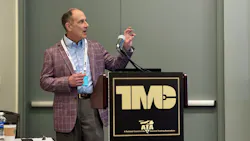
NASHVILLE—After a sharp increase in Q3 2025, combined parts and labor costs dropped 1.3% in Q4, according to the latest Decisiv/TMC North American Service Event Benchmark Report, presented at the 2026 TMC Annual Meeting & Transportation Technology Exhibition.
The quarterly decrease was driven largely by a 2.6% drop in labor costs, alongside a smaller 0.4% decline in parts costs. Following a 3.8% increase in Q3, this decline may be the result of improving service efficiency across fleets and shops.
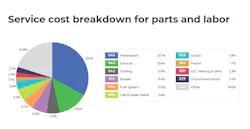
Costs were up in 10 of the 25 VMRS systems that Decisiv tracks, 7 fewer compared to last quarter.
Parts pressure remains
While the quarterly dip in parts costs is good news, the long-term trend still points upward, with Q4 2025 combined parts and labor costs rising 2.0% year-over-year. This was almost entirely due to parts, which increased 3.7% YoY, while labor costs decreased by 0.4%.
“A similar theme lately—parts are driving up the cost, and labor is the moderating function,” noted Robert Ziemba, Decisiv VP of marketing, who presented the data.
In recent years, labor costs have had to rise across the board to mitigate the technician shortage with higher wages. So why did labor drop in Q4? Ziemba suggested that the decrease in both parts and labor at the end of last year was due to shops simply improving workflows and using service data more effectively.
“Fleets are facing increased cost pressures on parts and labor for their service costs, but they're actually doing a great job in moderating those cost increases,” Ziemba explained. “While transportation costs are going up, it's not service and repair that's driving a lot of it.”
There were a few notable increases in combined parts and labor costs from Q4 2024 to Q4 2025:
- Axle Driven - Rear (022): 20.6%
- Wheels, Rims, Hubs, and Bearings (018): 15.5%
- Filter Kits (Multi-Piece) (047): 11.9%
Here are the significant decreases in P&L costs YoY:
- Aerodynamic Devices (004): -21.0%
- General Accessories (051): -5.3%
- Air Conditioning, Heating, and Ventilating (001): -4.6%
Long-term trends
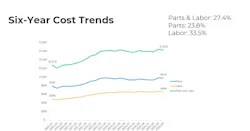
Looking at Decisiv’s data from Q1 2020 through Q4 2025, parts and labor costs increased significantly due to post-pandemic inflation, though this has begun to level off in recent years.
Overall service costs have risen faster than the general Producer Price Index (PPI), highlighting continued pressure on maintenance budgets.
The bottom line is that although cost pressure may be shifting, it isn’t going away. While parts costs may remain unpredictable and labor costs may stabilize, shortages persist.
“Given long term, persistent costs that fleets are facing, there's obviously tremendous value in driving efficiency, improving repair velocity, reducing downtime, and reducing repair time,” Ziemba noted. “That helps moderate those costs that fleets are experiencing.”
How the data is compiled
The data is based on Vehicle Maintenance Reporting Standards for the top 25 systems, which represents 97% of service events. Representing over 7 million commercial vehicles with about 615,000 service operations captured monthly, the data comes from Decisiv’s service relationship management (SRM) platform.
SRM Alliance
Also at TMC, Decisiv announced the launch of the SRM (service relationship management) Alliance, a new industry initiative aimed at standardizing and improving service management across the commercial vehicle ecosystem. Founding members include Decisiv, PACCAR, Isuzu, Hino, and technology partner KPIT, along with participation from dealer groups and other service stakeholders.
The effort also aims to eliminate a common pain point in fleet maintenance: jumping between multiple systems to track repairs, parts, and service status. By aligning on shared data standards and workflows, the group hopes to improve shop efficiency, speed up repairs, and give fleets better visibility into service events.
"Today you're working in 10 different platforms to try to get the right part, at the right place, at the right time," said Tim Hardin, president and CEO of Decisiv. "Everybody can race to try to make each one of those 10 better. Or you can define the finish line, and the finish line is one portal to service customers."