More shops feeling positive about diesel repair’s future, Fullbay report finds
NASHVILLE—Fullbay has released its 2026 State of Heavy-Duty Repair Report, and the data found within the 99-page guide should provide a confidence boost to diesel shop managers across the U.S. and Canada. The sixth annual report from the Phoenix-based shop management software provider mainly focuses on how shops operate their business and compensate employees, as well as offering insights into parts markups and how shops use AI.
The report, free to download at Fullbay.com, was created using responses from 900 respondents and data from thousands of Fullbay customers, with about 70% working at or owning independent repair shops. The median respondent age was 41, with 17% listing themselves as under 30.
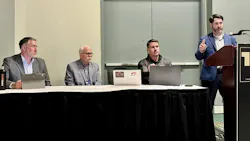
Fullbay CEO Trent Broberg revealed some of the findings at the American Trucking Associations’ Technology and Maintenance Council 2026 Annual Meeting during a panel with Peter Cooper, CEO and founder of Ascend Consulting, and Jack Poster, TMC’s VMRS service manager. [Editor’s note: Yours truly was the moderator.]
The main topics of discussion related to what the report said about average labor rates and tech pay, and how successful shops have responded to the dwindling supply of good technicians.
“Without this information, you're flying blind,” Poster said of the info found in the report. “So this really is a good piece of information for our members.”
Things looking up?
Tariffs, emissions uncertainty, and the freight recession gained a lot of negative attention in the industry last year, but despite the many industry challenges in 2025, three out of five said business was better in 2025 than in 2024.
“From what we're hearing preliminarily and seeing in the data, 2026 will continue that trend over ’25,” Broberg remarked.
The panel noted tariffs could have more of an impact this year, as last year's inventory levels hedged against the immediate impact of cost hikes.
The uptick in shop positivity was credited to a large number of shops “continuing to grow and finding new ways to drive revenue,” offered Broberg, now about six months into his role as CEO.
Cooper explained that growth comes from fleets holding onto trucks longer, as purchase price has continued to rise and truck maintenance has become more complex due to emissions and technology advances.
“A lot of fleets are kind of the secondary market,” Cooper said. “They really do not want to get rid of the old trucks because they're afraid of the newer trucks and some of the emissions. And honestly, they're very complicated to work on. The older trucks are just easier to fix.”
Broberg added that the four-year-long freight recession has also made it more difficult to buy new equipment. During this past sluggish cycle, fleets even parked underutilized tractors and trailers for long periods of time, likely relaxing preventive maintenance to triage active equipment.
But as the economy picks up momentum, “you're seeing people pull those trucks off the fence, and trailers with lot rot,” Broberg said.
Now the challenge is to conduct inspections, make repairs, knock off rust, and get them on the streets making money again, he offered. That means more business for shops.
Labor rates
Broberg noted that the topic of labor rates is “the number one question” Fullbay is asked about. And that makes sense, as the number greatly influences both fleets and shops. And yes, the number continues to rise year over year as quality service becomes more valuable and more costly to perform. The survey indicated the median rate hit at $145/hour in 2025, for a 7.4% increase YoY. That’s also 16% more than what Fullbay reported for 2023.
Cooper, who frequently visits shops across the country, said the tech shortage is a big reason why.
“Honestly, across the board, labor rates have to go up because there's a very small pool of qualified people, and it's basically like an auction block at this point,” he explained. “And guys are leaving for a $1 an hour raise. They'll leave a shop and go across town—it's crazy.”
Cooper added that the specialization of technology on the trucks (such as advanced driver assistance systems) requires shops to invest in more repair and calibration equipment, while the combined costs for repair software subscriptions also increase expenses.
On the mobile maintenance side, the labor rate was $160/hour, rising 10% YoY. This factors in that 1 out of 10 mobile providers said they charge a mileage fee.
A little less than half agreed their rates match competitors, while a third said they charged less, and 7% charged more. Half of the shops assess their labor rates annually, while one in three exceed that. According to the 2025 SOHD report, 44% assessed labor rates twice or more per year.
Fullbay noted that 12% don’t check their rates. That’s almost double the 7% who reported not assessing in the previous year. It’s not the exact same shops that answer each year, but this is a number Fullbay believes should be low, as those who do not know what to charge for labor “could be leaving money on the table.”
For those unsure of how often to assess labor rates, Fullbay has an information guide available on their site.
Employee compensation
The rising labor costs were driven by the need to attract and retain technicians. The median hourly rate was $33 in 2025, a 10% hike over 2024. In the U.S., the Western states topped the list at $35/hour, while the Southwest had the lowest at $31/hour. Canadian techs reported a median of US$30.50/hour.
Cooper noted tech pay is “increasing almost 3 times past inflation over the last year; [shops are] just spending more money to get these qualified people.”
Top Shop concerns
Even though a majority feel the repair sector is improving, it’s not without nagging problems to overcome. The top five concerns in the Fullbay SOHD were:
- Technician shortage/hiring qualified staff: 43%
- Increased operating expenses such as rent, utilities, and insurance: 43%
- Managing cash flow/profitability: 39%
- Rising parts and labor costs: 36%
- Customer retention and competition: 28%
Benefits also play a big role.
“It's not about just the cost and the salary or hourly wages that you're providing your workers,” Broberg said. “It's more about the entire package. Are you providing benefits? Are you providing 401 (k)'s? Are you able to provide them with bonus structures and variable-based pay?”
The bottom line is that shops need to remain competitive in this respect to maintain productivity.
“If you're dealing with five or six technicians in the shop, think about it, if you lose one, that's a pretty big hit,” Poster offered.
The VMRS manager also noted that techs talk to each other.
“Technicians from shop A know what's going on in shop B,” he explained. “They know what [other] technicians are making; they know what the benefits packages are. So you get them a little upset, they can say, ‘See you later,’ and go over to Company B.”
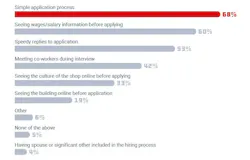
Cooper added that aside from culture, “transparency of pay” is equally important. Shops should not be afraid to list wages on job postings, he reasoned, because not listing pay at all is more detrimental.
Broberg agreed, noting there was “a 26% point gap on if you're actually posting the wages that you're hiring at, versus not—that's the biggest predictor of whether you're going to hire technicians or not.”
When applying for a job in a shop, what makes a good hiring process?
Culture’s impact on staffing
Though wages are going up, the technician shortage/hiring qualified staff topped the report’s list of top shop concerns, with 43% choosing it. The survey found 57% also reported being understaffed.
A bright spot was that more than half said their annual technician turnover was under 10%. This indicated to Broberg that many shops are starting to value culture more. Nearly half of respondents said shop culture was the most important factor in technician job satisfaction, even beating out pay (36%).
“I think what you find are different classes of shops, shops that are culture rich, shops that are paying top or median tier for their technicians, the Fullbay CEO said.
Shops should be able to answer why a tech would want to work for them, Cooper said, because “We see the employers that have a good answer to that do not have the hiring problems that the other stores have.”
One final dose of positivity: Fullbay found that 75% of the technicians would recommend their shop to somebody else to work there. WrenchWay’s 2026 Voice of the Technician Survey, comprising 85% auto techs to 13% diesel, was practically the inverse, with 70% not likely to recommend the technician trade to a friend.
“If you use the Net Promoter Score in this industry versus automotive repair, we are way better off than they are, which means there's actually an opportunity here for fleets and shops to steal some people from the automotive field, because most automotive techs are not happy with their job,” Cooper concluded.
About the Author
 John Hitch
John Hitch
Editor-in-chief, Fleet Maintenance
John Hitch is the award-winning editor-in-chief of Fleet Maintenance, where his mission is to provide maintenance leaders and technicians with the the latest information on tools, strategies, and best practices to keep their fleets' commercial vehicles moving.
He is based out of Cleveland, Ohio, and has worked in the B2B journalism space for more than a decade. Hitch was previously senior editor for FleetOwner and before that was technology editor for IndustryWeek, and managing editor of New Equipment Digest.
Hitch graduated from Kent State University and was editor of the student magazine The Burr in 2009.
The former sonar technician served honorably aboard the fast-attack submarine USS Oklahoma City (SSN-723), where he participated in counter-drug ops, an under-ice expedition, and other missions he's not allowed to talk about for several more decades.