Service orchestration through data connectivity
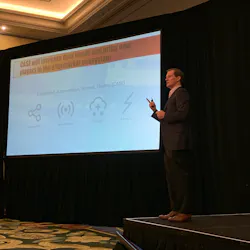
Heavy Duty Aftermarket Week (HDAW) 2020, held in Dallas, Texas this week, conducted educational workshops providing information for the pressing industry topics of today and tomorrow. One such workshop was titled, “What connected service management means for your customers,” presented by Rob Bradenham, senior vice president, commercial vehicles, Decisiv, Inc. The focus of discussion included data connectivity, predictive analytics, and a future entailing automated servicing practices.
“Data is the new bacon,” Bradenham’s presentation began.
The analogy implied that data is everywhere, and it is best served and utilized at the right time, place, and with the right people. The heavy duty truck market is no exception, as assets and operations create a vast data set. Data is being produced, tracked, and analyzed by original equipment manufacturers (OEMs), enterprise resource planners (ERPs) and other enterprise systems, customer call centers, service providers, dealerships, fleet managers, fleet management systems, telematics and diagnostic devices, drivers and operators, and more.
“For truck service to work efficiently, all of this data has to come together,” Bradenham said.
Currently, many in the heavy duty truck industry are experiencing data communication chaos; as data is produced, its value is lost when analytics are sent to dead-ends, filed away, and not utilized to their potential. Or worse, a disconnect from the data source to those able to act on the data never occurs. Bradenham said that the solution will come from a concept defined as CASE – Connected, Autonomous, Shared, Electric. The industry will have to focus on CASE practices so that all the data produced is circulated to all involved parties to streamline data sharing and make data utilization easier.
The cost of data communication chaos is realized when the technician in the bay that is servicing assets is not given the insight that comes from data analytics. For instance, the results of an oil analysis history from a vehicle a technician is servicing are never received. This disconnect could be resolved by providing the technician these results, but it would be better served through predictive analytics and automated ordering, scheduling, and communication.
The future, Bradenham said, will be a fully connected system. As vehicles become further equipped with sensors, telematics, and data-producing elements allowing them to detect failure or service warnings with precision, predictive analytics-driven through software developments will be the linchpin of more automated service practices.
Eventually, the sensors on the vehicle will not only be able to let a fleet know when it is time for the oil to be changed but will send that information to a maintenance management system. This system will schedule the service for that oil change, order the necessary quantity of oil, and track delivery of that oil, all while running the information against the oil analysis history that the vehicle has produced and implementing any necessary adjustments to the entire service process.
Data connectivity and sharing will not only occur within a fleet and its assets, but also to the fleet's suppliers, service partners, dealerships, and any and all involved in the service process. Bradenham closed the presentation by emphasizing that connectivity and data sharing will deliver service orchestration, actualizing insight into action.
About the Author

Tyler Fussner
Associate Editor | Fleet Maintenance
Tyler Fussner is Managing Editor - Community Manager at Supply Chain Connect, part of the Design & Engineering Group at Endeavor Business Media.
Previously, Fussner served as the Associate Editor for Fleet Maintenance magazine. As part of Endeavor's Commercial Vehicle Group, his work has been published in FleetOwner magazine, as well as Bulk Transporter, Refrigerated Transporter, and Trailer-Body Builders.
Fussner's May 2022 print feature 'The dawn of hydrogen trucks' was named the best single technology article in B2B by the judges of the 2022 Folio: Eddie and Ozzie Awards. Fussner was also awarded Silver in the Technical Article category for the Trade Association Business Publications International (TABPI) 2021 Tabbie Awards.
Fussner previously served as Assistant Editor for Endeavor's Transportation Group on the PTEN, Professional Distributor, and VehicleServicePros.com brands.
Fussner studied professional writing and publishing at the University of Wisconsin-Whitewater. He has experience in shop operations, is a Michelin Certified Tire Technician, and a Michelin Certified Tire Salesperson.