Penske makes techs comic-book heroes with training overhaul
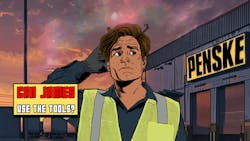
Penske Truck Leasing recently overhauled its training programs, updating its online training module and making its technicians the heroes in a new educational comic book. In the story, technicians watch as everyman James Santiago goes to his first PM class, engaging new trainees with knowledge and a hero’s journey-esque story before they set foot in the bay.
“We went with the narrative as a way to gain and hold interest,” said Andy Howat, manager of Maintenance Training Solutions, Penske Truck Leasing. “As you read through the comic book, you get taught the things that they're going to teach you. You begin to learn at square one, so that by the time you're with the person, you're primed.”
Trainees start their experience with the comic book on their first day, which acts as a primer to the training they’re about to experience with drawn characters doing maintenance tasks combined with photographs of Penske tools and equipment. Meanwhile, the characters are going through their own training journeys, as the trainees soon will.
The updated program goes through four stages: Orientation through Tool School, instructor-led training, another round of Tool School, an online exam, and a final qualification. This way, the comic book and Tool School all prepare trainees for their first in-person experience with their tools and equipment.
 Measuring fleet KPIs
“We are always looking for ways to meet the learners where they are,” said Holly Gerke, VP of Maintenance Technical Training & Development, Penske Truck Leasing. “And Andy was able to do that in a much more powerful way than we have before, because he made it more personal.”
Tool School and its sidekick comic book
Tool School and the comic book come in French Canadian, Spanish, and English, with Tool School starting as an animated module that’s something like a cross between a video game and a movie. New technicians sign in to the module, then their animated ‘character’ enters the school, listens to a principal’s orientation speech, then goes to class. Then, the program switches to videos of their technical trainers, and the module becomes a first-person learning instructor. But throughout the video training, Tool School rotates between shots of the trainer and shots of the technicians' animated classmates, with the animated characters asking the trainer questions and participating.
“The whole goal is, if you're a Penske associate and you're in Tool School, you forget that you're sitting at a computer watching a course,” Howat emphasized. “You feel like you're in the room. That was the goal.”
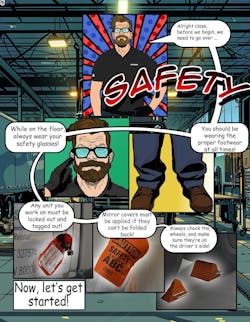
This way, the trainees “remember” going to class with the characters in the comic book, creating a cohesive narrative. But Penske sacrificed none of the accuracy in favor of creativity.
“We had to make sure [the comic book] was interpreted in a way that was accurate,” Gerke noted. “You use the comic book… so there wouldn’t be a lot of room for a technician to misunderstand information.”
To do so, Howat said his team focused on setting up the most challenging parts of, for instance, preventative maintenance inspections, including learning several new tools. The comic book lets technicians see images of each new tool, how it’s used, and even what can happen if they aren’t used correctly. Then, the back cover also includes a crib sheet for each tool, sort of like collectible Pokémon cards.
“We were pin-point accurate with those tools and those vehicles in the comic book,” Howat added.
Origin story
Howat’s team first came up with the idea of an immersive, educational comic by taking inspiration from the U.S. military.
“We knew that the US Army uses [comics] for training,” Howat stated. “So with that, we started down the road of, ‘Okay, how can we use color illustrations as well as a teaching methodology?’”
With this question in mind, Howat worked with Matthew Bandy, Penske’s only Regional Content Curator, to develop the story. They started by going to a comic store and pouring over Scott McCloud’s “Understanding Comics” and other graphic novels to better understand how to hammer out the narrative they wanted.
Then, they went “back and forth with the scripting” to build out their story, Howat recalled.
Finding a dedicated audience
While Gerke characterized the comic book as a “bold, brave way” for the company to revamp its training program, all of Bandy and Howat’s work paid off. Like the latest issue of “Batman,” Gerke and Howat noted that “The Maintenance Field Guide” comic was so popular that they couldn’t keep it on the shelves. It was so popular that they’re making another issue, this time focusing on another role in the organization, she said.
“When you receive feedback that's in the form of an action, like the consumption of this, [that’s when] we knew we were on the right track,” Gerke concluded.
About the Author
 Alex Keenan
Alex Keenan
Alex Keenan is an Associate Editor for Fleet Maintenance magazine. She has written on a variety of topics for the past several years and recently joined the transportation industry, reviewing content covering technician challenges and breaking industry news. She holds a bachelor's degree in English from Colorado State University in Fort Collins, Colorado.