Continental Express secret to weathering recessions? Consistency.
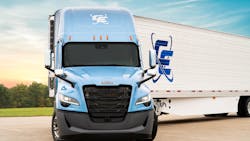
As Russell Gottemoeller tells it, he started Continental Express—now a mid-sized reefer fleet out of Sidney, Ohio—because the double-dip recession of 1981-1982 didn’t leave him many options.
Russ, like most at the time, didn’t have as many job prospects as he’d like. But he did know trucks, and more importantly, had an entrepreneurial spirit and motivation to create jobs for his family and many others. Back in 1976, he started running four trucks and drivers off his father’s farm. He went on to lease 10 tractors to another company. The heavy economic pressure was too much for that lessee, though. They went bankrupt, and the units needed a new home. That turned out to be Continental Express, Inc., which Russ founded in 1984.
Russ believed that simple things like putting in an honest day of work to support your family and taking care of your staff and customers would get him through any rough patch. And he sees starting during a time of economic hardship as a long-term advantage.
“Coming into this industry in a challenging market has given us a foundation of hard work and anticipating changes to stay a step ahead of the curve,” Russ asserted.
It’s never been easy, but the fleet always lives to fight another day by sticking to a few simple rules, allowing them to control their own destiny: They own their own equipment, self-insure, and do nearly all maintenance in-house.
Continental Express has kept its strategy unchanged, though it has steadily grown, now comprising 560 or so Class 8 trucks, 1,400 reefer trailers, and 150 dry van trailers. It’s perennially named a Best Fleet to Drive For by Carriers Edge and also earned the Tyson Foods’ 2025 Rising Star Carrier of the Year Award. Russ is now CEO, and his son Bradley Gottemoeller serves as president. And as Russ intended, the family business employs hundreds of workers across its 10 terminals.
Sticking to the basics and counting pennies
Despite the Class 8 market dropping sharply in 2025, Continental did what they always do: buy 50 new trucks. More specifically, they purchased 50 of the latest “Fifth Generation” Freightliner Cascadias. These MY2026 Cascadias feature a modest fuel efficiency bump and several driver safety systems enhancements. A dozen were added to the fleet as of late October.
In the fleet’s existence, the Gottemoellers have bought 1,000 total Freightliners, the first being a 1974 FWT. They know what they’re getting from Daimler—reliability and simplicity. Working with one make also keeps things simple for the fleet’s 75 technicians, training team, and parts counter, too.
And they should get their money’s worth with the new trucks. The 2016 Cascadias they are replacing have odometers nearing a million miles, the equivalent of two round-trip jaunts to the moon. The older a truck gets, the more attention it needs in the shop, so that is an instant upgrade to uptime.
The fleet's fuel costs should also see some improvement. Brad said early data from last October and November show their MY2026 Cascadias do even better than the 1.9% baseline improvement over the previous generation, getting 7.85 MPG versus around 7.3 MPG for the ’23 and '24 models—a 7.5% increase. The Fifth Gens also have an array of ADAS bonuses, which we cover in the video below.
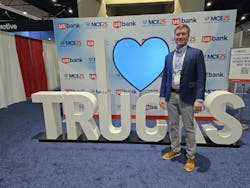
But having enough capital to buy several dozen new trucks a year, even during a historic freight recession, is not rocket science. They practice patience and prudence and “stick to the basics,” Brad told Fleet Maintenance at American Trucking Associations’ Management Conference and Exhibition in San Diego this past October.
“We always preach, ‘If you watch the pennies, the dollars will come,’” Brad explained, noting it has been a constant battle, especially during this nearly four-year-long freight recession. “We really just try to home in on the details every day.”
That starts with managing where the trucks operate based on age. At 500,000 miles, trucks transition to local routes and return home to one of the ten terminals each night. Five, including the Sidney location, have maintenance shops, so the tractors are routinely inspected on a weekly basis in addition to scheduled PMs. Oil sampling through Shell Rotella is another frequent occurrence to detect issues.
Brad is a stickler for details, so to make sure all expenses on the older trucks are wise ones, they judge what replacement parts to use on a case-by-case basis.
“Our maintenance director will send me an email like ‘Hey, this truck's got 657,000 miles on it and the transmission went out. Do you want to look at OEM or go aftermarket?’ And he provides a list of options.”
If they can’t justify certain expenses, they may scavenge a good DPF off another truck rather than buy a new one, just to get it in the trade-out cycle.
Conversely, if an older truck has performed better than expected without needing much maintenance, the fleet will invest in it and run it for a couple more years, Brad said.
When asked if Brad was scouting any new technology at the trade show for the service department, like predictive maintenance or AI tools, Brad commented that vendors' pitches often involve spending $50,000 on their technology to recoup $100,000 in the long run.
“I could go broke if I bought all these things out here that would ‘save’ me money,” Brad offered.
As a reefer fleet that has to keep moving, Continental Express is not in the position to take a flyer on what’s shiny and new, like AI. They prefer human technicians’ eyeballs inspecting the tractors and trailers.
“If you're waiting for something to happen, or you're just looking at the data, trying to make a decision, a lot of times it can pass you by,” Brad said.
Instead of getting wrapped up in new data tools and subscriptions, he said the family’s strategy is to “be really lean and mean on what [they] need to do,” and that’s focusing on the three core values of safety, service, and communication.
Safety and efficiency
Safety technology is one area the fleet will invest heavily in and is always looking to upgrade. Most of that has to do with keeping billboard lawyers at bay.
“We have everything to lose, nothing to gain,” he said of the current legal abuse epidemic attacking trucking. “[Plaintiff lawyers] have everything to gain, nothing to lose. They can file a lawsuit—even when they know it's probably bogus.”
They have used Netradyne dashcams since they’ve been available, and have a dedicated employee who monitors alerts for egregious driving behavior, like frequently taking their hands off the wheel or eyes off the road. For serious problems, the drivers are contacted immediately. Management also receives a weekly engine data report from DTNA engine data to show risky driving behavior, like harsh acceleration.
Back in 2017, multiple drivers quit over the dashcams. But then one of the biggest anti-dashcam drivers in the company, who stayed, got into an accident. It wasn’t his fault, and the video backed that up.
“He went from the biggest [opponent] for it, to being our company advocate [for dashcams] a year later,” Brad recalled.
Brad also hopes someday a vendor or OEM will add an alert for drivers staying in the left lane too long, as most of the fleet’s accidents occur in the passing lane when a driver is getting too aggressive.
He wants drivers to “be the stone in the stream in the right lane—even if [the vehicle ahead] goes down to 60 mph, it's better than trying to go around and pass it,” he said.
The fleet currently governs highway speeds to 64 mph during normal operation and 67 mph when adaptive cruise is on. Continental Express also had the techs reprogram the cruise control ECU so that it shuts off when the windshield wipers are active.
“If they're in inclement weather—snow, rain, and that—we don't want them on the cruise; we want them to be attentive,” Brad said.
Uptime and maintenance
According to Tim Braun, Continental Express director of maintenance, the drivers communicate issues through their iPads in the cab, calling a dispatcher, or even stopping by his office in Sidney.
“Between these methods, we are able to keep our downtime to a minimum and keep our drivers moving so they can keep making money,” Braun said.
He also has an open-door policy with techs. He keeps things simple, too. There are no scheduled one-on-ones, but he says he makes it a point to touch base with all the techs regularly “to make sure they’re taken care of.”

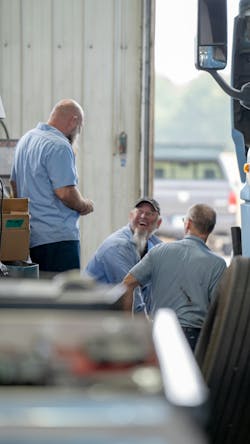
The median technician tenure is 6.5 years, with some having worked in the shop since the 1990s. He attributes their staying power to having good shop equipment, competitive pay, and good culture.
“It’s generally understood in the culture at Continental Express that hard work leads to rewards and there’s always room for advancement if they want to put the work in,” Braun said. “It’s important that everyone on the team is well-compensated for their jobs. I think that lends to job satisfaction, which translates into the work they do.”
The Gottemoellers believe in paying well, but have chosen not to offer productivity bonuses.
“We've looked into incentivizing through an attendance bonus, or you don't call off,” Brad said. “Our thought is we'd rather just reward you [with a raise] at the end of the year. We try to give the people who are showing up to work and doing a good job a larger raise.”
Training is also a big part of keeping uptime strong. They will fly techs in from other terminals to conduct Freightliner and Thermo King training, for example.
Brad noted that even lower-tier techs receive a good amount of training.
“Everyone has a role, and our tire changers and oil changers are just as important as our guys who can program,” Brad said.
And that might be the true secret to Continental’s staying power and resistance to recession. While saving pennies can shield a fleet from a few rainy days, its foundation built on discipline and self-determination keeps even torrential downpours from washing them away.
Do you think Fleet Maintenance should profile your shop or fleet? Email [email protected] and tell us why!
About the Author
 John Hitch
John Hitch
Editor-in-chief, Fleet Maintenance
John Hitch is the award-winning editor-in-chief of Fleet Maintenance, where his mission is to provide maintenance leaders and technicians with the the latest information on tools, strategies, and best practices to keep their fleets' commercial vehicles moving.
He is based out of Cleveland, Ohio, and has worked in the B2B journalism space for more than a decade. Hitch was previously senior editor for FleetOwner and before that was technology editor for IndustryWeek, and managing editor of New Equipment Digest.
Hitch graduated from Kent State University and was editor of the student magazine The Burr in 2009.
The former sonar technician served honorably aboard the fast-attack submarine USS Oklahoma City (SSN-723), where he participated in counter-drug ops, an under-ice expedition, and other missions he's not allowed to talk about for several more decades.