Rubber City Retread: Bridgestone opens Bandag Training Center in Akron
Key Highlights
- Bridgestone’s new $3 million Bandag Training Center will help fleets and dealers improve retreading knowledge and practices.
- Retread tires cost an average of 40% less than new tires, offering fleets significant equipment savings.
- Proper casing maintenance can extend tire life, increase retreading opportunities, and reduce fleet operating costs.
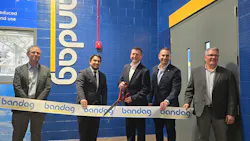
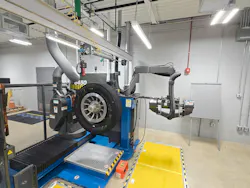
AKRON, Ohio—On October 29, Bridgestone officially opened a new Bandag Training Center at its Akron campus to educate industry professionals, including internal employees such as plant managers, as well as dealer and fleet personnel, on the full swath of retreading best practices. The 15,000-sq.-ft. facility includes a classroom and full retread shop that has everything needed to complete Bandag’s 10-step retread process. Bridgestone, which says Bandag has a 49% share of the retread market, invested $3 million in the center, which is part of the site’s tire test lab.
That corner of the building, previously used for storage, is now “able to deliver the entire suite of training that we offer,” said Brian Douglas, VP of retread solutions for Bridgestone North America.
Bridgestone also has the Bandag Learning Center in Muscatine, Iowa, where the retread company was founded by Roy J. Carver in 1957. Bridgestone had a retread training center in La Vergne, Tennessee, but all operations at the tire plant ceased last summer. Douglas said after “an exhaustive search,” the Akron site, also home to the Advanced Tire Production Center, was selected.
Along with Muscatine and Bridgestone’s headquarters in Nashville, the new Bandag center will also serve a role in developing new retreading innovations such as products and manufacturing equipment.
Recycling a Rubber City original
This location makes perfect sense to carry retreading into the future, as it’s also a retread of sorts. The building sits on the same foundation on which Harvey Firestone started his first major manufacturing operation in 1910.
Akron Mayor Shammas Malik, who cut the ribbon at the new center, noted that Bridgestone and Firestone are “pillars of the community.” The 35-year-old mayor especially feels that connection, having graduated from Firestone High School.
“It's such an interesting business model to be able to bring people in here, train them on the technology, and then be able to help the customers maintain their fleets,” Malik said, noting how retreads keep tires out of landfills and create a circular economy.
Akron is also working on refreshing its identity, as the mayor explained the city is working with Bridgestone and other private and public partners to build its Sustainable Polymers Tech Hub, which has the intent to replace natural rubber and oil-based materials with sustainable options.
Retreading alone goes a long way in sustaining precious raw materials. Retreading a heavy-duty casing requires 300 lb. less rubber than a new tire, or about 93%, according to a NHTSA/EPA study. Bridgestone noted that per year the retread industry also saves 217 million gallons of oil and keeps 1.5 billion lbs. of tires out of landfills.
Bridgestone: CSI
The retread industry also provides 51,000 jobs.
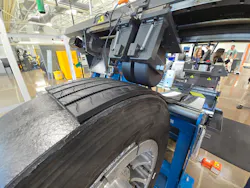
Mike Hazelrigg, manager of technical training and franchise support at Retread Solutions, likened the work of a retread technician to that of a forensic investigator. “It's like a crime scene. And you're trying to figure out what happened.”
Because the tires come in from trucks performing a wide range of jobs and environments, techs must inspect each for various types of damage. They check the condition of the steel belts, look for punctures from nails or other objects, and spot any other issues that could affect the tire's suitability for retreading.
And Bandag's hands-on training is centered around teaching them how to identify and solve these tire mysteries using the company’s modern production-scale equipment, which is connected by a seamless monorail handling system that carries the casings from buffing to curing.
Inside the Bandag retread process
Bandag uses a 10-step process to inspect, repair, and retread tire casings, extending their service life and returning them to the road.
1A. Initial inspection: Each casing receives a unique barcode for tracking throughout the process.
1B. Electronic inspection: Technicians inspect the casing inside and out, identifying and marking visible damage.
2. Shearography: Vacuum and laser technology reveal hidden casing damage and internal anomalies.
3. Buffing: Worn tread is removed, and the casing is reshaped and prepared for new tread.
4. Skiving: Damaged or rusted steel cords are removed to prevent potential retread failures.
5. Repair: Damaged areas are removed and repaired to restore the casing.
6. Applying cushion: An uncured bonding layer is applied to the prepared casing.
7. Building: New tread is applied and precisely centered on the casing.
8. Enveloping: The tire is placed in an elastic envelope and prepared for curing.
9. Curing: The tire is cured to permanently bond the new tread to the casing
10. Final inspection: Technicians perform a final inspection to ensure the retread meets quality specifications.
Because the equipment is continuously innovated with more automation added, Douglas said even retread experts who have been with the company for 30 years can get something worthwhile from the training.
“We're always developing new innovations with the retread equipment, so certainly somebody who's even been [with Bandag] for 30 years might have been doing a very manual process before. It might be more automated now, so they definitely will need training on that new piece of equipment,” Douglas said.
Re-educating fleets on retreads
Fleet leaders won’t be operating the shearography machine or buffing the casing, but they will learn how to efficiently conduct advanced tire analysis. On the classroom side, Bandag’s training team will provide ways to optimize their tires’ total cost of ownership.
“For fleets, we provide education on appropriate tire maintenance—everything from inflation to identifying irregular wear—to help them get the longest life possible out of their tires,” Douglas said.
He noted Bandag can retread casings (which do not have to be Bridgestone) as many as four times, with some casings reaching the million-mile mark.
“The better fleets maintain their casings, the more opportunities they have to retread those tires,” Douglas offered. “Retreading will always save a fleet money when it's coupled with a good, educated operator group in that fleet who is maximizing the life of those tires and those casings.”
According to an October report from research firm Marqstats, on average in 2025, a retread tire cost 40% less than a new tire: $243 versus $405. This equals a total of $3 billion in savings for U.S. fleets annually. Nine out of 10 fleets with over 100 trucks have retread programs, while only about a third of fleets under five trucks do.
One reason is that the tracking process may seem daunting to small fleets that have far fewer people and resources to handle maintenance.
“Retreading has traditionally required a lot of fleet sophistication to manage,” Douglas noted. “Smaller fleets maybe have been intimidated by that process of tracking them as assets in the past.”
As fleet management software expands and RFID tracking becomes more common, not to mention the workload a fleet can delegate to AI, it’s likely that in the near future maintenance tasks like running a retread program should become more manageable.
Douglas thinks that time is now.
“I think retreading is very accessible for any size fleet, whether you have two trucks or 200 trucks,” he said, advising that Bandag’s dealer network, which has 2,500 touchpoints, can assist fleets of any size. “They can help even smaller fleets create a retread program that can work for them and maximize the investment they've made in those tires.”
About the Author
 John Hitch
Editor-in-chief, Fleet Maintenance
John Hitch is the award-winning editor-in-chief of Fleet Maintenance, where his mission is to provide maintenance leaders and technicians with the the latest information on tools, strategies, and best practices to keep their fleets' commercial vehicles moving.
He is based out of Cleveland, Ohio, and has worked in the B2B journalism space for more than a decade. Hitch was previously senior editor for FleetOwner and before that was technology editor for IndustryWeek, and managing editor of New Equipment Digest.
Hitch graduated from Kent State University and was editor of the student magazine The Burr in 2009.
The former sonar technician served honorably aboard the fast-attack submarine USS Oklahoma City (SSN-723), where he participated in counter-drug ops, an under-ice expedition, and other missions he's not allowed to talk about for several more decades.