Longtime Freightliner customer shares first impressions of Fifth Generation Cascadia
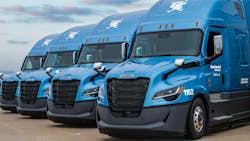
Class 8 truck orders closed out 2025 with a modest surge in December, but for most of the year, a prolonged freight recession and uncertainty around future emissions regulations kept fleets cautious about major equipment investments.
Continental Express was a notable exception. The Sidney, Ohio–based carrier purchased 50 model-year 2026 Freightliner Cascadias, consistent with its long-standing practice of buying 50 to 55 trucks annually.
Company president Brad Gottemoeller said the fleet maintains the same replacement cadence in boom times or busts. And because the fleet has about 560 trucks, this cycle means Continental refreshes roughly 9% of its mid-sized fleet each year.
Those Fifth Generation Cascadias replace 2016-model trucks that may be approaching one million miles. As equipment ages, the fleet reassigns those tractors to local routes. This way the shop can give them weekly inspections. Eventually, the maintenance burden outweighs the value of keeping them in service, and they head off to the secondary market. The steady churn ensures a continuous influx of modern equipment—and gives at least 50 drivers each year access to the latest safety and efficiency technology.
Since its founding in 1984, Continental Express has remained almost exclusively a Freightliner customer on the tractor side, purchasing more than 1,000 units over four decades. The first was a 1974 Freightliner FWT cabover. Operating a single OEM platform has simplified maintenance and parts stocking, allowing technicians to develop deep familiarity with the equipment while keeping inventory predictable and manageable.
While the Fifth Gen’s sleeker cab for better aerodynamics is the most obvious change on first glance, updates to the Detroit Assurance with ABA6 Suite of Safety Systems are what make the Fifth Gen stand out, according to company president Bradley Gottemoeller, with DTNA taking a giant leap forward in the ADAS department.
“It’s a complete upgrade,” he said, noting that Continental consistently specs the highest-level Assurance package. The fleet has repeatedly been named a CarriersEdge Best Fleet to Drive For, and safety technology is pivotal to that.
Gottemoeller pointed to smarter active braking that combines short- and long-range radar and can react to vehicles in adjacent lanes and around curves. He said the sensors are more accurate and generate fewer false positives—particularly with automatic braking—than earlier systems.
Enhancements include:
- Active Brake Assist 6 (ABA6), which uses 5 new short- and long-range radars, a new camera, and new software for full braking on moving and stationary vehicles, pedestrians, and cyclists
- Automatic Emergency Braking that improves active brake assist in multiple lanes, around curves, and vehicles positioned at angles
- Side Guard Assist to alert to objects and pedestrians from the front of the cab to the end of a standard trailer
- Active Side Guard Assist activates at speeds under 12 mph if no corrective braking comes after the alert
- Active Lane Assist 2 offers better lane keep assist, lane departure protection, and lane change assist
- Front Guard Alert uses radar to monitor for pedestrians when the truck is stopped or moving at low speeds and alerts the driver

“With some of the older collision mitigation systems, a sensor might misread an overpass and need realignment,” he said. “But even early on, I always told drivers that the number of false positives was tiny compared to how many times the system saved us.”
Founder and CEO Russell Gottemoeller echoed that sentiment. “The safety of our drivers is a top priority, and having additional technology to help them get home safely matters,” he said. Early feedback from drivers on the Fifth Gens has been positive.
One thing the fleet did not spec was the factory-installed MirrorCam system due to cost and current market conditions. Continental Express does employ Netradyne dashcams, though.
Efficiency upgrade
The new trucks also deliver measurable fuel-cost benefits. DTNA estimates that the aerodynamic updates—including a new hood, Max Aero Fender, and A-pillar reflectors—should improve fuel efficiency by about 1.9% over the fourth-generation Cascadia on a spec-for-spec basis. Continental’s early data suggests the gains may be greater.
Gottemoeller said the dozen or so MY2026 Cascadias the fleet had received averaged 7.85 mpg in October and November, compared with roughly 7.3 mpg for the fleet’s 2023 and 2024 models—a 7.5% improvement.
Why the discrepancy?
“Customers can see additional gains by optimizing spec choices available on the Freightliner Cascadia, such as aerodynamic packages, downsped drivetrains, axle ratios, low-rolling-resistance tires, and predictive cruise features,” said Lisa McKenzie, DTNA’s on-highway product marketing manager.
Operating discipline also plays a role. Continental limits highway speeds to 64 mph in normal operation and 67 mph when adaptive cruise control is engaged, a strategy that further supports fuel efficiency.
At 100,000 miles per truck annually and an average diesel price of $3.50 per gallon, a 7% fuel-efficiency improvement translates to roughly $145,000 in annual savings across the 50 new trucks compared with recent models.
According to ATRI, fuel accounted for about 21% of total cost per mile in 2024. Continental’s approach also benefits the maintenance share of CPM—$0.20 or about 9%—by keeping a fair share of trucks under that 500,000-mile mark where maintenance costs start to balloon. This helps the fleet manage maintenance and have steady uptime, while getting a taste of the latest and greatest technology.
And in 10 year’s time or so, those local drivers will get to enjoy those benefits, too.
About the Author
 John Hitch
John Hitch
Editor-in-chief, Fleet Maintenance
John Hitch is the award-winning editor-in-chief of Fleet Maintenance, where his mission is to provide maintenance leaders and technicians with the the latest information on tools, strategies, and best practices to keep their fleets' commercial vehicles moving.
He is based out of Cleveland, Ohio, and has worked in the B2B journalism space for more than a decade. Hitch was previously senior editor for FleetOwner and before that was technology editor for IndustryWeek, and managing editor of New Equipment Digest.
Hitch graduated from Kent State University and was editor of the student magazine The Burr in 2009.
The former sonar technician served honorably aboard the fast-attack submarine USS Oklahoma City (SSN-723), where he participated in counter-drug ops, an under-ice expedition, and other missions he's not allowed to talk about for several more decades.