As recall activity continues to rise across commercial vehicles, fleets are looking for ways to complete repairs without sidelining trucks for days at a time. Mobile service, better recall tracking, and improved communication between OEMs, dealers, and maintenance teams are becoming essential tools for keeping vehicles in service while addressing safety issues.
Steps to reduce downtime
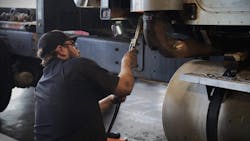
Mobile repair capabilities can help minimize downtime. Rush Truck Centers deploys mobile technicians, especially for a reflash or issues that don’t require parts. The company has also invested in training for specific campaigns, including a large-scale NHTSA recall that required a team of 80-plus certified welders and dye penetrant inspectors. The company also got equipment lists and locations, and deployed techs remotely to speed the repair process, Cummins said.
Thibodeaux said that Peterbilt helped coordinate mobile technicians to address a torque rod failure campaign that affected about 2,000 of Waste Connections’ trucks. Repair time for each truck dropped to just days, but would likely have resulted in weeks of downtime if the company had to take trucks into a dealership.
Ford Pro’s Hunt said the manufacturer has the largest mobile service fleet of any full-line automaker in the U.S. and, in many cases, services vehicles at customers’ locations.
GM also deploys repairs in the field through its MobileService+. “We are implementing a new process to assist our fleet customers with more robust field action notifications to increase awareness and encourage needed service,” McKee said. “The new process involves a more refined and targeted approach as we inform customers of field actions affecting their fleets and identify specific vehicles.”
Even with structured processes to alert customers and provide a fix, recall completion can be a challenge, especially as vehicles age and ownership changes. In the commercial vehicle space across light-, medium- and heavy-duty vehicles, there’s about a 70% to 75% completion rate after 18 months, Haunreiter said. For medium- and heavy-duty specifically, that increases to about 80%, on average.
Miller estimates that about 80 million vehicles with open recalls are on U.S. highways. Owners are often unaware of a recall, especially if they aren’t the first registered owner, because they may not have received information from the OEM.
Leo Connolly, manager of warranty processing and trend analysis at DTNA, said customer notifications depend on the type of remedial action being done, with recalls having mandated communications while service or warranty campaigns do not. “Customer notification relies on registration and ownership records,” he said, adding that DTNA applies multiple data checks to validate addresses and ownership information. “If initial notifications are unsuccessful, DTNA may use third-party support—within privacy requirements—to help identify updated registration data for follow-up notifications.
DTNA also monitors recall completion rates and may use additional outreach when customers have not scheduled the remedy. The OEM also supports dealers through ‘Open Campaign’ reports to coordinate outreach and service scheduling. “These reporting tools also allow visibility into broader maintenance opportunities across a customer’s fleet,” Connolly said.
In a written statement to Fleet Maintenance, Stellantis said that it uses multiple channels to communicate recall activity to dealers. In addition to mailing first-class letters to registered owners, as required by NHTSA, some Stellantis vehicles display recall notifications on their screens.
Bishop said Volvo uses a structured, multi-layered communication approach to ensure customers and dealerships receive information quickly and with the correct level of detail. “We’ve also upgraded our VIN look-up tool that gives both dealers and customers better access to recall statuses, even before a remedy is available,” she said.
Technicians at the Boston Public Works Department proactively check VINs through OEM systems. “We also monitor OEM alerts and NHTSA notifications and occasionally receive recall notices directly from dealerships by mail,” Pardo said.
The goal is always to complete as many repairs as possible in a single visit. Fleetio pulls U.S. safety recall information from NHTSA and alerts customers when there’s a new match to one of its vehicles based on year, make, and model, but the key is centralizing this information with other repair needs. “In a real operation, you’re dealing with breakdowns, driver-reported requests, PM schedules, inspections, faults, alerts, and yes, recalls. The hard part is keeping them from living in separate places,” Daneri said.
Whenever possible, Kenworth Truck Sales tries to couple a campaign or recall with regular maintenance and checks for open campaigns or recalls every time the vehicle is checked into any service department. “This also helps us partner with other dealers to complete campaigns and recalls on vehicles that were not sold by Kenworth Sales,” she said.
Rush has integrated with OEM systems and pulls recall and campaign information when a repair order is opened. Prior to the integrations, service advisors would manually search for open campaigns or recalls, Cummings said.
The change has more than doubled the completion rate on eligible campaigns from 30% to 62%. Rush also has dedicated personnel who keep track of open campaigns and alert customers. The dealership sends information out via its Service Connect communication portal and phone, text or email, but customers don’t always act on the alerts.
“Those who ask for the update are the exception,” Cummings said. “Most are either unaware or are pressed for time, and they will still occasionally decline a recall or a campaign, even when we prompt them because they’re concerned about getting the truck back on the road.”
Because downtime is a primary concern, Recall Masters reviews service bulletins and works with the repair facilities and technicians to determine how long a repair will take and the availability of parts. “It’s very manual and it involves us boots on the ground, because the manufacturer may say it is an easy repair and the technician says, ‘Yeah, it is easy after you spend six hours dismantling the engine,” Miller said. “We try to get to the truth of it.”
Sorting through the noise
Another factor contributing to unaddressed recalls is recall fatigue. “You’re blasting people, and they have a hard time differentiating from what’s important versus what’s not,” Miller said. As new events appear, Recall Masters prioritizes them based on parts availability, the number of vehicles affected, and urgency.
“I don’t believe that all recalls are created equal. For instance, you’ve got recalls because there’s a page in the owner’s manual that describes the operation of the vehicle differently. It would cause confusion, but it’s not a mechanical problem,” Miller said. “We call those nuisance recalls.”
Most fleets triage recalls based on severity first, then operational exposure. “If there is a clear safety urgency, especially anything that carries a strong consumer advisory posture, fleets tend to treat that as a front-of-the-line item. NHTSA tracks recalls that carry ‘Do Not Drive’ or ‘Park Outside’ consumer advisories, and that’s the kind of signal that typically drives urgency,” Daneri said.
After that, fleets assess which assets are mission-critical and highly utilized and plan the rest around the least disruptive windows they can find. To help manage the growing number of recalls and improve uptime, Waste Connections recently hired a warranty manager, and certifies its technicians to do warranty work in-house and is rolling out Fleetio software across its 306 maintenance facilities.
Waste Connections also handles some issues on its own, even if it doesn’t capture the warranty dollars. “If it is a windshield wiper arm, I’m not going to down a truck for three days for that to go to a dealer. We address it,” Thibodeaux said.
Recalls that are acknowledged or completed should be documented the same way a fleet would document any critical repair, “because teams change, assets move and the only thing that survives turnover is a clean record,” Daneri said.
OEMs said vehicle owners should take every recall seriously. “Failing to act on a recall can expose fleets and drivers to significant safety, operational, and regulatory risks,” Bishop said. “Unaddressed defects can result in the loss of critical safety functions, which also can cause higher exposure to operational downtime and unplanned costs.”
Haunreiter warned that unresolved recalls can cause secondary failures, resulting in significantly more downtime than making an appointment and getting the initial issue fixed.