How upfitting affects uptime: Why maintenance starts during spec'ing

In vocational fleets, uptime is rarely determined by what happens after a truck goes into service. It is shaped much earlier, during specification and design, and especially during upfitting. Every choice, from material selection and electrical integration to weight distribution and service access, directly affects how often a vehicle is available to work and how easily it can be maintained.
Across dealers, upfitters, OEMs, and fleet solution providers, the message is consistent: uptime is not accidental; it is engineered. When upfits are planned correctly, maintenance becomes predictable, diagnostics are simpler, and trucks stay productive longer. When they are not, downtime is inevitable.
And those problems are often in motion long before a technician ever
works on the vehicle.
Upfitting expert Leyhan Hansen, who puts out an e-newsletter
called The Upfit Insider, agreed that many of the downtime issues fleets struggle with years into a truck’s life are already embedded in the original specs.
“Most maintenance problems don’t start in the shop. They start at the spec sheet,” he said.

The biggest issues usually trace back to spec’ing decisions made in an effort to cut upfront costs, added Hansen, also government and fleet account manager for Pritchard Commercial.
Material choice is one of the clearest examples. For example, Hansen pointed to snow removal applications, where corrosion exposure is unavoidable. “If you’re building a snowplow truck and you don’t go stainless [steel], you’re setting that truck up to rot early. Salt doesn’t care about your budget.”
The same pattern shows up when it comes to equipment selection.
Hoist selection is an area where improper upfitting leads directly to reliability and maintenance problems. “Once you get into heavier dump applications, a scissor hoist starts becoming the wrong tool,” Hansen said. “That’s where you need a telescopic hoist if you want reliability and proper lifting performance.”
And beyond individual components, overall vehicle configuration and weight distribution can make those problems worse.
Hansen warned, for example, that while pairing oversized bodies with undersized chassis may look acceptable on paper, it creates chronic overloading in the field. “A lot of fleets think that putting a 3- to 4-yard dump body on a 14,000- to 16,000-lb. GVW truck is fine,” he explained.“In reality, you’re setting that operator up to overload the truck every day and the result is premature wear on suspension, brakes, and the drivetrain.”
These examples emphasize how spec decisions create problems, but they’re only part of the picture. How components are sourced, integrated, and installed ultimately determines whether these risks turn into real-world failures.
 dreamstime_xl_51603756
 dreamstime_xxl_360129655
Integration and sourcing concerns
At Mike Albert Fleet Solutions, maintenance impact is evaluated through how well the upfit is engineered into the chassis. Alexa Rubin, manager,
truck upfit, explained that maintenance outcomes are driven by interconnected categories, including material integration, component sourcing, installation standards, and chassis integration.
On material integration, Rubin emphasized the importance of understanding how different metals interact over time. “Understanding metallurgical interactions is critical,” she said. “A simple specification like incorporating Mylar insulation behind fasteners when joining aluminum to steel significantly limits electrolysis. That choice prevents long‑term structural corrosion and reduces related maintenance interventions over the vehicle’s service life.”
Component sourcing presents another long‑term tradeoff.
“Brand‑name products typically have higher quality,” Rubin said. “While lower‑cost alternatives may look attractive, they often lead to maintenance nightmares, including poor fitment, rattling, and premature corrosion.”
Installation quality may be one of the most overlooked factors.
“Electrical work, in particular, is a complex task, and if done incorrectly, can cause issues that may not surface for several years,” Rubin stated.
At Ring Power, product manager Brian Plawecki reinforced the importance of chassis specification. “One of the most important factors affecting long‑term maintenance is how the chassis and body are specified at the beginning of the build,” he said.
When wheelbase or cab‑to‑axle dimensions are mismatched, fleets often face costly downstream fixes, he continued, adding that “moving axles or extending frames after the fact is expensive and introduces additional complexity that could have been avoided during specification.”
He also stressed ordering the right factory provisions upfront. “Specifying PTO provisions, auxiliary switch banks, and upfitter interface modules during the initial chassis order can significantly simplify adding hydraulic systems, lighting, or other auxiliary equipment later in the truck’s lifecycle.”
Upfitting is engineering uptime
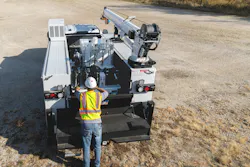
“Many fleets underestimate what upfitting truly represents,” Hansen noted. “Upfitting isn’t just adding a body to a truck. In reality, it’s engineering uptime. Proper decisions start with understanding the real‑world job the truck will perform and considering application, payload, duty cycle, and operating environment. If the spec matches the work, you win; if it doesn’t, you pay for it later.”
Rubin added that provider choice is a maintenance decision in itself. “A reliable provider must demonstrate technical capability, consistency, and accountability.”
From an installation standpoint, Cody Veal, AVP & production manager at Ring Power, highlighted the importance of execution. “Attention to detail during installation has a major impact on long‑term reliability,” he said.
“For example, things like improperly routed or unsecured wiring and
hoses can lead to failures in the field.”
Veal also emphasized that using standardized wire colors and labeling conventions across builds simplifies diagnostics for technicians and reduces troubleshooting time when vehicles require service.
Eric Bowman, VP of inventory and logistics planning at Ring Power, pointed to serviceability as a critical design factor.
“Vehicle uptime is strongly influenced by how well the chassis and equipment are integrated,” Bowman explained, as centralized upfitter
connection modules make troubleshooting easier by consolidating electrical inputs and outputs into a single location.
He also noted the importance of corrosion prevention, adding that “applying rubberized undercoating to body structures and ensuring
proper routing and securing of wiring and hydraulic lines can significantly extend the service life of the vehicle.”
Hansen identified misalignment between the dealer, upfitter, and end user as a recurring problem. “The end user doesn’t always know what they need,” he said, “and without coordination, you end up ordering the wrong chassis for the body. The result is either modification or rework, and both cost time and money.”
Rubin warned that most common failures in upfits occur at the interface between the chassis and the equipment, pointing to errors such as drilling into fuel tanks or cutting filler necks. These issues may not be immediately visible but can lead to serious safety risks and costly downtime.
At DTNA, Kevin Otzenberger, medium-duty and vocational product marketing manager, cautioned against unnecessary cab modifications. “Cutting holes in the cab floor or walls can increase the risk of noise or water intrusion over time,” he said. “Ordering harness preps with protective wiring caps helps shield connectors from weather exposure.”
Andrew Brown, Ford Pro brand manager, commercial Super Duty & VIS 2.0, added that modern safety systems raise new concerns. “If
an upfit such as a large front bumper or a wide service body can interfere with these sensors, it can affect ADAS functionality.”
“Overall, planning the upfit during the initial vehicle spec’ing phase allows for right‑sizing the powertrain and chassis,” Brown added. “That extends the life of the engine and transmission and maximizes resale value.”
About the Author
 Seth Skydel
Seth Skydel
Seth Skydel, a veteran industry editor, has more than 41 years of experience in fleet management, trucking, and transportation and logistics publications. Today, in editorial and marketing roles, he writes about fleet, service, and transportation management, vehicle and information technology, and industry trends and issues.