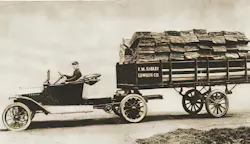
The first decade of American trucking was defined by foundational ideas. Alexander Winton created the first "semi truck", or auto hauler; Henry Ford made a case for preventive maintenance; and companies like Goodyear simplified repairs with innovations like the detachable straight-sided tire.
As trucks became more practical and reliable, the years to follow brought a new era of specialization and refinement, one full of purpose-built tools and components to revolutionize the budding industry.
1911 - Kennedy introduces all-metal toolboxes
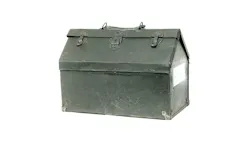
When traditional cloth tool bags proved a poor storage method for railroad engineer Howard Kennedy in 1909, he went home and fabricated a metal “suitcase” to better organize and protect the tools of his trade. Soon, other workers were asking him for one, and with the help of his ad exec brother, Charles Kennedy, they formed Kennedy Manufacturing to meet demand. The company is credited with the first metal toolbox sale in 1911.
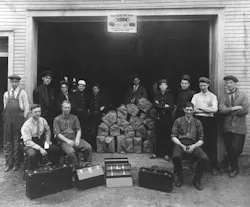
Within three years, the operation was moved out of Howard’s Fort Wayne garage over to Van Wert, Ohio, just across the state border. Here, they began making durable toolboxes and cabinets throughout the decades, even adding rollers for mobility later on in the ’40s. Built to last, the vintage models still look great and are popular with collectors. Fellow Ohio toolbox maker Cornwell Quality Tools acquired the company in 2016, increasing production at the Van Wert site to bring all manufacturing back to the U.S.
1912 - Invention of the electric starter
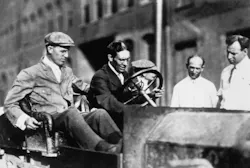
Before Charles Kettering invented the electric starter for gasoline engines, a driver would have to manually turn a hand crank jutting from the front of the car. It was a physically demanding task and dangerous, too. The crank could sometimes violently kick back and break a jaw or arm.
This happened to the friend of Cadillac founder Henry Leland in 1910, who reportedly was trying to help a broken-down female motorist. His broken jaw got infected and turned fatal, and Leland asked Kettering, an electrical engineer, to come up with a better solution.
Kettering got to work in his Ohio company, Dayton Engineering Laboratories Company (DELCO), and in a few years developed a lightweight system with suitable torque and starting power. The battery was similar to modern lead-acid batteries, and the direct-current starter combined powerful stator and rotor coils with gears to multiply torque. Starting was also sped up by replacing the earlier magneto ignition with battery ignition to energize the ignition coil.
The absence of hand cranking allowed increases in the engine’s compression ratio, greatly improving combustion and engine efficiency, as well. The system was adapted to gasoline truck engines and later on to diesel trucks as they began to show up on the nation’s highways in the 1930s. By this time, Kettering had sold Delco to General Motors, where he was head of research until 1947. Along with Thomas Midgley Jr., Kettering also developed leaded gasoline (to stop engine knock) and Freon. Revolutionary at the time, both were phased out due to environmental and health risks. ACDelco, though, is still going strong.
1914 - Fruehauf launches the first trailer
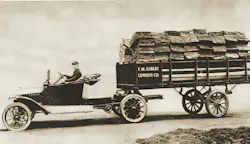
As Ruth Fruehauf tells it, her grandfather August Fruehauf and his partner Otto Neumann were successful blacksmiths in Detroit, with a facility that could fit 100 horses, but in the same city, “Henry Ford is building Model Ts as fast as he can get them off of the assembly line; they’re facing obsolescence quickly.”
Lucky for them, Fred Sibley, the man who provided Ford with a lot of lumber materials, wanted to take his boat up north to the lake, and do it with his new Model T, and not a horse-drawn carriage. He asked the blacksmiths to engineer a solution.
“So they put their heads together and removed the back seat from the Model T and the front axle from the wagon and sandwiched them together with a primitive pin hitch,” explained Fruehauf, who inherited a great deal of August’s papers and letters.
“It worked so well for the boat that Frederick Sibley had a light bulb go off, and he came back and bought two more Model Ts, realizing this [trailer] would give him a competitive edge in the lumber industry.”
In one fell swoop to accommodate a wealthy customer’s vacation, the modern trucking era began to take shape. Fruehauf would go on to produce tandem and bulk food trailers, using the principle and company slogan, “you can pull more than you can carry.”
For more details in the Fruehauf family history, visit SingingWheels.com.
1924 - Westinghouse ‘trains’ truck brakes
The Westinghouse Air Brake Company dates back to 1869, after famed inventor George Westinghouse decided trains needed a more reliable way to brake in emergencies. Compressed air was used in European drilling operations, and he carried that idea to locomotives. Shortly after, the system included a fail-safe design so that loss of air pressure applies the brakes. That was a success and carried over to trucks, which began hauling heavier loads after World War I. Previously, trucks used a system of rods, cables, and mechanical drum brakes and were ultimately reliant on the driver’s strength applied to the pedal—not something you’d want to rely on down a steep mountain grade. Hydraulic brakes also lacked redundancy, as a leak could affect braking power. WABCO integrated a Broussouse-type air compressor onto an International Harvester Coach in 1924, marking a pivotal moment in truck safety.
“The ability to uniformly and powerfully brake turned trucks from risky, hard-to-stop machines into safe, scalable freight vehicles, enabling the growth of modern logistics,” noted Patrick McNally, Head of Engineering Advanced Braking Systems, North America, ZF, which now owns WABCO.
1925 - Hydraulic lifts replace grease pits
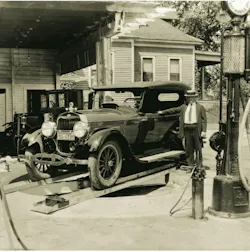
While getting a haircut in 1924, a shop owner named Peter Lunati saw how the barber’s chair used hydraulics to go up and down and got inspired to translate that power to the garage bay via the first hydraulic automotive lift. This invention, basically two metal tracks supported by a center hydraulic piston, allowed mechanics to easily raise a vehicle above ground and avoid climbing into the slippery, grease-filled pits to work under the vehicle, something Lunati himself loathed.
The truly genius aspect of Lunati’s patented lift is that it was powered by the existing air compressor used for inflating tires to force oil into the lift piston. The lift also rotated 360 degrees, hence the name of the company he and his partners founded in March 1925: Automobile Rotary Lift Company.
By October, the first lift was installed at Liverseige Service in Memphis, Tennessee, and by the end of the decade, the lifts caught on in shops across the country.
In the 1920s, the lifts were marketed widely, and this innovation still defines how shops are set up today. Rotary turned 100 last year, and has evolved to offer every kind of lift imaginable, but the company still recognizes that barbershop observation as “the haircut that launched an industry.”
1926 - Automatic fifth wheel makes easier connection
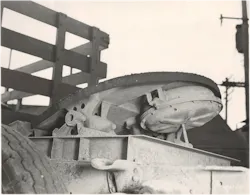
Shortly after Fruehauf brought the trailer to the market, Charles H. Martin and Herman Farr patented the rounded rocking fifth wheel for a smoother ride. This meant “if you were carrying dairy products, you didn’t end up with cream on the end,” Ruth Fruehauf joked.
In 1926, her grandfather developed an automatic fifth wheel with the modern horseshoe shape that guides the kingpin into a locked position. Holland Hitch would manufacture these fifth wheels, and as SAF-Holland, it is still the standard for many OEMs.
“The other really cool thing that Fruehauf did was give the patent to the industry,” Fruehauf recounted. “They wanted a driver from Chicago to be able to go to Texas, drop off a load, pick up a load, and bring it back with the same engineering equipment. If you had, you know, several different kinds of hitches, then your truck could potentially be incompatible.”
In 1948, Holland Hitch improved upon that original design and introduced the first modern style fifth wheel with a twin lock jaw design and side pull release handle. This basic design evolved to the Holland Model 3500, which has been the standard for millions of trucks. Now, as SAF-Holland, the company continues to improve safety and ease maintenance with advanced materials, low‑lube technologies, sensors, and enhanced safety features, the company noted.
1926 - Walking beam evenly distributes loads
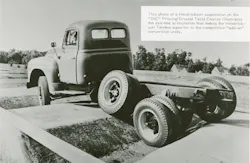
It’s no exaggeration that Swedish immigrant Magnus Hendrickson played a large role in early work truck uptime. These were the vehicles that moved earth and wood to make way for towering skyscrapers and massive dams. The problem was that the tandem axles on early logging and dump trucks could not equally bear the load while going over rough roads. The wrong pothole could mean a cracked axle or damaged driveline. In general, the traction suffered, and the driver felt every rock and rut.
The inventor and his Illinois-based Hendrickson Motor Truck Company came up with a way to equalize weight by connecting the tandem axles with a walking beam. As the forward axle hit a pothole or bump, the beam would pivot and transfer some of the load to the other axle. This greatly enhanced work truck durability and kept them on the job.
“At a time when most roads were unpaved and punishing on equipment, the innovation gave drivers a smoother ride, reduced stress on both the chassis and cargo, and enabled trucks to haul heavier loads more reliably,” offered Gerry Remus, Hendrickson VP of truck commercial vehicle systems.
It also hinted at how vital weight distribution management would be to truck and trailer lifespans. Hendrickson and other companies have moved on to adding tag axles for extra support and softened bumpy roads with air ride suspensions, along with dozens of other innovations, but those suspensions couldn’t run without first learning how to walk.
1929 - Cummins cup-type injector
If trucking had a Mt. Rushmore, you better believe Clessie Cummins would be there, front and center. At 11, he allegedly built a steam engine for his family farm, and by 22, he was helping Ray Harroun tune up the Marmon Wasp, the first car to win the Indianapolis 500 in 1911.
He is, of course, most well-known for founding Cummins Engine Company in 1919 with William G. Irwin, who bankrolled Harroun. The company started with a stationary Dutch Hvid engine that Clessie modified. The self-taught engineer was convinced he could build a lighter, more efficient diesel engine suitable for trucks. The trick was figuring out a way to operate efficiently at an increased RPM.
He believed the solution to be a fuel injector with open nozzle holes that would pre-heat fuel held within a tiny cup at the base of the injector. The hot air generated during compression would enter the cup just prior to ignition. This would speed the ignition of the fuel, reducing the delay in ignition that had plagued high-speed diesels in the past, making them noisy and inefficient.
In a process described in The Diesel Odyssey of Clessie Cummins, written by Clessie’s son Lyle, Cummins and an engineer named Hans Knudsen went through a whopping 10,000 prototypes before landing on a practical version of the injector. This enabled Cummins to put a Model U diesel into his 1926 Packard motorcar, which he drove from Indiana to the 1930 New York Auto Show. He averaged 26 mpg over 800+ miles.
The next year, Cummins drove a Marion truck powered by his engine from New York to California in 1931, a 3,214-mile trip, to fully prove his diesel engine’s efficiency and practicality. The trip was a success, with a scant $11.22 spent on fuel (or $235 in 2026 dollars) for the whole trip.
Ever since, Cummins has been one of the preeminent names in engine technology.
About the Author
 John Hitch
John Hitch
Editor-in-chief, Fleet Maintenance
John Hitch is the award-winning editor-in-chief of Fleet Maintenance, where his mission is to provide maintenance leaders and technicians with the the latest information on tools, strategies, and best practices to keep their fleets' commercial vehicles moving.
He is based out of Cleveland, Ohio, and has worked in the B2B journalism space for more than a decade. Hitch was previously senior editor for FleetOwner and before that was technology editor for IndustryWeek, and managing editor of New Equipment Digest.
Hitch graduated from Kent State University and was editor of the student magazine The Burr in 2009.
The former sonar technician served honorably aboard the fast-attack submarine USS Oklahoma City (SSN-723), where he participated in counter-drug ops, an under-ice expedition, and other missions he's not allowed to talk about for several more decades.