Hankook focuses on fleets as U.S. TBR production gets rolling
Key Highlights
- Hankook expanded its Clarksville plant from 1.5 million to over 2 million sq.-ft., adding 1,400 workers and increasing annual capacity to 11 million units by 2026.
- The company is focusing on innovative products emphasizing performance attributes such as retreadability, fuel efficiency, and durability for fleet customers.
- Hankook aims for up to 90% of its tires sold in the U.S. to be manufactured locally, reducing supply chain disruptions and controlling costs.
- The Clarksville plant has become Montgomery County’s largest private employer, with efforts to recruit and retain talent through incentives like onsite medical clinics and daycare support.
- Market challenges include a decline in replacement truck tire sales, but Hankook’s strategic investments and quality improvements have earned industry recognition, including the prestigious Diamond Supplier Award.
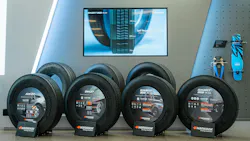
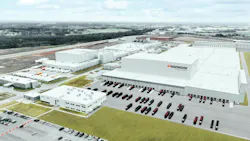
CLARKSVILLE, Tennessee—Until this past April, Hankook Tire only manufactured passenger and light truck tires at its Clarksville plant, which opened nine years ago at a cost of $800 million. But like the South Korean tire maker itself, a lot has changed since then. Hankook has spent $1.6 billion expanding the plant. This increased the size from 1.5 million sq.-ft. to over 2 million sq.-ft., and allowed the plant to add 1,400 workers and tooling needed to double annual PLT capacity and finally add TBR (truck & bus radial), which is projected to reach a capacity of 1 million units per year by 2028.
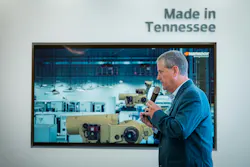
“From 2017 to 2026, we went from building zero domestic units to what will soon be 11 million,” explained Rob Williams, president of Hankook’s U.S. operations, during a media event and plant tour held August 17. “That'll make us the fastest-growing tire manufacturer in North America.”
To keep that pace, Hankook must prove itself a viable, dependable option for fleets, ultimately answering its tagline: “Why Hankook."
The company is ranked No. 7 globally among tire makers; No. 2 Bridgestone is headquartered 1,000 feet from Hankook in Downtown Nashville and has reportedly invested $550 million in its Warren County TBR plant (while closing its La Vergne plant in 2025). And because tires are a fleet's third-highest expenditure after driver pay and fuel, every competitor is always looking to convince customers why them.
“We've got to show the market what our products are doing performance-wise—retreadability, fuel efficiency, you name it,” asserted Mark Roe, VP of TBR sales for the U.S.
Innovation gaining traction
Those attributes are actually named in Hankook’s underlying commercial tire technology, SMARTEC (Safety, Mileage, Anti-chip and cut, Retreadability, and Traction).
“It starts with innovation, right?” Williams offered, reiterating, “We've got to have the most innovative products.”
This starts at the Technodome innovation lab in Seoul and in the U.S., at the Hankook Tire America Technical Center in Akron, Ohio, the Rubber Capital of the World. And the labors of the R&D team play out on the road, where drivers test the tread, and in the back office where fleet managers crunch the TCO numbers.
And though on the passenger side, Hankook uses the slogan “Driving emotion,” that carries little weight with data-minded fleet managers, especially with current fuel and equipment costs.
“Their costs have risen tremendously, and we need to show them Hankook is the way to go,” Roe said.
This is why, for fleets, Roe said he and his team “preach cost per mile and cost of ownership.” He also asserted Hankook does win the TCO against some competitors.
“We've got some stiff competition—there are good products out there, and we're not going to deny that,” Roe said. But we know that we need to show those fleets because they're looking at sheer numbers, you know, their costs have risen tremendously, and we need to show them cost of ownership of Hankook is the way to go.
And larger fleets weigh several factors before switching tire suppliers, as we covered in-depth earlier this summer.
Brian Antonellis, SVP of fleet operations at Fleet Advantage, noted:
“Low-cost operators will move between brands with very little loyalty. Operationally-focused companies will use data to understand tire performance and balance vs. acquisition. While they will move between brands, they are far more loyal and understanding of how their decision will impact the P&L and operational performance of the fleet.”
Ken Everhart, director of corporate accounts for Hankook Commercial, explained the fifth generation of SMART products yielded from Hankook’s investment in innovation will “help those fleets that are looking for rolling resistance, mileage performance, cost per mile—a lot of cool stuff.”
Everhart added that Hankook has expanded its nationwide dealer network and is currently developing improved emergency road service offerings.
To ensure each product does what it’s supposed to, Roe said Hankook hired a sales engineer whose only job is to track the products.
“We're also large-scale testing on all segments,” Roe added. “That's a big thing for us. We'll show our customers why Hankook.”
Show, don’t tell
For fleets as in sports, the best ability is availability. And the biggest shift for Hankook’s fleet customers is that they don’t have to wait for product to be shipped across the Pacific anymore.
“There'd been a lot of disruptions during COVID, and it was unheard of in our industry trying to get product from abroad, so having the ability to source the product locally is obviously a very strong selling feature for us,” Williams said.
The plan is for up to 90% of Hankook tires sold in the U.S. to be made here.
“We need to make sure that we're controlling our costs, so we can pass that cost savings along to our partners,” Williams said.
It’s also worth noting that Clarksville, one of America’s modern boomtowns due to the low cost of living, is centrally situated in the U.S. supply chain. From there you can ship to three-fourths of major American cities in only one day, according to the Clarksville-Montgomery County Economic Development Council.
Currently, on the TBR side, Clarksville makes the AH37 regional steer tire and TL52 trailer tire. This fall, the high-mileage, fuel-efficient Smart Line AL52 steer and DL52 drive tire.
Hankook’s commercial rollout still has a ways to go.
“We're still ramping up on TBR/medium commercial,” Williams said. “We're roughly about 30% to capacity at this point.”
To get to this expansion point, Hankook increased its headcount from 900 to 2,300 employees, making it Montgomery County’s largest private employer.
“We have to make a great product, but it starts with the people who make that great product,” Williams offered.
Keeping it that way isn’t easy, though.
“Not only recruiting, but retaining people has been far and away the biggest challenge,” Williams said.
On the recruiting side, Hankook has hit up Fort Campbell across the Kentucky border and brought in some managers who had worked at Bridgestone’s shuttered La Vergne TBR plant. To provide incentives for employees to stay, Hankook also helps fund a nearby daycare that provides employees a reduced rate, and set up an onsite medical clinic and cafeteria.
To reach its capacity goals—and justify the various investments, Hankook needs to drum up demand. To that end, the company hired dedicated fleet managers a few years ago and more recently brought on a field sales engineer and OE and government specialists.
“Once [customers] accept the product, they need to have the product available,” Williams explained. “If they have a problem with the product, they need to have our dealer partners help them, or we have to have our technical service team or our territory managers to be on the spot to make sure that we can handle any of their concerns on our product.”
Deflated market
Even with Hankook ready for a big push, it must contend with opposing winds from the market. According to U.S. Tire Manufacturers Association July numbers, while OE truck tires are up 6.2% compared to 2025, replacement truck tires, the majority of its TBR business, are down 7.1% YoY.
Currently, the tire maker has a roughly 80/20 split between replacement and factory-installed tires.
“The market is definitely not as healthy as it once was,” said Roe, who said to grow, a tire manufacturer has to take business from a competitor. Still, he offered that “Hankook has had a decent year.”
Along with that, the investment in Clarksville has signaled to the industry that Hankook will not be easy prey for those looking to steal market share.
“The Tennessee factory alone is getting us noticed in a lot of segments that we weren't previously,” he said. “We're really optimistic going into ‘27 and ’28.”
Quality assured
Even though tire sales trend downward, Hankook’s sales team has been armed with a solid conversation starter. On Aug. 17 at the plant, the tire maker received the prestigious Diamond Supplier Award from International Motors, with Hankook inviting media members to witness. The OEM awarded only seven of about 1,600 of International’s direct suppliers this year, explained Sanjay Goel, International’s head of procurement for cabin and electronics.
![International Motors presented a 2026 Diamond Supplier Award to Hankook Tire on Aug. 17 at the company's Clarksville, Tennessee plant, which will make both the AH37 and DH37 tires for the OEM there starting next year. [From L to R: Wayne Rygel, director of supplier quality at International; Sanjay Goel, head of procurement for cabin and electronics at International; Rob Williams, Hankook Tires America president and CEO; and Sang Hyun Oh, Hankook global VP and CTO.]](https://img.fleetmaintenance.com/files/base/ebm/fm/image/2026/08/6a9194c19c8a3bda2726872f-june2026169.png?auto=format,compress&fit=max&q=45?w=250&width=250)
Hankook has had a partnership with the Lisle, Illinois-based OEM since 2013, supplying the AH37 regional steer and DH37 regional drive tires at the factory level for International’s HV Series, MV Series, and IC Buses, as well as replacements. These tires were previously supplied from South Korea and by next spring are both planned to come from the Clarksville plant.
For the award, International judged its suppliers on several key metrics, including quality, service, and sustainability. Hankook scored perfect marks in all three.
“The product that you're providing has to be very high quality, because it's taking our children from home to school and back safe,” Goel said.
He also noted both companies share a “customer-first” mindset.
Wayne Rygel, director of supplier quality at International, explained one reason Hankook won was how much effort the company put into improving its quality. In the past, Rygel said his quality engineer for tires expressed “some frustration” due to issues in the field and at the plant. He shared his feedback and suggestions with their leadership 2.5 years ago while visiting the Technodome in Seoul.
Williams acknowledged that, “In the past, we experienced some isolated quality-related challenges, as is common in any manufacturing environment.”
He added that Hankook “[took] every issue seriously and viewed it as an opportunity to improve.”
And as far as International is concerned, “The Hankook team took [our feedback] to heart,” Rygel said.
And that previously frustrated quality engineer was a key backer of Hankook for the supplier award, telling Rygel they deserved the accolade because, “I've seen a 180-degree turnaround in that culture; the product we're seeing now is fantastic, great quality.”
About the Author

John Hitch
Editor-in-chief, Fleet Maintenance
John Hitch is the award-winning editor-in-chief of Fleet Maintenance, where his mission is to provide maintenance leaders and technicians with the the latest information on tools, strategies, and best practices to keep their fleets' commercial vehicles moving.
He is based out of Cleveland, Ohio, and has worked in the B2B journalism space for more than a decade. Hitch was previously senior editor for FleetOwner and before that was technology editor for IndustryWeek, and managing editor of New Equipment Digest.
Hitch graduated from Kent State University and was editor of the student magazine The Burr in 2009.
The former sonar technician served honorably aboard the fast-attack submarine USS Oklahoma City (SSN-723), where he participated in counter-drug ops, an under-ice expedition, and other missions he's not allowed to talk about for several more decades.