Diesel vs. electric APUs: Comparing TCO
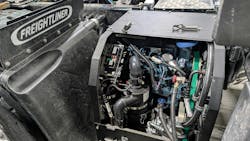
Excessive idling of sleeper trucks burns fuel, accelerates engine wear, and adds strain to aftertreatment systems—all while the truck is parked. For many fleets, that makes an auxiliary power unit (APU) worth evaluating.
If a fleet decides an APU is right for them, the next question is if it wants a diesel or all-electric version. Factoring all the power draws will discern that an eAPU can get drivers through a 10-hour rest period.
“Fleets need to account for the total hotel load, including climate control, appliances, electronics, and anything else drawing power,” said Bill Maddox, senior manager for product at Carrier Transicold, a provider of diesel and electric APUs. “Our Aspen diesel APU, for example, delivers 5.2kW continuously and can handle HVAC and multiple hotel loads simultaneously while also heating the tractor engine and maintaining a battery charge. Battery-based APUs may struggle when demand is high or runtimes are long.”
That has definitely been the argument against traditional AGM battery-style eAPUs. However, new battery technologies are leveling the playing field.
Lithium-ion batteries are capable of providing the power needed to fully operate an eAPU for a full 10 hours. They utilize a “lithium iron-phosphate” chemistry, or LiFePO4, which is known for its thermal stability and high cyclability. The result is considerably longer runtimes and life cycles than AGM-style APUs.
Carrier Transicold, DClimate, Dragonfly Energy, and Polar Fox APU have already introduced lithium-ion eAPUs. Gnewikow said Thermo King continues to explore this approach.
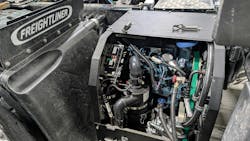
Comparing total cost of ownership
Fleets should always consider their specific application to determine if diesel or electric makes the most sense. Analysis of total cost of ownership (TCO) should factor into that determination.
Purchase price: Diesel APUs have generally cost more up front than AGM-style eAPUs. However, lithium-powered products in general have historically been more expensive than their gas- or diesel-powered counterparts. That is changing.
“The price of lithium cells and battery packs has dropped dramatically,” said Martin Duffy, executive vice president of DClimate, a Transtex brand that specializes in eAPUs. “Generally speaking, the eAPU we introduced in March 2025 should be the same price or even a tad lower than a comparable diesel unit. I could never have said that five years ago.”
Dragonfly Energy says its lithium-powered eAPU is also less expensive to purchase than a comparable diesel. In addition, even though it’s more expensive than an AGM-style eAPU, it offers significant cost savings over time due to reductions in fuel consumption and required maintenance.
Fuel consumption: While a diesel APU eliminates idling, it does burn 1/4 gallon of fuel per hour to operate. According to data from Dragonfly Energy, an AGM-style eAPU doesn’t consume fuel, but it does require 8 to 12% idling because it normally can’t make it through a full 10-hour rest period. Even a lithium-ion eAPU will likely incur some idling, albeit much less.
“We designed our Battle Born All-Electric APU to store enough energy to get through a driver’s 10-hour rest period, even in the hottest climates when the AC is working the hardest and pulling max power,” said DJ Hasler, market manager for HDT at Dragonfly Energy. “In real-world usage, however, drivers sometimes don’t drive long enough to charge 100%, or maybe they’re on the road a while and need to do a 34-hour reset.” That is why Dragonfly Energy estimates an average of 2% idle over the course of a year.
In 2024, technology support company Velociti partnered with Dragonfly to fund new Battle Born eAPU deployments through Velociti’s Instant ROI and VeloCare programs, spreading payments over a period of up to 36 months.
During that pay period, one fleet of 1,000 tractors using his solution saved $2.25 million versus using an AGM to power their eAPU, according to the companies.
Even against a bunk heater, Dragonfly said its LiFePO4 solution was a quarter of the cost of using the engine auto start/stop and bunk heater. This is because although an engine auto start/stop and bunk heater solution costs $2,000 versus $8,500 for the Battle Born APU, you have to look at the long game. After four years, the former solution consumes 40,000 gallons for rest-period idling versus 672,688 gallons for lithium eAPU. Another $4,000 is saved in maintenance costs from the reduced strain in the main engine and emissions system.
That is just one example, of course. Most APU manufacturers provide their own TCO/ROI calculators where you can input your own data. Make sure you work closely with any vendor you are considering to ensure everyone understands the application you are trying to solve.
Maintenance: Diesel APUs have engines and aftertreatment devices that need to be periodically maintained; eAPUs don’t. Diesels also have more mechanical parts that can wear and require replacement.
The eAPUs do have electrical connections that need to be closely monitored and maintained. AGM-style units also have batteries that need to be replaced every couple of years. Lithium-based systems are generally designed to provide roughly 10 years of life, and generally come with five-year warranties on the batteries. Dragonfly Energy actually offers a 10-year warranty on its battery system.
Polar Fox APU says its lithium-based eAPU provides another avenue for fleets to reduce TCO. Polar Fox utilizes “dual-purpose” LiFePO4 batteries, which means they also possess the cold cranking amps (CCA) needed to start a truck. Thus, they eliminate the need for a second set of starting batteries, which helps reduce TCO.
Resale value: One more factor to consider when analyzing TCO is residual value when selling or trading the truck. Well-maintained diesel APUs often add value because of their long life cycle and the fact that they reduce wear on the truck engine and aftertreatment system. The eAPUs provide the same benefit, particularly today’s new lithium-based systems that offer warranties exceeding the typical first trade cycle (four years).
Just in case a fleet can’t get the residual value it’s looking for, DClimate’s Duffy said plug-and-play systems are beneficial because the fleet could easily remove the eAPU and put it on another truck in the fleet. “It’s almost like having residual insurance,” Duffy said.
Diesels getting easier to maintain
While an argument can definitely be made that a lithium-based battery system is the least maintenance-intensive, some diesel APU manufacturers have focused on making preventive maintenance easier and less costly themselves, helping reduce TCO for fleets that see more value in a diesel APU.
Green APU, for example, uses non-proprietary components that are readily available across the retail channel. “That helps keep availability up and cost down, simply due to supply and demand,” offered Eric Davis, technical specialist and customer service manager at Green APU. “We’ve incorporated a lot of standard components found on popular automotive brands like Honda and Nissan. That keeps things simpler while still meeting the needs of fleets.”
Thermo King has also taken measures to lower maintenance costs on its diesel APU. “Our 3rd Generation TriPac has a 2,000-hour oil change interval,” Gnewikow pointed out, alluding to a couple of proprietary design elements that make that possible. “Our intent is to match the APU oil change interval as closely with the tractor maintenance as possible.”
Preventive maintenance tips
With diesel APUs, Carrier Transicold’s Maddox said technicians should adhere to the manufacturer’s recommended intervals for oil and filter changes, including the cabin air filter, while also inspecting coolant levels, belts, hoses, and other key components every six months or so in a long-haul application.
Thermo King’s Gnewikow recommends operating the heater for 15 minutes each month during the non-heating months. “This helps prevent the heater from gumming up with carbon soot, etc.,” Gnewikow explained.
While maintenance of an eAPU is minimal, it’s important to keep a close eye on electrical connections. “As long as you’ve torqued the terminals properly and inspect them periodically when a truck is in for another service, you’re pretty much done,” Wade Seaburg, chief commercial officer at Dragonfly Energy, said.
“Our system connects to the truck by running wires from the starting bank back to our lithium module,” DClimate’s Duffy added. “Sometimes those connections get disconnected when other work is being done on the vehicle. So it’s a good idea to check that they were reconnected properly.”
With today’s lithium-based eAPUs, the battery system is inherently “smart.” Thus, technicians should take advantage of any telematics data that’s available.
“On a monthly basis, technicians can review BMS (battery management system) logs and software/firmware for warnings and updates,” Sophia Fox, managing partner at Polar Fox Technologies, said. “Every six months, a battery health check should be performed where the technician checks cells for balance and validates BMS operation.”
Fox said it’s also important to track eAPU hours and maintain accurate records, which includes energy consumed and fault events. Using this data, fleets can better plan battery replacements before end-of-life begins to impact runtime.
Whatever you choose, stay active and involved after install and through the equipment’s life. If you think an idle engine can cost you, that’s nothing compared to an idle maintenance manager.
About the Author
 Gregg Wartgow
Gregg Wartgow
Gregg Wartgow is a freelancer who Fleet Maintenance has relied upon for many years, writing about virtually any trucking topic. He lives in Brodhead, Wisconsin.