Mind the gap: NACFE finds reducing tractor-trailer
Key Highlights
- NACFE recommends starting with skirts on dry vans and reefers, then addressing the tractor-trailer gap.
- The October report puts a 5% fuel economy gain at roughly 714 gallons a year for a truck running 105,000 miles at 7 mpg.
- Annual trailer mileage, highway speeds and repair costs can change how quickly an aero package pays for itself.
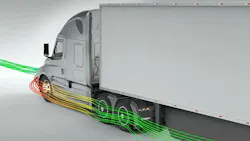
The gap between a Class 8 tractor and its trailer has been bedeviling aerodynamic engineers for decades. No matter how slippery they make the rest of a tractor-trailer, that gap between the tractor and the trailer is always there confounding their efforts. That’s because at highway speeds, the gap is a low-pressure area that pulls passing air into it and up against the front end of the trailer. The resulting air turbulence and drag created by the trailer gap is significant. Cummins, for example, estimates that once the tractor-trailer gap exceeds about 30", every additional 10" adds roughly 2% to the rig’s aerodynamic drag.
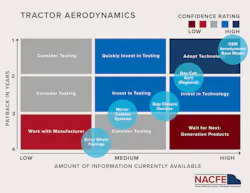
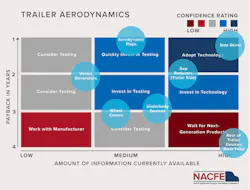
Understanding the trailer gap is one reason the North American Council for Freight Efficiency (NACFE) combined its tractor and trailer aerodynamics studies in a new report called "An In-depth Look at Tractor & Trailer Aerodynamics."
NACFE analysts estimate that at highway speed, roughly 65% of the energy needed to move a Class 8 tractor-trailer goes toward overcoming aerodynamic drag. The trailer accounts for about half of that drag.
“Our second report on aerodynamics in 2020 told fleets that good aero was worth doing,” said Mike Roeth, NACFE’s executive director, in announcing the report. “Six years of data did not change that conclusion. It strengthened it.”
Start with skirts, then look behind the cab
For most dry van and refrigerated fleets, NACFE recommends starting with trailer skirts to boost fuel efficiency.
Trailer skirts limit the air that flows under the trailer and around the running gear.
However, if you’re already running skirts, the next best place to look for improved aero performance is behind the cab, NACFE added. Passive fixed cab extenders help guide air past the trailer gap. And there are now active, speed-variable systems that go a step further. These systems automatically pull a trailer closer to the tractor at highway speeds to close the trailer gap and improve airflow past it. As the truck decelerates, the system expands the trailer gap to ensure a driver can maneuver safely.
Fittingly, NACFE puts rear-of-trailer devices last on its current ranking of aerodynamic features. The report noted that three tail products built to OEM standards have been discontinued since the council’s last review. Many of the problems with trailer-tail aero devices are maintenance-related, the report added. A fleet considering trailer tails should look at how often its trailers back into tight docks, incidents of damage in yards, and assess how quickly the shop can put a damaged device back in service before committing to buying.
Figure payback on the miles the equipment runs
But, as recent geopolitical events have proven, investments in aerodynamic devices are worth it.
For its research, NACFE models a long-haul tractor as running 105,000 miles a year at 7 mpg. Using those figures, a 5% improvement in fuel economy saves about 714 gallons annually. At $4 per gallon, that’s roughly $2,860 a year, or 2.7 cents per mile in fuel alone. Considering the current average gallon of diesel costs $5.84, your annual savings would be $4,169, or 4 cents per mile.
In comparison, NACFE puts the installed cost of its example package, which includes skirts, a rear device, and wheel covers, at $6,000 to $7,500.
At that fuel price, simple payback works out to roughly 25 to 32 months before repairs.
To get started, NACFE suggested putting a package on trailers with steady highway work and comparing fuel use with similar tractor-trailer combinations running the same lanes. Track repair labor and parts while the test is running to determine which devices work best in your applications.
Fuel and energy volatility is going to be a feature and not a bug in fleet management from now on. Spec’ing your fleet to be as aerodynamically efficient as possible is perhaps the best tool available today to mitigate those costs and keep your freight moving.
About the Author
Jack Roberts
With nearly three decades covering trucking, Jack Roberts is known for reporting on advanced technology, such as intelligent drivetrains and autonomous vehicles, in an industry being transformed by technology.
In his Truck Tech blog, he offers his insights on everything from the latest equipment, systems, and components, to telematics and autonomous vehicle technologies. A commercial driver’s license holder, he also does test drives of new equipment and covers topics such as maintenance, fuel economy, vocational and medium-duty trucks, and tires.
He has been covering trucking since 1995.