Right to Repair takes a Topsy turvy turn
The fight for access to data has put the aftermarket and OEMs at odds as they wrestle for the right to write federal right-to-repair standards. It’s not the first time two industrial heavyweights went to blows over the precious resource du jour. The War of the Currents remains the gold standard. And because history has a pesky way of repeating itself, it serves as a road map for what not to do as the various companies, lobbyists, and politicians amp up their R2R campaigns.
In the late 19th century, everyone knew that electricity would change everything. The disagreement was how to harness it. Thomas Edison believed the power grid should run on low-voltage direct current, while Nikola Tesla and George Westinghouse argued for high-voltage alternating current.
Edison, who had the patents, infrastructure, and sheer will, struck first with a small-scale DC grid in Lower Manhattan to reliably power dozens of streetlights. But AC could travel farther and more efficiently, providing power to more people. Despite Edison’s advantage, AC won out.
Learning to control any force of nature rarely comes without casualties. Early electrical work was dangerous, and workers often lacked protective gear or safeguards. Back then, the closest thing to OSHA was the last thing you cried before hitting the ground (“Oh shi….”)
Edison’s companies turned these tragedies into opportunities, highlighting the inherent danger of AC. DC, though more costly to overcome energy loss, was safer, they argued.
That argument held merit; many linemen died in the early days. But specifically regarding Westinghouse, records indicate far fewer deaths than the media and Edison’s camp claimed.
Enter Harold P. Brown, an “independent” critic who lambasted AC power in op-eds, claiming safety had been sacrificed for profits. Edison liked the cut of his jib and provided the resources for Brown to show how deadly AC was by electrocuting cats and dogs. Brown later staged the first execution by electric chair in 1890, and surviving letters indicate Edison was directly involved in coaching Brown to convince authorities the process was humane and effective.
This was all done as the propaganda war to defeat Westinghouse escalated, though it was to no avail; AC simply proved the better option. Edison’s idea to insulate underground lines in cities was later adopted as AC infrastructure matured. Had Edison collaborated with Westinghouse to develop safer measures instead of fomenting fear, it’s possible fewer lives would be lost. And Edison’s legacy would be far cleaner—and not as closely tied to the tragedy of Topsy the Indian elephant.
After allegedly killing a drunk ruffian for burning her trunk with a cigar, the misunderstood pachyderm moved homes, now trying to find her way in man’s world, working for peanuts at Coney Island. But her trainer, also a bit of a drinker, commanded her to attack the police, or she followed him to the station after he was arrested. Reports vary, but the noble beast was branded a menace and sentenced to death.
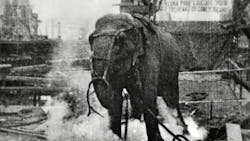
Topsy was publicly electrocuted at Coney Island in 1903, with many still believing Thomas Alva flipped the switch himself. The truth is Edison Electric Illuminating Co., not owned by Edison, provided the 6,600 volts of AC, which took an excruciating 10 seconds to topple Topsy. And yes, Edison Manufacturing Co. did provide the film crew to capture it all.
You can blame Edison for the invention of the Kinetoscope camera that filmed the execution, but no records link him to the event. In this case, blame Whitey (as in her abusive handler, William “Whitey” Alt.)
What does this have to do with Right to Repair?
It's not an exact analogy to the War of Currents, but the surface similarities are shocking. One side wants more public access and the other more safety. The aftermarket-supported REPAIR Act provides universal access to repair data to all shops and vehicle owners. The OEM side has argued that the bill as written allows third-party access to proprietary data unrelated to repairs, which could have a damaging effect. Insurance companies could use this data to spy on your speeding habits and raise your rates, while foreign competitors could steal OEMs’ trademark secrets. These arguments surfaced during a Jan. 13 hearing by U.S. House Subcommittee on Commerce, Manufacturing, and Trade on vehicle safety.
During his questioning of Hilary Cain, SVP of policy for the Alliance for Automotive Innovation, Rep. Tom Kean, Jr. of New Jersey, who noted the state was once home to Edison, wondered if federal repair laws could infringe on modern innovators’ IP and lead to customers buying less-tested (i.e., dangerous) parts from China.
Meanwhile, the aftermarket side theorizes that without their bill, the OEMs are out to destroy the aftermarket and jack up parts and repair prices. The U.S. parts aftermarket generated over $500 billion last year and the pro-REPAIR Act Auto Care Alliance itself admits indie shops outnumber dealerships 15 to 1.
This type of polarizing rhetoric from both sides gets us nowhere, an ironic position for the transportation industry. But now it's time to move on. Vehicles are about taking you places, and the repair industry is about fixing things. So let’s move to a solution. Both sides publicly agree that R2R should exist. How long will bickering keep a federal standard for this from happening?
As with all politics, long enough for neither side to be happy with the end result, probably. And maybe that's for the best.
As Edison had with his DC power campaign, the OEMs’ unsponsored SAFE Repair Act contains good ideas that could strengthen the REPAIR Act, such as a transparency proviso that could become a CARFAX for repair parts, alerting shops and customers to underperforming and defective repair parts. Reputable shops have told me they would never use such parts, and I believe them. But all laws would be obsolete if everybody did the right and ethical thing. (There are always people like Whitey Alt ruining it for everyone.)
The point is, federal legislation is needed to secure everything from daily commutes to interstate commerce. If both sides can dispense with the hyperbole and work together, a real solution that improves uptime for everyone can finally see the light of day.
But if instead the various factions wage a propaganda war to serve self-interests over the customer and industry, remember that unlike in Topsy’s era, we have access to all the data—and the modern record has a memory like an elephant.
About the Author
 John Hitch
John Hitch
Editor-in-chief, Fleet Maintenance
John Hitch is the award-winning editor-in-chief of Fleet Maintenance, where his mission is to provide maintenance leaders and technicians with the the latest information on tools, strategies, and best practices to keep their fleets' commercial vehicles moving.
He is based out of Cleveland, Ohio, and has worked in the B2B journalism space for more than a decade. Hitch was previously senior editor for FleetOwner and before that was technology editor for IndustryWeek, and managing editor of New Equipment Digest.
Hitch graduated from Kent State University and was editor of the student magazine The Burr in 2009.
The former sonar technician served honorably aboard the fast-attack submarine USS Oklahoma City (SSN-723), where he participated in counter-drug ops, an under-ice expedition, and other missions he's not allowed to talk about for several more decades.