Servicing the driveline: Handling the component you didn’t plan to touch
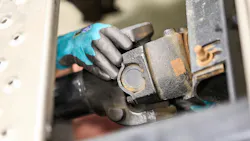
Walk into any heavy-duty bay and the driveline is rarely the reason the truck is on the lift. More often, the job is the axle or the transmission—and the driveline is simply in the way. To reach the intended work, a technician disconnects the driveline at the input or output shaft and swings it down or to the side, pivoting on the U-joints as much as 45 degrees, then supports it or straps it to the frame rail before getting started.
The driveline removal and reinstallation is one of the most routine tasks in the shop. It is not specialist work; just about any technician handles it, on just about any day. And precisely because it is so routine, the driveline’s design has an outsized effect on how a shop runs: labor hours, the risk of comebacks, and whether a job beats or blows its standard repair time.
Maintenance-free is not inspection-free
It’s important to note the common misconception that a maintenance-free driveline is also an inspection-free one. For example, Cummins’ Permalube RPL Series is permanently lubricated and sealed for life. But sealed for life does not mean out of sight, out of mind. A routine visual check during scheduled service is still how a technician catches misalignment or early wear before it becomes an unplanned event on the road. Folding that quick inspection into every adjacent service—axle or transmission—is inexpensive insurance against expensive downtime.
The hidden time in handling
The bigger day-to-day challenge is handling. Once the driveline is disconnected and swung aside, it has to be properly supported. Let it hang at the wrong angle and the center bearing rubber can pull out of its bracket. At that point, a quick detour becomes a longer one, because the technician now has to loosen the bracket bolts and reposition the bearing before anything goes back together. None of that work was on the repair order, and it is exactly the kind of hidden time that quietly erodes bay productivity.
This is where weight stops being a spec-sheet figure and starts being a practical concern. A lighter driveline is easier to maneuver and support, and is less likely to be mishandled while disconnected. The recently announced RPL35+ is up to 28 lbs. lighter than the current RPL35, and the response from technicians who saw it at TMC 2026 focused squarely on that point. Less mass to wrestle means less physical strain and a lower chance of the kind of misstep that damages a center bearing.
Fewer parts, fewer ways to go wrong
The disassembly and reassembly stage is where loose hardware causes trouble. The previous design relied on multiple tools and separate bolt, washer and nut combinations, with access needed to both sides of the joint. The RPL35+ moves to a wing-style bushing with a simplified four-bolt configuration that does away with flange connections and their associated hardware altogether allowing for fewer tools for the job.
For the technician, that means fewer loose components to track on the bench and fewer opportunities to leave a piece of hardware out during reassembly. It also makes the procedure more consistent across experience levels—a real consideration in shops managing a wide range of tenure and a tight labor market. Fewer parts and simpler steps translate directly into faster, more repeatable service.
Where the time savings land
This is the part that matters to a shop’s bottom line. Because assembly and disassembly are simpler, the job can be completed comfortably inside its flat-rate allowance – and in many cases under it. When a routine task that every technician performs consistently beats book time, that margin compounds across every bay and every shift. Faster turnaround means more jobs through the shop and a better return on the same labor hours.
There are inventory benefits too. The wing bushings connect to wing yokes already common across the broader RPL line, improving part commonality and shrinking the service kit. Because connection hardware is generally replaced at every service event, a smaller kit with fewer unique part numbers means quicker parts identification and simpler stock management for the parts department.
A change that asks nothing new of the shop
Perhaps the most useful point for maintenance teams is what does not change. The RPL35+ requires no new maintenance practices, no new specialized procedures and no retraining, and it carries the same durability and performance as the products it builds on. The serviceability gains arrive without adoption friction—the design does more of the work so the technician does less.
That is the right way to think about driveline serviceability. The driveline may not be the job a truck comes in for, but it shapes how long that job takes. And getting its design right pays back in the one place a shop can always use it: time.
About the Author
 Eric J. Lewandowski
Eric J. Lewandowski
With over 20 years of experience in the North American heavy-duty truck sector, Eric joined Cummins in 2022 following its acquisition of Meritor, where he held a series of product management roles covering strategy, business development and programme leadership. At Cummins, Eric is responsible for driveline product strategy and lifecycle management and works to align product development with evolving fleet requirements around efficiency, durability and total cost of ownership.