Tools and chemicals behind effective trailer washing
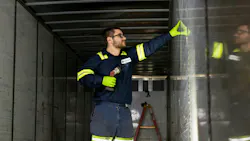
Running a trailer through the wash bay not only protects the hauler’s brand image, but also the fleet’s investment in the equipment, as spraying off dirt and road chemicals goes a long way in extending useful life.
“We position trailer cleaning as a maintenance investment, not a cosmetic expense,” said Rahul Natesh, CEO of JLE Truck Wash, which specializes in setting up and operating fleet truck washes. These incorporate a combination of automated equipment and manual labor.
In one case at a distribution center that ranked last in cleanliness in a company audit, JLE set up its onsite white glove service to handle all the equipment cleaning. On the next annual audit, this DC came in first, according to JLE. Driver satisfaction went up and the company banners and graphics looked more vibrant, too.
Trailer interiors are another thing to think about. What will a customer think if the doors swing open on a dry van and it’s absolutely filthy and stinking to high heaven? If you’re talking about a refrigerated trailer hauling food product, the customer is well within reason to reject the load. Plus, depending on how nasty the reefer is, it could be illegal due to the FDA’s FSMA Sanitary Transportation Rule. These require them to be cleaned as necessary, with documentation to support. This is to prevent cross-contamination and the spread of E. coli and other germs.
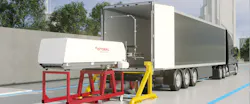
“With food [hauling], you want to clean it after every load,” asserted Kenneth Caruthers, regional sales manager for Istobal USA, which makes the HW’INTRAWASH, an automatic trailer cleaning machine that slides into the reefer trailer to clean it out.
Automatic method
If your fleet is too shorthanded for the manual method, drivers can always head to a public washout. Another option is to have the truck wash come to you. Companies such as JLE and Hydro-Chem Systems set up wash bays at distribution centers and large terminals to take on the pressure of cleaning your tractors and trailer.
JLE’s Private Label solution can be completely managed and operated by them, with no upfront capital investment. Along with gantry-style wash bays, power washers and chemical mixing systems, JLE can also offer yard spotters to move equipment to the bay. They also provide maintenance and repair on the washing equipment.
Logistics companies can defray costs by charging other carriers a fee to use the facility. Hydro-Chem also offers touchless wash bays for trucks, buses, farm equipment, and more. The process involves a low pH soak to remove minerals, oxidation, and road salts, followed by a high pH detergent to remove oils and carbon. After a high-pressure rinse the equipment is ready to get back on the road and get dirty again. Hydro-Chem noted the process takes a few minutes, versus over an hour for manual washing.
Istobal USA’s HW’INTRAWASH can clean and sanitize a 53-ft. reefer trailer in six minutes. The housing is perched on a mount, with the washing robot rolling out to wash and rinse every nook and cranny of the interior. A leading grocer has ordered more than a dozen in the last two years, Caruthers said, adding that if you perform 10 washes a day, “you’re going to show a great ROI.”
He added that “the machine never calls in sick and doesn’t need any benefits whatsoever.”
And further regarding trailers with refrigeration units, unsanitary conditions mixed with warmer summer weather are the perfect breeding ground for listeria and legionella, which, though rare, have affected commercial drivers.
From a business sense, it’s pretty clear that maintaining clean trailers is the smart thing to do. But there are several ways to go about it. To help with your trailer spring cleaning, we gathered several methods and strategies to get the job done quickly and efficiently.
Chemical cleaners
Cleaning trailer exteriors starts with choosing the right chemicals. Two types serve as the foundation for any good two-step program.
One step utilizes alkaline cleaners (high pH) which are formulated to remove common organic soils like dirt, grease, and bug residue.
“An alkaline product will take care of 95% of the soil on the surface,” said Tony Vertin, CEO of Ver-tech Labs, a provider of large-vehicle cleaning chemicals and application equipment.
In the second step, an acidic cleaner (low pH) helps remove inorganic soils like surface rust and hard-water scale.
Following the standard two-step approach will leave trailers as clean and protected as possible.
There is also an environmental benefit.
“Using both high- and low-pH products results in pH-neutral water discharge,” Natesh said.
That’s important for protecting ecosystems and sewer infrastructure, as well as maintaining regulatory compliance.
Vertin offered one word of caution regarding lower-pH acidic products.
“If you leave a product like that sitting on a surface too long, you could end up damaging the appearance of the metal that’s below the corrosion and scale you’re looking to remove,” he offered.
That’s why it’s always important to read the instructions for whatever chemical you’re using. Technicians have to understand a product’s
recommended dwell time, as well as its proper dilution ratio.
“Too much and too little dilution are both bad,” Vertin said. “Too little can require a lot more time to get a trailer clean, and too much can damage the surface.”
Vertin said it’s also important to know if the cleaning chemicals are considered metal-safe. For shops that don’t do a ton of washing and haven’t perfected their skills, it is probably best to opt for metal-safe cleaning agents that will never harm things like aluminum or chrome
Cleaning tools
For shops that manually clean trucks and trailers, Vertin said the two most commonly used tools are portable and wall-mounted foamers.
Portable wheeled foamers, typically available in 20- to 60-gallon capacities, are ideal for shops that will be washing outside or in varying locations. Vertin said it’s important to fill those with hot, softened water and the cleaning chemical set to the proper dilution. Then they connect to a standard air compressor.
Wall-mounted foamers can be a good choice for shops that have a dedicated wash bay. The technician will save a lot of time by not having to fill up a portable unit. Vertin said Ver-tech Labs’ wall-mounted system connects to city water pressure and relies on a metering device to incorporate the proper amount of cleaning chemical as water travels through the hose.
Mobile operations require a different tactic. Courtland Hail of Big Rig Mobile Wash in Beloit, Wisconsin, uses what’s known as a foam cannon. This product comprises a bottle of cleaner that connects to a pressure washer hose. As water travels through the hose, the cleaning chemical is siphoned up from the bottle.
On that note, a reliable pressure washer is typically considered a must-have when cleaning trailers manually. Hail’s business partner, Cole Luedeking, said something in the 3,000- to 3,200-psi range is ideal. But psi isn’t the only spec to consider when choosing a pressure washer.
“It’s actually more about water flow,” Luedeking said. “If you use even a 1/4” hose versus a 3/8” hose, you’ll notice a difference in how much pressure you’re actually able to produce. The job will also take a lot longer.”
Nick Wollenman, general manager of Deluxe Truck Stop in St. Joseph, Missouri, is in complete agreement. This shop is blessed with strong city water pressure, so they often don’t even need a pressure washer—as long as they’re using the right size hose.
“If we’re just doing a routine cleaning of a typical dry van or reefer, we use a 1-in. hose,” Wollenman said. “When we clean the inside of a reefer or other trailer that has more debris, we use a larger 1.5-in. hose so we’re able to flush it all efficiently. We’ll only use a pressure washer if we absolutely have to.”
Dylan Greve, a technician for Transport Services based in North Royalton, Ohio, uses a 4,000-psi unit that he said will usually remove most surface grime without even needing a cleaner.
Removing adhesive left behind by old decals requires some extra effort, however. “One thing I like about our pressure washer is that you can heat the water,” Greve said. “That helps remove that sticky adhesive. We also have little spray bottles filled with adhesive remover that I’ll sometimes have to apply.”
Greve also makes use of the shop’s steam machine. It resembles a toilet plunger and makes the difficult work of removing stubborn decals a breeze. “The best part is that it takes the adhesive right along with those decals,” Greve said.
Dealing with wastewater
A final step when washing trailers is dealing with all of the wastewater. It can’t enter storm drains or other sensitive areas. Ideally, the facility has an area with proper underground drainage that allows the wastewater to make its way to a sanitary sewer line.
Sometimes that may not be the case, however. And even if it is, some truck/trailer washing companies like to go the extra mile in helping their fleet customers achieve regulatory compliance.
“There’s this little organization known as the EPA that keeps an eye on this type of thing,” said Keri McGrath, executive of franchise administration for Fleet Clean, a provider of on-site mobile truck and trailer washing services. “When we go to a fleet facility, our approach is to make sure all storm drains are covered and all wastewater is recovered. Our franchisees have a vacuum pump in their trucks to reclaim all wastewater. That water is brought back to a Fleet Clean facility where it goes through our filtration process before being properly discharged.”
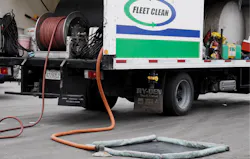
Whether hiring outside companies or using in-house staff to clean trailers, there must be a good plan for wastewater management. There also needs to be a good plan for washing trailers in general.
It’s not as simple as just blasting away with soap and water. By using the right chemicals, tools, and techniques, fleets can keep their trailers looking great and rolling smoothly for many years.
About the Author
 Gregg Wartgow
Gregg Wartgow
Gregg Wartgow is a freelancer who Fleet Maintenance has relied upon for many years, writing about virtually any trucking topic. He lives in Brodhead, Wisconsin.