Wired for success: When to repair and replace
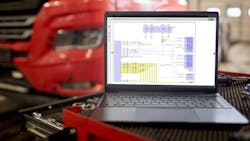
Damaged wires in a truck or trailer’s electrical system can create a cascade of problems, from out-of-service violations and faulty lighting to repeat failures that sideline equipment. Downtime adds up quickly, and with so many factors that can damage wires, the last thing a fleet needs is a splicing error or bad repair that leads to another preventable failure.
To combat this, you need trusted guides and tools. American Trucking Associations’ Technology & Maintenance Council (TMC) Recommended Practice (RP) 186 on wire and cable repair is always a handy resource. The RP also warns that the incorrect repair of wires leads to repeat failures and more costly repairs.
With this in mind, fleets and shops must train technicians to not just know how, but when, to break out the cutters and soldering iron. For example, TMC RP 186 recommends you replace, not repair, 10-gauge or larger wires and harnesses.
Techs’ diagnostic abilities must also match their repair skills. These will be used quite often in a modern shop.
“Electrical issues are rarely random,” said Al Anderson, VP of sales and marketing at Peterson Manufacturing. He emphasized that many electrical failures don’t happen overnight, but instead develop gradually due to improper repairs, poor installation practices, or environmental exposure.
“They’re usually the result of corrosion, routing problems, or improper repair techniques. When technicians take a disciplined approach to diagnostics and follow recommended practices, they don’t just fix the issue—they prevent the next one.”
Anderson said taking these steps, and employing a modular harness strategy, “can dramatically reduce repeat failures and protect uptime.”
And note that wire repairs are not just about splicing copper and resheathing; strive to restore OEM-level signal integrity and power flow, as well as durability. The repaired wires must survive against extreme temperature, abrasion, and anything else the road throws at it. The following best practices and tool suggestions will put you on the right track.
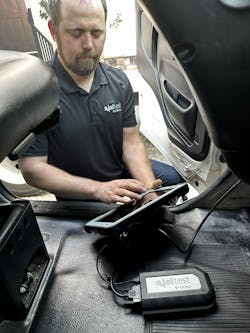
Accurate repairs start with the diagnosis
Fixing the problem starts with accurate troubleshooting, so before you break out the heat gun and crimpers, you’ll first need the digital repair tools.
“One of the first steps that a technician should take is to review the fault code, followed by the corresponding troubleshooting,” explained Jack Tussing, advanced technical support specialist for Cojali. “Then they should review the power, ground, and signal wire expectations for the fault code, followed by the sensor/component resistance. This can help determine the most likely cause of the fault code and where their diagnostics should start.”
Modern diagnostic platforms can efficiently show you what type of error you’re dealing with, for example, open circuit or short to ground, and where it occurs, such as between the ECU and a sensor.
This can “reduce the hours of troubleshooting versus using just a multimeter and test light,” Tussing added.
Kristy Coffman, director of the commercial vehicle group at Mitchell 1, agreed that accurately pinpointing the fault is critical to avoiding repeat repairs. “Misrepairs usually come from ambiguity —which connector, which pin, which ground, which splice,” she said. “Interactive diagrams and linked component info reduce ambiguity and rework.”
Mitchell 1’s TruckSeries platform offers both Interactive Wiring Diagrams and easy access to TMC RPs.
There are also a few distinctions between wiring diagnostics on tractors versus trailers. “While tractors have a dedicated power source and diagnostic port, trailers will typically require the use of an external power source and a power line carrier (PLC) connector,” Tussing continued. “Because of this additional requirement it is always best to start all wiring diagnostics on trailers with making sure that our power and communication sources are clean and secure.”
Chuck Ralston, director of Truck Care Academy and mechanical services at Love’s Travel Stops, also recommends a high-quality digital multimeter to reduce the risk of damaging something else on the truck. Tussing said oscilloscope use is becoming increasingly common as wiring systems become more complex.
The bottom line is that cutting into a harness too early creates more problems than it solves, so proper diagnosis is critical.
Repair or replace?
Once the fault is confirmed, it’s time to decide whether to splice or replace. According to Ralston, there are quite a few factors, along with gauge, that can go into this decision. A lot depends on how much of the harness is damaged.
“Typically, if less than half is damaged, it can be repaired,” he stated. “We also look at the availability of the harness. Some harnesses may not be available or need to be shipped to the location, so that changes how the repair is completed.” He added that the customer always has options and makes the final decision.
If a splice or repair is in order, it must include mechanical strength, soldering, sealing, and final testing as per TMC RP 186. Environmental concerns like vibration, abrasion, flex points, and corrosion should also factor into this decision and drive repair strategy.
Once you decide the right course of action, it's important to use the right wire repair tools and techniques.
Sidebar
A typical wire splicing and repair loadout includes:
- Wire strippers: Should be self-adjusting. Must not nick strands, as damaged strands increase resistance (does it say anything about insulated handles?)
- Crimpers: Have a mechanical stop to avoid over-crimping, piercing heat shrink, or smashing conductors
- Soldering irons: Utilize eye protection and other PPE to avoid burns from splatter
- Solder: Never use acid-core solder on vehicle wiring.
- Heat shrink: dual-wall polyolefin, adhesive barrier to seal against moisture
- Heat gun
About the Author
 Lucas Roberto
Lucas Roberto
Lucas Roberto is a Senior Staff Writer and producer of multimedia content for Fleet Maintenance magazine. He holds a bachelor's in media production and a master's in communication from High Point University in North Carolina.