Key Highlights
- Structured triage procedures and technician cross-training help shops maintain sound repair decisions when lead technicians are unavailable.
- Driver communication and diagnostic code histories help technicians pinpoint faults, especially intermittent issues.
- Reviewing repair history can reveal recurring failures and prevent unnecessary parts replacement.
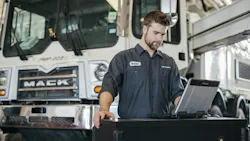
Time is of the essence when it comes to truck triage, yet speed isn’t the only thing that matters.
“A quality triage process isn’t just about getting trucks back on the road faster,” said Chris Hough, VP of maintenance design and engineering for Penske Truck Leasing. “It’s about making the right repair decisions quickly, especially in situations that aren’t so clear-cut.”
Triage technicians can make those right decisions when they are armed with the right skills and tools. But there must also be a good triage process in place, and a handful of things can get in the way of that.
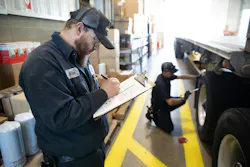
How deep is your triage bench?
It stands to reason that most shops want their most skilled diagnostics technician assigned to triage. In a perfect world, that technician will work out of a dedicated triage bay and be available all the time. But in the real world, that isn’t always possible since every shop is different in terms of size, staffing, and repair volume.
In the case of Love’s Truck Care, for instance, a couple dozen of their shops employ what amounts to a shop foreman. That’s the person in charge of triage. But what about the other 375-plus shops that don’t have a foreman? Chuck Ralston, director of Truck Care Academy and mechanical services, said whichever technician is available will jump into a triage situation.
“This is why a good, structured triage procedure must be in place for a shop to follow,” Ralston said.
That’s also why technician training and development is crucial. Ralston said Love’s stresses the importance of effective triage in its core technician training classes, as well as its training academies and mobile labs. The more technicians who know at least the basics of good triage, the better.
Hough agrees, adding that the actual repair can often be handed off to a less experienced technician once the triage tech makes the diagnosis. This creates the dynamics for not only a more efficiently run shop, but also an excellent training opportunity.
“Our triage technicians are typically mentoring someone else in the shop,” Hough pointed out. “When they triage a vehicle and hand that repair off, they explain what they found and how they went about making their determination. That helps develop other technicians.”
That’s important because, according to Hough, not having a backup plan is the biggest potential gap in a shop’s triage operation.
“What happens when your primary triage technician is unavailable?” Hough asked. “Do you have someone who can step in with confidence and continue making sound repair decisions? That’s why developing talent is so important. A strong triage process doesn’t depend on one person; it depends on building the knowledge and capability of the entire team.”
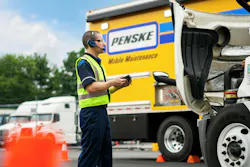
Gathering enough information upfront
A strong triage process also requires effective information gathering. This is where the proper diagnostic software comes into play, whether that involves OEM platforms or an all-makes solution.
“A truck is going to tell you what’s wrong with it 60 or 70% of the time, or at least point you in the right direction,” Ralston said.
But what about the other 30 or 40%? This is where communication with the driver can make or break a triage effort.
Jim Moore, senior manager of technical maintenance support at Ryder, said it’s important to ensure that call center staff and service writers are trained on how to ask the right questions when fielding driver complaints. But even then, vital information can get miscommunicated or lost in transmission altogether, which underscores the importance of maintaining a communications lifeline between the technician and driver.
“The worst thing in the world is not having the driver right there,” Moore said. “The first step in triage is to verify the complaint. If you don’t verify, you could wind up going down a rabbit hole in search of the wrong thing. When you can get the technician talking to the driver, you can get to the root cause a lot quicker.”
“I had a truck a few weeks ago that had a reported brake issue, but that’s all I was told,” shared Kyle Walton, the 2025 Ryder Top Tech Champion who works out of the Bristol, Pennsylvania, location. “I asked if we had a phone number for the driver. Fortunately, we did. After talking with the driver, I found out it was more of a noise complaint which we were then able to pinpoint and resolve. If I hadn’t found that out, we would have lost a lot of time. You could spend all day looking for a random brake issue.”
Talking with drivers is especially important when triaging intermittent issues. Maybe the complaint is an ABS lamp, which could be attributed to a multitude of causes. By asking the driver questions about when it happens and under what conditions, pinpointing the actual cause becomes much more practical. For instance, maybe the driver says the ABS lamp sometimes comes on when it’s raining. That could suggest that moisture may be infiltrating wiring or a connection, or maybe a wheel sensor. That at least gives the triage technician a clue as to where to get started.
Moore said good triage technicians will also look at log files to further pinpoint the root cause.
“When you can’t seem to replicate an intermittent issue, you can talk to the driver to try and find out a time it happened,” Moore said. “Then you can look back at the diagnostic code history to see what was going on. Then you can start chasing the right problem.”
“Those code histories can put everything on a timeline to better explain the series of events leading up to a failure,” said Michael Lewis, customer support and technical assistance at Cojali USA, a developer of advanced diagnostics solutions. “You can group fault codes by system and time stamp to see which code logged first, and then use the information to trace back to an initial root cause.”
He added that this data can also help establish statistical probabilities, allowing techs to home in on the most likely source of the problem.
Forgetting to look at past repairs
One mistake triage technicians can make is neglecting to look at a vehicle’s repair history. Doing so can help identify poor-quality parts that continue failing. Recurring issues could also suggest that a different root cause needs to be diagnosed.
“Maybe you think it’s a NOx sensor, but it’s actually a wiring issue,” Moore shared as an example. “When you look at the repair history and see that the NOx sensor has been changed before, that’s a clue. Sure, you could always get a bad part. But it usually points to something else.”
“Sometimes you need to be careful about slipping into that parts-changing mentality,” Walton added. “This can be tough sometimes because some loads are time-sensitive and you can really feel the pressure.”
But as mentioned earlier, the goal of triage isn’t just to diagnose something quickly. The goal is to diagnose it correctly so the truck can be fixed right the first time.
Jumpstart triage with remote diagnostics
Remote diagnostics can further accelerate the triage process. If a fleet calls with a complaint, pulling data off of a connected vehicle over the air can help shops prepare for the vehicle’s arrival. Depending on their degree of confidence in what the problem is, they can arrange for a bay and technician to work on the vehicle, and perhaps even begin the process of ordering parts.
Remote diagnostics really shows its value with roadside calls. For instance, Hough said a significant portion of Penske Truck Leasing’s fleet is now connected, providing real-time access to vehicle health information remotely.
“Our roadside coordinators use that information to perform an initial triage and determine whether an issue can be safely resolved at the roadside or if additional service is needed,” Hough said. “Sometimes that decision is based on a specific fault code or a combination of codes.”
Hough offered an example.
“We started seeing an increased failure rate of an exhaust brake solenoid on a particular engine,” Hough related. “When one of the solenoids fails, the repair typically cannot be completed roadside. In those cases, our priority is to minimize any disruption to the customer’s operation. Rather than leave the customer waiting, we would dispatch a substitute unit and tow the disabled truck to one of our service locations for repair.
“On the other hand, if a driver contacts our 24/7 Roadside Assistance Center because a check engine light has come on, we can often interpret the truck’s data remotely and determine the likely cause,” Hough continued. “For example, if the fault points to a coolant level sensor, that is usually a quick repair. The technician still needs to diagnose whether the issue is a failed sensor, a damaged harness, or another related component. But regardless, it is typically the type of repair that can be completed quickly in the field.”
Walton offered another example.
“Let’s say there’s a Cummins 1922 code (high DPF differential pressure),” Walton said. “When that happens, you’re pulling the DPF for cleaning, which you can’t do roadside. You’ll also want to check for any upstream issues. Learning this remotely saves a trip out to a stranded truck you can’t do anything with anyway.”
On the other side of the spectrum, remotely repairing a connected vehicle could even be possible.
“Something as simple as driving the correct and up-to-date software to a truck out in the field can really improve its health, eliminating up to 70% of the problems the typical truck encounters,” said Phillip Swaim, Mack vice president of channel experience. “The really nice thing about over-the-air (OTA) updates is that a shop can plan an update around the driver’s schedule. On average, a software update takes around 30 minutes. Why not schedule that during a driver’s rest period or while they’re eating in a restaurant?”
Innovations march on
While remote diagnostics has been around for many years now, its capabilities continue to improve. In the case of Mack and its GuardDog Connect solution, for instance, the core system is relatively the same as it was in 2013 when it was introduced. But according to Swaim, the intelligence capabilities have improved considerably.
“There are far more connected trucks in operation today, which are providing millions more datapoints,” Swaim said. “There is also the influence of AI, which is far more advanced today. We’ve worked really hard at being able to take that data and enrich it to become more action-oriented. We’re looking at data and repair events to identify patterns. For example, if these three sensors say this and this and this, we know that 99% of the time it means this. That’s what we refer to as a rule, which we put in the system to help with future diagnostics.”
Once an issue is isolated, GuardDog Connect communicates that information to the appropriate dealer, along with repair instructions and SRT so the truck can be scheduled efficiently. According to Swaim, this ability to triage remotely can reduce downtime by up to 45 minutes by eliminating the need for the initial in-shop triage diagnostics step.
For drive-up customers at a Certified Mack Uptime Dealer, Swaim said the first step after checking in with the service advisor is to perform triage diagnostics in an uptime bay. If the technician can’t pinpoint the issue within 45 minutes, that vehicle is sent to another bay for advanced diagnostics and repair. On the other hand, if the technician can diagnose the issue in under 45 minutes, that vehicle will just stay in the uptime bay if it’s an easier repair that can be completed within four hours. Longer repairs require the vehicle to be moved to a different bay.
The reality is that in today’s triage-centric shop environment, evolving technologies like AI-assisted diagnostic tools, advanced telemetry systems, and remote diagnostics are helping technicians make fast, accurate diagnoses like never before. But a shop still needs the right technicians with the right training, as well as a well-formulated triage process such as Swaim just described.
“The uptime products and programs are extremely important,” Swaim said. “But if you don’t have a good way of working with those programs and the data they bring, that’s where everything can break.”
“AI does an amazing job of analyzing datapoints,” Love’s Truck Care’s Ralston added. “But you still have to take time to develop your technicians. The whole concept of having a defined, consistent triage process must be ingrained in everything you do.”
About the Author
 Gregg Wartgow
Gregg Wartgow is a freelancer who Fleet Maintenance has relied upon for many years, writing about virtually any trucking topic. He lives in Brodhead, Wisconsin.