Jumpstart triage with remote diagnostics
Key Highlights
- Remote diagnostics enable fleets to access vehicle data over-the-air, allowing for better preparation and quicker roadside or in-shop repairs.
- AI and advanced telemetry systems analyze data patterns to identify issues, reducing diagnostic time and improving repair accuracy.
- Over-the-air software updates can eliminate up to 70% of common problems, scheduled conveniently during driver rest periods to minimize disruption.
- Effective triage processes, combined with skilled technicians, are essential for leveraging new technologies and ensuring efficient vehicle maintenance.
- Future innovations will continue to improve diagnostics and repair workflows, but foundational training and process discipline remain critical.
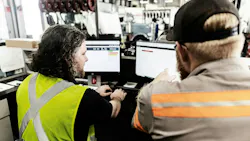
A well-defined triage process helps shops make the right repair decisions quickly, but remote diagnostics can give them a head start before a truck even arrives. By accessing vehicle data over the air, fleets can better prepare for repairs, make smarter roadside service decisions and, in some cases, resolve issues without a shop visit.
If a fleet calls with a complaint, pulling data off of a connected vehicle over the air can help shops prepare for the vehicle’s arrival. Depending on their degree of confidence in what the problem is, they can arrange for a bay and technician to work on the vehicle, and perhaps even begin the process of ordering parts.
Remote diagnosing really shows its value with roadside calls, noted Chris Hough, VP of maintenance design and engineering for Penske Truck Leasing, which has a significant portion of connected assets that remotely send real-time vehicle health information.
“Our roadside coordinators use that information to perform an initial triage and determine whether an issue can be safely resolved at the roadside or if additional service is needed,” Hough said. “Sometimes that decision is based on a specific fault code or a combination of codes.”
This helped as the fleet noticed an increased failure rate of exhaust brake solenoids on a particular engine. “When one of the solenoids fails, the repair typically cannot be completed roadside,” Hough said. “In those cases, our priority is to minimize any disruption to the customer’s operation. Rather than leave the customer waiting, we would dispatch a substitute unit and tow the disabled truck to one of our service locations for repair.
“On the other hand, if a driver contacts our 24/7 Roadside Assistance Center because a check engine light has come on, we can often interpret the truck’s data remotely and determine the likely cause,” Hough continued. “For example, if the fault points to a coolant level sensor, that is usually a quick repair. The technician still needs to diagnose whether the issue is a failed sensor, a damaged harness, or another related component. But regardless, it is typically the type of repair that can be completed quickly in the field.”
Ryder technician Kyle Walton offered another example: “Let’s say there’s a Cummins 1922 code (high DPF differential pressure). When that happens, you’re pulling the DPF for cleaning, which you can’t do roadside. You’ll also want to check for any upstream issues. Learning this remotely saves a trip out to a stranded truck you can’t do anything with anyway.”
On the other side of the spectrum, remotely repairing a connected vehicle could even be possible.
“Something as simple as driving the correct and up-to-date software to a truck out in the field can really improve its health, eliminating up to 70% of the problems the typical truck encounters,” said Phillip Swaim, Mack VP of channel experience. “The really nice thing about over-the-air (OTA) updates is that a shop can plan an update around the driver’s schedule. On average, a software update takes around 30 minutes. Why not schedule that during a driver’s rest period or while they’re eating in a restaurant?”
Innovations march on
While remote diagnostics has been around for many years now, its capabilities continue to improve. In the case of Mack and its GuardDog Connect solution, for instance, the core system is relatively the same as it was in 2013 when it was introduced. But according to Swaim, the intelligence capabilities have improved considerably.
“There are far more connected trucks in operation today, which are providing millions more data points,” Swaim said. “There is also the influence of AI, which is far more advanced today. We’ve worked really hard at being able to take that data and enrich it to become more action-oriented. We’re looking at data and repair events to identify patterns. For example, if these three sensors say this and this and this, we know that 99% of the time it means this. That’s what we refer to as a rule, which we put in the system to help with future diagnostics.”
Once an issue is isolated, GuardDog Connect communicates that information to the appropriate dealer, along with repair instructions and SRT so the truck can be scheduled efficiently. According to Swaim, this ability to triage remotely can reduce downtime by up to 45 minutes by eliminating the need for the initial in-shop triage diagnostics step.
For drive-up customers at a Certified Mack Uptime Dealer, Swaim said the first step after checking in with the service advisor is to perform triage diagnostics in an uptime bay. If the technician can’t pinpoint the issue within 45 minutes, that vehicle is sent to another bay for advanced diagnostics and repair. On the other hand, if the technician can diagnose the issue in under 45 minutes, that vehicle will just stay in the uptime bay if it’s an easier repair that can be completed within four hours. Longer repairs require the vehicle to be moved to a different bay.
The reality is that in today’s triage-centric shop environment, evolving technologies like AI-assisted diagnostic tools, advanced telemetry systems, and remote diagnostics are helping technicians make fast, accurate diagnoses like never before. But a shop still needs the right technicians with the right training, as well as a well-formulated triage process such as Swaim just described.
“The uptime products and programs are extremely important,” Swaim said. “But if you don’t have a good way of working with those programs and the data they bring, that’s where everything can break.”
And what of future progress aided by AI? Chuck Ralston, director of Love’s Truck Care Academy noted that “AI does an amazing job of analyzing data points, but you still have to take time to develop your technicians. The whole concept of having a defined, consistent triage process must be ingrained in everything you do.”
About the Author
 Gregg Wartgow
Gregg Wartgow is a freelancer who Fleet Maintenance has relied upon for many years, writing about virtually any trucking topic. He lives in Brodhead, Wisconsin.