Painless protection: Shell Rotella unveils PC-12 engine oils
Key Highlights
- Shell Rotella's new formulations meet the upcoming PC-12 standards, focusing on lower chemical limits and enhanced engine protection.
- The transition to these oils is designed to be seamless, requiring no changes to current maintenance practices or schedules.
- Extensive testing at Shell's Houston Technology Center ensures the new oils deliver superior wear protection and deposit control, even under severe conditions.
- The new API categories, CL-4 and FB-4, are backward compatible and introduce lower viscosity grades like 0W-20 and 5W-20 for heavy-duty diesel engines.
- Fleets can expect extended warranty coverage with Shell's new oils, along with benefits like reduced emissions system clogging and improved aftertreatment performance.
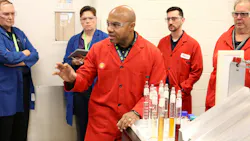
HOUSTON—The diesel engine oil industry is on the cusp of its most significant transformation in a decade, but for shop managers and technicians, the revolution will be refreshingly de-dramatized.
Shell Rotella recently invited media to the sprawling Shell Technology Center here in Southeast Texas to unveil its next generation of heavy-duty engine oils, engineered to meet the forthcoming PC-12 standards—officially known as API CL-4 and API FB-4. While the new formulations boast lower chemical limits, enhanced wear protection, and advanced deposit control to accommodate stricter emissions regulations, the transition won’t require shops to rewrite their PM schedules.
“This should be a seamless transition,” Karin Haumann, OEM technical manager for Shell Global Solutions, told Fleet Maintenance.
“There’s nothing that anybody has to do to prepare. You don’t have to change your maintenance practices or strategies. And there may be some opportunities in the future to extend oil drain intervals or even explore other viscosity grades to accomplish fuel economy. So this category widens those opportunities, but there’s nothing they must change today to prepare.”
The launch news centers on Shell’s updated portfolio, which builds upon over 50 years of heavy-duty engine expertise and more than 13 million miles of real-world testing to prepare for the January 2027 rollout of the new API categories, Shell Rotella leaders and technicians maintained during the Oct. 14 tour. The development of these new oils focused on combating breakdown and managing lower limits of sulfated ash, phosphorus, and sulfur to protect delicate aftertreatment systems. Distinct from previous products, the new lineup features rebalanced additive chemistry to make up for reduced traditional anti-wear components, ensuring backward compatibility while exceeding the performance of the outgoing CK-4 standards.
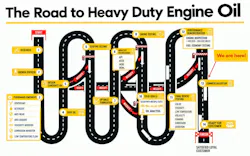
Inside the Shell Technology Center
Behind the new chemistry is a powerful research and development engine. Shell Technology Center Houston, or STCH, is an expansive 200-plus-acre campus housing nearly 40 buildings and 200 laboratories. Opened in 1975, it’s the largest technology footprint in Shell’s global network. Approximately 1,700 scientists operate at the location, representing just a portion of the 500 technologists working in Shell's mobility and lubricants division worldwide across centers in Hamburg, Germany; Atsugi, Japan; Shanghai, China; and Bangalore, India.
“If you want to be a good innovator, you have to be someone who develops things that are at the cutting edge,” noted Dr. Jason Brown, Shell general manager for industry and transport lubricants technology. “So, you really need to understand the application you’re developing for. But to truly understand that application, you’ve got to understand the drive behind those who created it.”
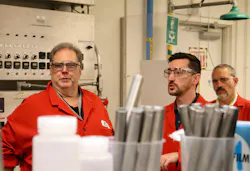
Validating oil chemistry in the lab
The educational tour provided an exclusive look at how these new formulations are validated before they enter a commercial crankcase.
Our group began in the tribology lab, where technicians study friction and wear. Using a reciprocating tribometer, they screen new formulations by oscillating components against actual engine parts supplied by OEMs. Optical and stylus profilometers are then used to measure the depth of wear scars down to the micron, while a mini traction machine calculates the formation rate and thickness of the protective “tribofilm” that guards engine parts during cold starts.
The oxidation lab is where oils are intentionally pushed to their breaking point to simulate severe engine environments. Technicians utilize a custom-built “hot tub” instrument that mimics the heating and cooling cycles of a piston, pushing oil temperatures between 260 and 293 degrees Celsius to measure deposit formation over time. They also utilize rocker cooking tests that heat aluminum plates up to 280 degrees C to evaluate the additives left behind.
Inside the testing lab, the focus shifts to foundational fluid characteristics. Technicians evaluate kinematic viscosity, perform Noack volatility tests to measure evaporative loss by cooking the oil, and run cold flow simulator tests at temperatures as low as negative 33 degrees C to ensure the oil flows instantly to critical engine parts in extreme winter conditions.
Finally, a deposit analysis room highlighted the real-world results of these advanced formulations. The stop featured teardown parts from a field trial running Detroit Diesel DD15 engines with over 700,000 miles—more than half of which were run on PC-12 tech. While the main bearings showed virtually no wear and the cylinder liners retained their original factory crosshatching, evaluating piston cleanliness requires more advanced methods.
To that end, Matt Urbanak, associate technology manager for HD engine oils, demonstrated how a new 3D scanning tool can generate precise heat maps of piston deposits. “It helps visually,” he explained. “You can’t look at that dirty piston right there and know, hey, there’s a lot of heavy carbon on there, or if it’s relatively clean. We can do that with this machine.”

Shell Rotella's updated heavy-duty engine oils
- API specifications: Meets new CL-4 and FB-4 standards, replacing CK-4 and FA-4.
- Compatibility: CL-4 is backward compatible with CK-4 applications; FB-4 targets lower-viscosity applications.
- Rotella T4 15W-40: 58% stronger deposit control than the previous CK-4 formulation.
- Rotella T5 10W-30: Exceeds oil breakdown requirements by more than 90%.
- Rotella T6 10W-30: Delivers 66% more wear protection than required by API CL-4.
- Warranty updates: T5 coverage increases to 12 years/400,000 miles; T6 to 15 years/600,000 miles.
- Availability: Phased rollout beginning in early 2027.
Performance figures are based on Shell's reported testing.
New APIs and formulations
The industry’s shift to PC-12 brings two new API categories designed to handle the increased combustion temperatures and efficiency demands of modern diesel engines. CL-4 serves as the direct, backward-compatible replacement for CK-4, maintaining traditional high-temperature high-shear (HTHS) viscosity. FB-4 replaces FA-4, catering to newer engines designed for lower HTHS viscosity to maximize fuel efficiency. Notably, the PC-12 category officially introduces 0W-20 and 5W-20 viscosity grades to the heavy-duty diesel market.
“There’s a continuous drive for consumers and the OEMs we work with to extend oil drain intervals … and that puts different stresses on the oil,” said Patrick Joyce, a project leader and formulator at Shell. “There are increases in combustion temperatures to make the engines more efficient, and that drives oils to potentially break down faster. So we have to build our oils to resist that.”
To meet these standards, Shell reformulated its additive packages to handle lower chemical limits. The new category drops the maximum phosphorus allowance from 1,200 parts per million down to 800 parts per million. Because phosphorus and zinc are traditional anti-wear agents, Shell utilized supplemental anti-wear chemistry to ensure robust protection despite the chemical restrictions.
“So many times in my role, I feel like a cook,” Joyce told Fleet Maintenance. “Here at Shell, we like to use quality ingredients … and really, with a lot of PC-12 technology, it’s about putting those quality ingredients together in a way that allows us to have the lower sulfated ash—and lower cost.”
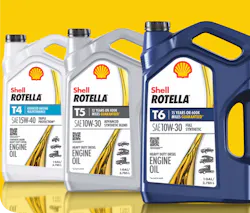
The updated Shell Rotella portfolio breaks down like this:
- Rotella T4 (15W-40): Now featuring synthetic blend technology, this tier delivers 58% stronger deposit control to help keep engines cleaner and support longer life, the company reported.
- Rotella T5 (10W-30): This advanced synthetic blend exceeds industry oil breakdown requirements by more than 90%, Shell said.
- Rotella T6 (10W-30 and 15W-40): The flagship full-synthetic oil provides an average of 66% better wear protection than industry requirements—and delivers 85% stronger resistance to deposits, according to Shell.
Deployment and fleet considerations
For fleet maintenance professionals, preparing for the transition requires understanding the timeline and operational benefits. Licensing for the new API categories begins January 1, 2027, with products rolling out to retail shelves and bulk tanks in the first and second quarters, Shell said.
Because CL-4 is backward compatible with legacy equipment, fleets will not need to stock separate oils for older and newer engines or perform specialized changeover procedures. As Haumann emphasized, no preparations or expensive updates are necessary, leaving current maintenance practices uninterrupted. Shell is also backing its new T5 and T6 products with an enhanced lubrication warranty—increasing to 12 years or 400,000 miles for T5, and 15 years or 600,000 miles for T6—as a proof point of its confidence in the improved technology.
Beyond simplified stocking and backward compatibility, the primary engineering achievement with PC-12 hinges on protecting the most sensitive components of modern commercial vehicles. And the reduced sulfated ash limits—which are intended to decrease the amount of incombustible material that, unlike standard fuel soot, permanently clogs diesel filters and sensors—will be welcome news for fleets frustrated with troublesome emissions systems.
“It’s designed to extend and protect the life and the performance of aftertreatment systems—and that’s all part of the chemistry,” Haumann concluded. “Our limit was here on some of those things, and now it’s much lower. That’s going to have a direct impact on aftertreatment performance.”